Reviewed by Larry Forman, Attorney
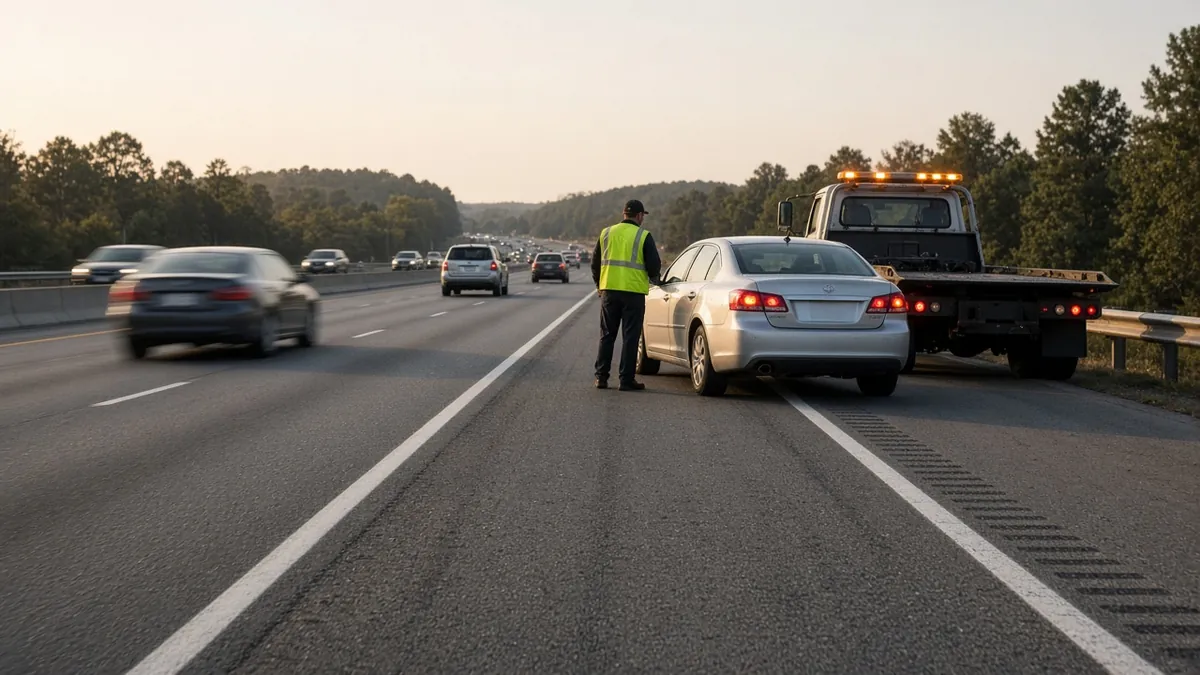
A flat tire, an overheated engine or a minor fender-bender can leave you stopped on the shoulder of I-65 or I-264 with traffic flying past at 70 mph. Police officers, tow operators and road crews work in that same narrow space every day. Kentucky's move over law requires passing drivers to give them room. When a driver doesn't, and hits a car or a person on the shoulder, that driver is almost always at fault.
What does Kentucky's move over law require?
The rule is in KRS 189.930. When a driver approaches a stopped vehicle it covers, the driver must, "while proceeding with due caution":
- Move over to a lane that isn't next to the stopped vehicle, if the road has at least four lanes with two going the driver's way and the lane change can be made safely, or
- Slow down to "a safe speed to road conditions," if the road has fewer lanes or moving over would be unsafe
That's not a suggestion to wave at. A driver who could have moved over, or who slowed only slightly while passing a few feet from a stopped car, may have broken the move over law.
A separate part of the move over law covers moving emergency vehicles: when one approaches with lights or a siren, drivers must pull to the edge of the road and stop until it passes. Our Kentucky traffic laws guide covers the rest of the rules of the road.
Who does the move over law protect?
More people than most drivers realize. The law applies to a stopped:
- Emergency vehicle showing flashing lights, such as police cars, ambulances and fire trucks
- Public safety vehicle showing flashing lights. Kentucky law defines that to include "wreckers" (tow trucks), utility repair vehicles, state, county and city service vehicles, highway equipment and escort vehicles for wide loads (KRS 189.910(2))
- Disabled vehicle "displaying some type of warning signal, such as emergency flashers, flares, or retroreflective signals"
That last category means an ordinary driver with a flat tire and hazard lights on is covered by the move over law. Turning on your flashers or setting out flares or reflective triangles is what triggers the protection, so it's worth doing every time.
How often are emergency vehicles hit?
In 2024, Kentucky State Police recorded 1,158 collisions involving emergency vehicles, which killed 6 people and injured 217 (KSP, 2024 Kentucky Traffic Collision Facts). That figure includes every kind of crash with an emergency vehicle, not only crashes on the shoulder. Kentucky doesn't publish a separate count of disabled cars and tow trucks struck on the shoulder.
Who is at fault when a car on the shoulder is hit?
Usually the driver who left the travel lane or passed too close. Common causes include:
- Distraction, like looking at a phone and drifting onto the shoulder
- Fatigue. Drowsy drivers often drift right without braking. See drowsy driving accidents.
- Speed too high to react to a stopped car
- Failing to move over or slow down as the move over law, KRS 189.930, requires
- Following too closely, so the driver behind can't see the stopped car until the car ahead swerves around it. See rear-end collisions.
A driver who breaks a safety statute and causes the kind of harm it was meant to prevent can be found negligent on that basis alone. A move over law violation that causes a shoulder crash can be that kind of violation. Insurers sometimes argue the stranded driver shares blame for where they stopped or for not using flashers. Kentucky's pure comparative fault rule reduces your recovery only by your own share, if any. See our Kentucky negligence law guide.
Sometimes a chain reaction starts in the travel lanes and sends a car onto the shoulder, or the stop itself was caused by road debris. Then more than one driver may share fault, and accident reconstruction can sort out who did what.
If you were standing outside your car
People hit while changing a tire, waiting for a tow or checking damage are often hurt badly, because nothing protects them. A few things to know:
- Your claim is against the driver who hit you, the same as any pedestrian injury claim.
- No-fault benefits still apply. Which policy's PIP pays can depend on whether you were in, getting into or out of, or away from your car. See how Kentucky PIP works.
- If the driver kept going, your uninsured motorist coverage may step in. See our hit-and-run page.
Tow operators and roadside workers
Tow operators, utility crews and road workers are among the people the move over law protects. Those hurt on the job usually have workers' compensation. They can also bring a claim against the driver who hit them, because workers' comp doesn't protect an outside driver. See third-party workplace injuries. For crashes in active road construction, see our work zone accident page.
What to do if you break down on the shoulder
- Get as far right as you can, and off the road entirely if there's an exit or a wide spot.
- Turn on your hazard lights right away. Use flares or reflective triangles if you have them.
- If it's safe, get out on the side away from traffic and stand well back from the road, behind a guardrail if there is one.
- If it isn't safe to get out, stay buckled in.
- Call 911 or roadside assistance and give your direction and nearest exit.
If you're hit, call 911, get medical care, and keep any dashcam video. See our list of evidence to preserve after an accident.
How Forman & Associates helps
We gather the evidence that shows how close and how fast the other driver passed, and whether the driver followed the move over law: vehicle data, traffic camera and dashcam video, the tow or police report, and witnesses. We look at every source of coverage, including PIP, the driver's liability policy, your UM/UIM coverage and, for workers, workers' comp. We prepare cases for trial from the start. Larry Forman has tried 50+ jury trials and won 95% of them. See our car crash lawyer page and our sideswipe accident page.
Move over law FAQ
Does Kentucky's move over law apply to a regular car with its flashers on?
Yes. It covers a disabled vehicle displaying a warning signal such as emergency flashers, flares or reflective signals, not only police cars and tow trucks.
What if the driver couldn't safely change lanes?
Then the law requires the driver to slow down to a safe speed for the conditions while passing. Moving over is required only where it can be done safely on a road with at least four lanes.
Who is at fault if my parked car on the shoulder was hit?
Usually the driver who left the travel lane or passed too close. Insurers may argue about where you stopped or whether your flashers were on, but that only matters to the extent it actually contributed.
I'm a tow truck driver who was hit on the job. Can I sue?
You can usually bring a claim against the driver who hit you in addition to workers' compensation. Workers' comp may have to be repaid from that recovery, so talk to a lawyer about how the two fit together.
How long do I have to file a claim after being hit on the shoulder?
Generally two years from the crash or the last PIP payment for Kentucky motor vehicle claims. Work injury claims have their own deadlines, so act quickly.
Hit while stopped on the shoulder?
You did what you were supposed to do, and the move over law may have required the other driver to give you room. Get a free case evaluation or call (502) 931-6788. No fee unless we win.
This post is general information about Kentucky law, not legal advice.