
Reviewed by Larry Forman, Attorney.
Motorcycle wreck cases are not simply car wreck cases on two wheels. They are categorically different in the injuries they produce, the legal defenses they attract, and the biases they trigger at every stage of the claims process. When a motorcyclist is involved in a collision — regardless of fault — insurance adjusters, defense attorneys, and sometimes even jurors arrive with a pre-formed assumption that the rider was speeding, weaving, or behaving recklessly. That assumption is wrong in the majority of cases, and dismantling it requires a specific, evidence-first legal strategy that most personal injury firms are not equipped to execute. Drivers and passengers in regular vehicles should talk to a car accident lawyer in Louisville.
Kentucky is a pure comparative fault state, which means that even if an insurer or defense team successfully argues that you were partially responsible for the crash, you can still recover compensation — reduced proportionally by your share of fault. This makes the fight over fault allocation the central battle in most motorcycle cases. A driver who turns left in front of you, fails to check their mirror before changing lanes, or runs a red light and then claims you were speeding is attempting to shift their liability onto you. Our firm builds the evidentiary case that locks in their fault before that narrative ever gains traction.
Louisville and Jefferson County roads — including the interstate corridors of I-64, I-65, and I-71, as well as the two-lane rural routes throughout surrounding Kentucky counties — see a significant volume of motorcycle crashes each riding season. Many involve left-turn collisions, rear-end impacts at intersections, and dangerous road defects that a car driver might not even notice but that are catastrophic for a rider. If you were injured on any Kentucky road, Forman & Associates knows this terrain, knows this jurisdiction, and knows how to build a case that survives a jury’s scrutiny.
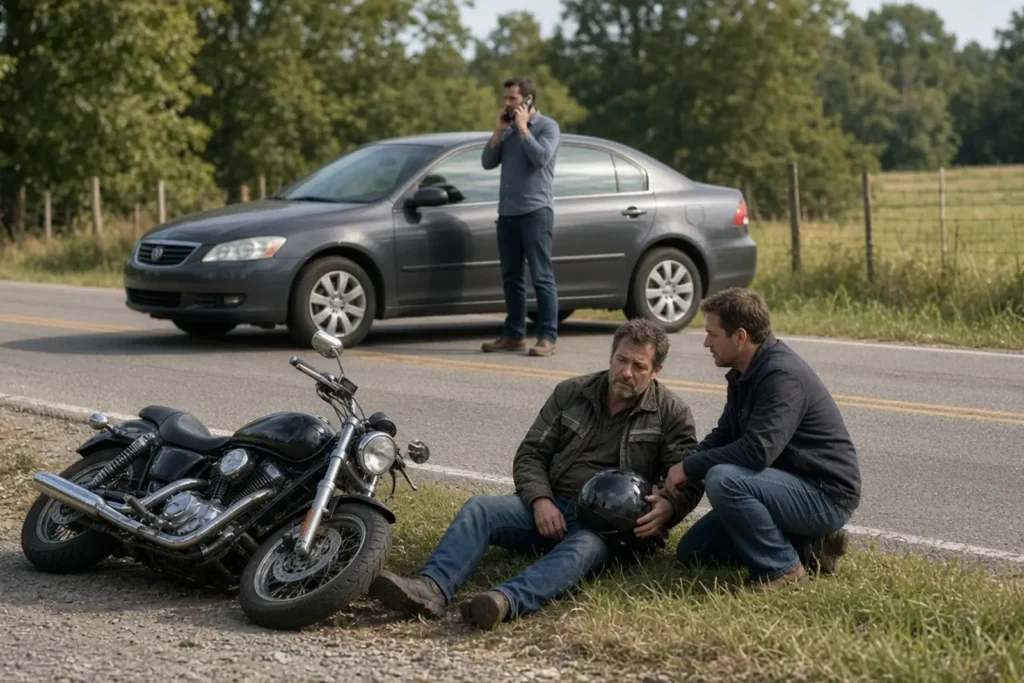
Motorcycle rider bias is not theoretical. Peer-reviewed research has found that car drivers judge motorcyclists more harshly than riders’ actual personalities warrant, seeing them as more impulsive and less careful than riders really are. In personal injury cases, that stereotype affects how claims are valued, how negotiations proceed, and how juries deliberate, and it can leave riders blamed for crashes they did not cause simply because of the vehicle they chose. Insurance companies know this — and they use it strategically to devalue claims and pressure riders into accepting far less than their case is worth. See what affects a motorcycle accident settlement in Kentucky.
Countering that bias requires more than arguing the facts. It requires controlling how your story is told from the very first piece of evidence gathered at the scene. Our firm retains wreck reconstruction experts who can establish the geometry of the crash with precision. We obtain surveillance footage, intersection camera recordings, and witness statements before they disappear. We document your riding history, your equipment, your license, and your compliance with all traffic laws to neutralize any suggestion of recklessness. By the time the other side’s attorney makes their bias argument, we have already buried it under a mountain of objective evidence.
We also understand motorcycle injuries in a way that matters at trial. Road rash, degloving injuries, orthopedic trauma, traumatic brain injuries despite helmet use, and spinal cord damage are not abstract concepts to our team — they are the documented reality of what happens when a human body at speed meets asphalt or steel with no protective cabin around it. Presenting the true severity of those injuries to a jury — clearly, compellingly, and without minimization — is a core part of how we maximize your recovery.
The most common type of fatal crash between a motorcycle and another vehicle, according to NHTSA. A driver turning left across traffic fails to see or yield to an oncoming motorcycle — often at intersections the rider had every right to cross. If a crash like this took someone you love, see our fatal motorcycle accident lawyer page. Left-turn motorcycle crashes.
Drivers who fail to check mirrors and blind spots before merging strike motorcycles that are perfectly visible to any attentive driver. This is negligence, not an wreck.
A distracted or tailgating driver who fails to brake in time and strikes a stopped or slowing motorcycle can cause catastrophic spinal and head injuries — even at relatively low speeds.
A parked motorist who opens their door into an active travel lane without checking for approaching riders creates a sudden, unavoidable collision that the rider had no reasonable means to avoid.
Potholes, uneven pavement, debris, missing lane markings, and defective guardrails that a car driver might navigate safely can be lethal for a motorcycle. Government entities responsible for road maintenance may bear liability. A defective tire, brake or other motorcycle part can also cause a crash; see our product liability lawyer page.
Impaired motorists pose extreme danger to motorcyclists whose smaller profile is even harder to perceive under the influence. DUI-related motorcycle crashes carry potential punitive damages exposure. A bar that over-served the driver may also be responsible under Kentucky's dram shop law. Learn how Kentucky's SB 66 drugged-driving law can affect a crash victim's claim.
Louisville riders share the road with heavy commuter and truck traffic, and the motorcycle crashes we see tend to follow familiar patterns. If a cyclist or walker was hurt instead, see our Louisville bicycle accident lawyer or pedestrian accident lawyer page. On busy corridors like Dixie Highway and Bardstown Road, a steady run of intersections, driveways and parking-lot entrances gives drivers constant chances to turn left across a rider’s path or pull out without looking. Where cars park along the street, a driver who opens a door without checking can leave a rider nowhere to go. On the interstates (the Watterson Expressway (I-264), the Gene Snyder Freeway (I-265) and the Kennedy Interchange downtown, where I-64, I-65 and I-71 meet), the danger shifts to drivers changing lanes into a rider’s blind spot and rear-end crashes in stop-and-go traffic. And on scenic two-lane routes like River Road, curves, gravel, debris and broken pavement that a car barely notices can bring a motorcycle down.
The national numbers point the same way. NHTSA reports that in 46% of 2023 fatal crashes between a motorcycle and another vehicle, the other vehicle was turning left while the motorcycle was going straight, passing or overtaking. In Kentucky, the 2024 Kentucky Traffic Collision Facts report shows motorcycles were less than 1% of the vehicles in all collisions but about 9% of the vehicles in fatal collisions. Kentucky law speaks directly to the most common of these crashes: a driver turning left at an intersection or into an alley, private road or driveway must yield to oncoming traffic that is in the intersection or close enough to be an immediate hazard (KRS 189.330(9)).
Where your crash happened also shapes the investigation. It affects whether Louisville Metro Police or Kentucky State Police wrote the report, which businesses may have cameras, and who was responsible for maintaining the road. If you were hurt on a motorcycle anywhere in Louisville, a Louisville motorcycle accident lawyer on our team can start that work right away. See how to get a Kentucky accident report and intersection crashes in Kentucky.
Kentucky’s most popular riding roads bring their own crashes. As a Kentucky motorcycle accident lawyer, Larry Forman also handles wrecks on the curves of the Red River Gorge (KY-11, KY-15 and KY-77 through the Nada Tunnel) near Winchester and Mount Sterling, the horse-farm two-lanes around Lexington, the Bourbon Trail back roads near Bardstown, and the Woodlands Trace through Land Between the Lakes near Murray and Paducah. On rural roads the common causes shift to drivers crossing the center line on blind curves, gravel washed onto the pavement, and farm equipment pulling out. Those cases are filed in the circuit court of the county where the crash happened, and the police report usually comes from Kentucky State Police or the county sheriff.
Motorcycle injuries are often more serious, and more expensive over a lifetime, than an insurer’s first offer suggests. We regularly see:
When injuries are life-changing, the claim has to account for future surgeries, care, lost earning capacity and changes to your home and daily life. Learn more on our catastrophic injury lawyer page. If a crash took the life of someone you love, see our wrongful death lawyer page. And because serious motorcycle injuries can exceed the at-fault driver’s coverage, we also look at underinsured motorist claims.
Insurance companies classify motorcycle claims differently than car wreck claims and they fight them harder. When they know your attorney is Larry Forman, who has won 95% of the jury trials he has tried, their calculus on what to offer changes significantly. That leverage is the foundation of every case we take.
Larry Forman has tried 50+ jury trials and won 95% of them. That track record is known in Kentucky legal circles — and it changes how the other side negotiates.
Crash scene photographs, surveillance footage, intersection cameras, black box data from the other vehicle, and witness statements — we move the moment you hire us, before evidence disappears or memories fade.
We retain specialists who can reconstruct the geometry and physics of your crash with precision establishing speed, sight lines, and fault allocation with the kind of objective authority that holds up under cross-examination.
From the first demand letter to closing arguments, we anticipate and dismantle the motorcycle bias narrative before it gains traction.
You pay nothing out of pocket. Our firm advances all costs, and we only collect if we secure a recovery on your behalf. Zero financial risk to you.
Larry Forman is one of the most-watched legal voices online. He knows how to tell your story — in front of a jury, a judge, or a national audience.
Over $5,000,000 recovered for injured people.
Past results do not guarantee, predict or warrant a similar outcome in any future case. Each case depends on its own facts and the law.
Yes and this is exactly the kind of defense we are built to counter. Kentucky's pure comparative fault system means you can recover even if you are found partially at fault. The critical question is how fault is allocated, and that allocation is determined by evidence — not by what the other driver tells their insurance company. Our firm builds the objective, reconstruction-backed evidentiary record that establishes what actually happened, not what the defense claims happened. See what to do if you were partly at fault.
Not wearing a helmet does not bar your claim. Kentucky's helmet law (KRS 189.285) requires helmets only for riders and passengers under 21, riders using a motorcycle instruction permit, and riders who have held a motorcycle license for less than one year, so many adult riders may legally ride without one. Even so, the defense may argue that your head and neck injuries were worsened by not wearing a helmet, and they may succeed in having some portion of those specific damages reduced. However, it does not eliminate your claim or bar recovery for your other injuries. The at-fault driver is still responsible for causing the crash. We work with medical experts to carefully distinguish which injuries are and are not attributable to helmet use.
Kentucky's deadline for most motorcycle accident injury lawsuits is generally two years after the injury or the last PIP (basic or added reparation benefits) payment, whichever is later (KRS 304.39-230(6)). If no PIP benefits are paid, which is common for riders who didn't buy PIP, the two years generally run from the date of the injury. Claims against government entities and other special situations can have shorter deadlines or notice rules, so don't rely on any deadline until a lawyer has reviewed your situation. These deadlines are strict — missing one almost certainly ends your ability to recover anything. Beyond the lawsuit deadline, evidence preservation is even more time-sensitive. Surveillance footage is routinely overwritten within days, and the other driver's vehicle data can be reset or lost quickly. Contact us immediately after your crash to protect your case.
Do not provide a recorded statement, do not agree to any settlement, and do not sign any documents before speaking with an attorney. The other driver's insurance adjuster works for the carrier — not for you. Their job is to minimize the payout, and a recorded statement made in the days after a crash, before you know the full extent of your injuries, can be used to permanently undervalue your claim. Politely decline and call our office first.
Yes. If a pothole, deteriorated road surface, missing signage, defective guardrail, or other road maintenance failure contributed to your crash, the government entity responsible for that road may be liable. Claims against government defendants involve specific notice requirements and procedural steps that differ from standard personal injury claims — which is precisely why having an attorney involved immediately is critical in these cases.
This is a common and serious problem in motorcycle wreck cases, where injuries frequently exceed the at-fault driver's policy limits. Kentucky's minimum liability coverage is only $25,000 per person and $50,000 per accident (KRS 304.39-110), and insurers must offer uninsured and underinsured motorist coverage on motorcycle policies (KRS 304.39-040(3)). If your policy includes that coverage, you may be able to pursue it in these situations. Learn more about uninsured vs. underinsured motorist coverage and our underinsured motorist lawyer practice. Additionally, if a defective vehicle component, a negligent road authority, or a commercial driver contributed to the crash, additional defendants — and additional insurance policies — may be available. We conduct a full coverage analysis on every case we take.
Yes. A passenger can bring a claim against any driver who caused the crash, including the driver of another vehicle and, if they were at fault, the rider you were with, through that rider’s liability coverage. PIP works differently: a motorcycle passenger can collect PIP for a motorcycle crash only if PIP was bought for that motorcycle or by the passenger (KRS 304.39-040). Passengers under 21 must wear a helmet under KRS 189.285.
Yes. As Kentucky motorcycle accident lawyers, Forman & Associates represents motorcycle wreck victims throughout the state and handles cases nationally. Whether your crash occurred on a Louisville city road, a Jefferson County highway, a rural two-lane route in Eastern or Western Kentucky, or a state or interstate highway anywhere in the Commonwealth or the nation, we are available to review your case at no cost. Contact us for a free consultation regardless of where the wreck happened.
Only if PIP was purchased. Kentucky requires PIP on cars, but it's optional for motorcycles. Unless basic PIP was bought for the motorcycle or by the injured person, neither the rider nor the passenger can collect PIP benefits from any source for a motorcycle crash (KRS 304.39-040(4)). A rider without PIP is still generally bound by Kentucky's no-fault limits unless a motorcycle no-fault rejection was filed with the Department of Insurance before the crash (KRS 304.39-060(9)), and may be unable to recover the first $10,000 of the claim from the at-fault driver. To recover pain and suffering, the injury generally has to meet Kentucky's tort threshold, such as more than $1,000 in medical expenses, a broken bone or a permanent injury (KRS 304.39-060(2)(b)). These rules depend on your policy and filings, so bring your declarations page to your consultation. See how Kentucky PIP insurance works.
Usually not. TRIMARC's cameras show live views of Louisville-area interstates, but TRIMARC says it does not record those feeds. Video of a motorcycle crash more often comes from helmet cameras, dashcams, doorbells, nearby businesses and other drivers' phones, and much of that footage is recorded over quickly. That's why we send preservation requests as soon as we're hired.
Not until your lawyer says it's OK. Your helmet, riding gear and motorcycle are evidence: the damage can show how and where you were hit. Keep the gear as it is, photograph the bike before any repairs, and ask the insurer to hold the motorcycle before it's salvaged or sold. We can arrange an inspection and send preservation letters.
You may have a product liability claim against the manufacturer or seller, either in addition to a claim against another driver or instead of one. Tire blowouts, brake or ABS failures, and defective wheels or throttles are examples. Keep the motorcycle and the failed part, and don't let a shop throw the part away, because the part itself is often the key evidence. See our product liability lawyer page.