
Plenty of falls are nobody’s fault. Many are. Kentucky law expects people who own or control property to take reasonable care of the people they invite in. That includes grocery stores, big-box retailers, restaurants, hotels, apartment complexes and office buildings. When an owner knows about a hazard, or should have found it, and doesn’t fix it or warn you, and you get hurt because of it, you may have a claim. Common hazards include liquid in an aisle, a broken step, a loose handrail or a dark stairwell.
Slip and fall cases are one part of a bigger area of law called premises liability. If you were hurt some other way on someone’s property, such as an assault in a poorly secured parking lot or an elevator that malfunctioned, see our premises liability lawyer in Louisville page, our negligent security page or our elevator and escalator injury page. This page covers slips, trips and falls.
If you were injured due to a property owner’s negligence in Louisville or anywhere in Kentucky, speak with our team today. Every case is reviewed at no charge — and we never collect a fee unless we win.
Most people assume a fall case is simple: the floor was wet, I fell, they pay. In real life, insurers push back hard, usually in four ways.
The owner controls the evidence. Surveillance video can be recorded over. The spill gets mopped up, the step gets repaired, and an employee writes the incident report. Unless someone asks the owner in writing to keep it, the proof of what happened can disappear.
“You should have watched where you were going.” Insurers often argue that the hazard was “open and obvious.” Under Kentucky law, that argument usually doesn’t end a case. It still comes up in almost every one, and it has to be answered with evidence.
“Your injuries came from something else.” Insurers often blame a prior injury, age or a pre-existing condition. That’s especially common with hip, back and shoulder injuries. Clear medical records from the start make a big difference.
The deadlines are short. In Kentucky, most injury lawsuits have to be filed within one year. If the fall happened on government property, there may be a notice deadline as short as 90 days, or the government may be immune from suit altogether.
Fall cases are won or lost on evidence, and much of it is gone within days. If you can, gather or protect:
See our guide to evidence to preserve after an accident.
Falls happen in many ways. These are some of the hazards that cause them. If one of them caused your fall, the property owner may be responsible.
Spilled drinks, leaking coolers, freshly mopped floors and rainwater tracked through an entrance. When a customer falls on a foreign substance in a Kentucky business, the law can shift the burden to the business to show it used reasonable care.
Potholes, raised sidewalk slabs, crumbling curbs and unmarked changes in level, the kind of trip hazards that are easy to miss when you're carrying groceries or watching traffic.
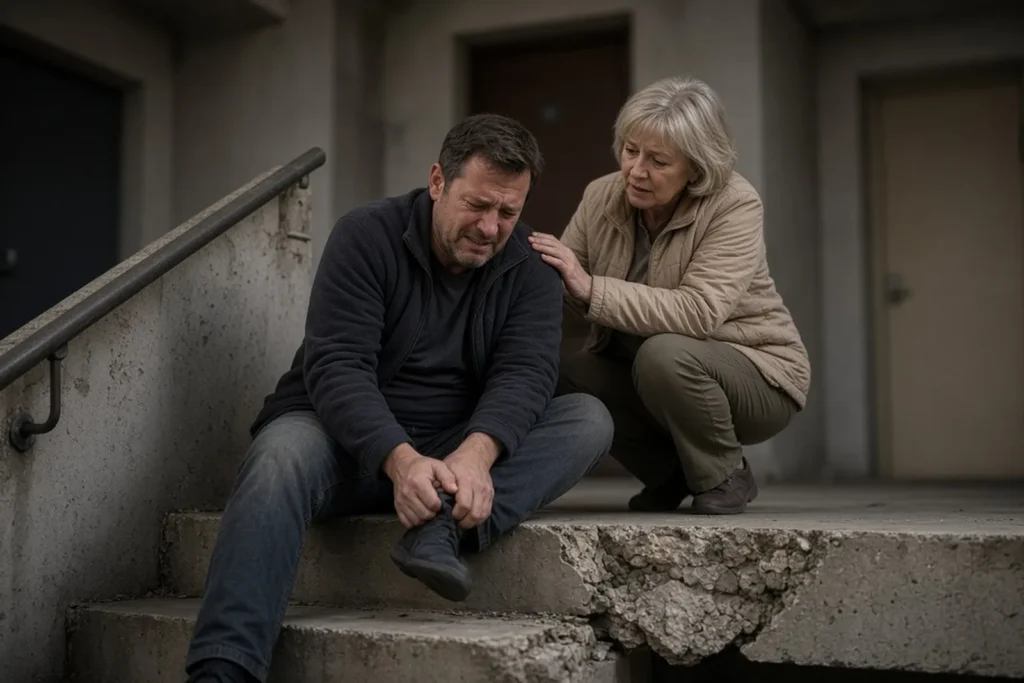
Loose or missing handrails, cracked or uneven steps and worn treads. Stairway falls cause some of the most serious injuries we see, including head and spine injuries.
Dark stairwells, hallways, parking garages and apartment breezeways can hide hazards that would be easy to see in good light.
Icy entrances, walkways and parking lots during and after winter storms. Since 2015, Kentucky law has not automatically protected property owners from claims involving natural ice and snow.
Bunched-up rugs, torn carpet, boxes in the aisle, cords across a walkway and merchandise left on the floor.
CALL NOW — Free Case Evaluation Request Your Free Consultation
Where you fell shapes the case. Stores and restaurants that invite customers in owe them the highest level of care. At apartment complexes, the landlord or management company is generally responsible for the common areas it controls, such as shared stairs, breezeways, walkways and parking lots. We look at leases, management contracts and snow-removal or maintenance contractors to find everyone who had a job to do.
Winter falls are common in Louisville. A Louisville Metro ordinance (Louisville Metro Code § 97.113) requires people and businesses that own or occupy property along a public street to remove snow from the sidewalk in front of their property within 24 hours after it falls. Whether that ordinance helps a particular injury claim depends on the facts and on Kentucky law, so it’s one piece of the picture, not an automatic win. The leading Kentucky Supreme Court case on ice falls, Carter v. Bullitt Host (2015), started in Jefferson Circuit Court and involved a hotel guest who slipped on ice under the hotel’s covered entrance.
Sidewalks and public property follow different rules. Kentucky courts have held that Louisville Metro Government has sovereign immunity. In a 2023 case, the Kentucky Court of Appeals upheld the dismissal of a claim by a man who tripped over a defect in a Metro-owned sidewalk. That doesn’t always mean nobody is responsible. A business, property owner, contractor or utility may share responsibility for the spot where you fell. If you fell on a street or sidewalk in one of the separate small cities inside Jefferson County, Kentucky law (KRS 411.110) requires written notice to that city within 90 days. Claims involving state property generally go to the Kentucky Board of Claims, which has its own deadlines, caps awards at $250,000 per claim and doesn’t allow pain-and-suffering damages.
Stores are where many Louisville falls happen. A spilled drink in an aisle, produce on the floor, a leaking cooler, a mopped floor with no warning sign, or a bunched-up mat at a rain-soaked entrance can put you on the ground in a second. Parking lots add potholes, broken curbs and poor lighting.
What you do in the first few days matters. Ask the manager to write an incident report and get a copy or a photo of it. Take pictures of the floor, your shoes and whatever you slipped on before anyone cleans it up. Get the names of employees and witnesses. Store surveillance video is often recorded over within days or weeks, so a preservation letter needs to go out quickly. A Louisville slip and fall lawyer can send that letter and ask how long the hazard was there and whether employees walked past it.
Icy sidewalks, unsalted parking lots and refrozen melt near gutters and downspouts cause many winter falls in Louisville. Since Carter v. Bullitt Host (2015), Kentucky no longer applies an automatic “no duty” rule to natural ice and snow. Instead, the question is whether the property owner acted reasonably given the weather and timing, for example by salting, clearing, lighting or warning, and fault is shared under comparative fault.
Photograph the ice, the weather conditions and any missing salt or warning signs right away, because ice melts and the evidence goes with it. The deadline to file is usually one year under KRS 413.140, and claims against a government property owner can have shorter notice rules. See our guide to ice and snow slip and fall cases.
We see fall cases from grocery and big-box stores along Shelbyville Road, Preston Highway, Dixie Highway and Bardstown Road, apartment complexes across Jefferson County, Louisville Metro sidewalks downtown and in the Highlands, and parking lots after ice storms. Claims against Louisville Metro Government or a state agency follow different notice rules, so tell us right away if a city sidewalk or public building was involved.
Kentucky still sorts people on property into three groups, and each is owed a different duty:
Kentucky used to let property owners off the hook for any hazard a visitor could have seen. That changed with Kentucky River Medical Center v. McIntosh (2010) and Shelton v. Kentucky Easter Seals Society (2013). Today, an obvious hazard doesn’t erase the owner’s duty of care. The question is whether the owner acted reasonably, including whether it should have expected people to be distracted or to have no real choice but to walk past the hazard. Then a jury can weigh everyone’s share of fault.
For decades, Kentucky had a “no duty” rule for natural accumulations of ice and snow. In Carter v. Bullitt Host (2015), a divided Kentucky Supreme Court held that the old rule was no longer viable and that obvious natural outdoor hazards are handled under comparative fault, just like other open-and-obvious hazards. A property owner still isn’t an insurer of everyone’s safety. The question is whether it acted reasonably, for example by salting, clearing, lighting or warning, given the weather and the timing. Kentucky appellate courts have kept applying Carter, including in a 2024 decision involving ice at an apartment complex.
In Lanier v. Wal-Mart Stores (2003), the Kentucky Supreme Court held that when a customer shows a foreign substance on a business’s floor caused the fall, there’s a rebuttable presumption that the business didn’t keep the premises reasonably safe. The burden then shifts to the business to prove it used reasonable care. You usually don’t have to prove exactly how long the spill was there.
Kentucky follows pure comparative fault (KRS 411.182). If a jury finds you partly responsible, your recovery is reduced by your share but not wiped out. For example, if a jury values your damages at $100,000 and finds you 20% at fault, you could recover $80,000. Read more about how Kentucky’s pure comparative fault rule works.
Most Kentucky personal injury lawsuits, including fall cases, must be filed within one year (KRS 413.140(1)(a)). Claims involving government property can have shorter notice deadlines, a special forum or immunity, as explained above. Don’t rely on any deadline until a lawyer has reviewed your situation.
Depending on the facts, a Kentucky fall claim can include:
Falls often cause hip, wrist and ankle fractures, torn shoulders and knees, spinal injuries and head injuries. A hard fall can cause a traumatic brain injury even when you never lost consciousness. When an injury is life-changing, the claim has to account for future surgeries, care and lost earning capacity. Learn more on our catastrophic injury lawyer page. If a fall took the life of someone you love, see our wrongful death lawyer page. Falls in nursing homes raise their own questions about staffing and fall-prevention plans. See our nursing home abuse and neglect page.
Do not accept the first offer. Insurance adjusters for property owners are trained to move quickly — making early settlement offers before you know the full extent of your injuries and before your future medical needs have been established. Once you sign a release, your claim is permanently closed. Speak with a trial attorney before you accept anything.
Property owners and their insurers know which law firms settle cheaply and which ones go to trial. When they know your attorney is Larry Forman, who has won 95% of the jury trials he has tried, the conversation about what your claim is worth changes immediately and significantly.
Larry Forman has tried 50+ jury trials and won 95% of them. That track record is known in Kentucky legal circles — and it changes how the other side negotiates.
Surveillance footage, maintenance logs, prior incident reports, inspection records, and witness statements — we issue preservation demands and begin independent investigation from the moment we take your case, before the property owner's team controls the narrative.
Duty of care standards, comparative fault tactics, open and obvious defenses, government property notice requirements — our team knows every argument the defense will raise and builds the evidentiary record to defeat each one before it reaches a jury.
From expert witness retention to pattern-of-misconduct research, we build cases designed to win at trial — not just settle quickly to move to the next file.
You pay nothing out of pocket. Our firm advances all costs, and we only collect if we secure a recovery on your behalf. Zero financial risk to you.
Larry Forman is one of the most-watched legal voices online. He knows how to tell your story — in front of a jury, a judge, or a national audience.
CALL NOW — Free Case Evaluation Request Your Free Consultation
Most Kentucky personal injury claims must be filed within one year after the injury (KRS 413.140(1)(a)). Kentucky does not count the day of the injury, and a deadline that lands on a weekend or legal holiday moves to the next business day (KRS 446.030).
Store owners and landlords often argue that the hazard was open and obvious or that you should have seen it. Under Kentucky law, those arguments usually go to how fault is shared. Kentucky divides fault by percentage. The jury assigns a share to each party, and an injured person’s own share reduces the award rather than barring it (KRS 411.182).
Photograph the spot, the lighting and your shoes before anything changes. Report the fall to the manager, ask for a copy of the incident report, and ask in writing that camera footage be kept. Get names and phone numbers from anyone who saw it.
You also have a right to your own medical chart: a Kentucky hospital or provider must give you one free copy on written request (KRS 422.317), and federal privacy rules generally require a provider to act within 30 days (45 CFR 164.524).
After a serious fall in Louisville, many people are taken to UofL Hospital, which runs the region’s Level I adult trauma center, or to a Norton or Baptist Health emergency room. Get the hospital records early, because they show how you described the fall on day one.
If the hazard is on a public sidewalk or street, report it to Louisville Metro by calling Metro311 (dial 311). The report creates a dated record of the defect. Remember that Metro itself is often immune, so we look for an adjoining business, landlord, contractor or utility. Falls inside stores are documented with the store’s incident report and video, which we ask the owner in writing to preserve. Louisville injury lawsuits are generally filed in Jefferson Circuit Court at the Judicial Center, 700 W. Jefferson St., where Carter v. Bullitt Host, Kentucky’s leading ice-fall case, began.
The company whose name is on the sign isn’t always the only one responsible. In many Louisville fall cases, several businesses share control of the place where you fell:
Leases and service contracts decide who had which job, and each company may have its own insurance. We ask for those documents early, along with incident reports and video, because the defense often blames whichever company isn’t in the room.
The same Kentucky premises liability rules apply everywhere in the state, so as a Kentucky slip and fall lawyer, Larry Forman also handles falls outside Jefferson County, including in Lexington, Northern Kentucky, Bowling Green, Paintsville, Monticello and Paris. Those cases are filed in the circuit court of the county where the fall happened. The one-year deadline under KRS 413.140(1)(a) is the same statewide, and the first steps are too: get the incident report number, photograph the hazard and your shoes, and ask the business to keep its video.
Talk with our team about what happened. The consultation is free.