
Farm and agricultural equipment injury claims arise under two primary legal frameworks that frequently apply simultaneously to the same incident. Product liability claims hold equipment manufacturers, component suppliers, and distributors responsible when a defective design, a manufacturing flaw, or an inadequate warning caused or contributed to the injury. Negligence claims hold farm operators, employers, equipment owners, and third-party contractors responsible when their failure to maintain safe equipment, provide adequate training, or implement required safety protocols created the conditions for the injury. A farm and agricultural equipment injury lawyer who identifies and pursues every applicable theory against every responsible party builds a case that captures the full available recovery rather than limiting the claim to the most obvious defendant.
Kentucky’s strict product liability framework does not require proof that the manufacturer was careless. It requires establishing that the product was defective in its design or manufacturing, that the defect existed when the product left the manufacturer’s control, and that the defect caused the injury. This framework is particularly powerful in agricultural equipment cases because many of the most common farm injury mechanisms, including inadequate PTO shaft guarding, absence of rollover protective structures on older tractor models, defective auger and conveyor shielding, and grain bin entrapment resulting from inadequate safety systems, involve equipment designs whose hazards have been known to manufacturers for decades. When internal manufacturer documents reveal prior knowledge of the defect and a decision to prioritize production costs over safety modifications, the case for punitive damages becomes as significant as the compensatory damages case.
Kentucky’s agricultural economy, which includes significant grain farming, livestock operations, tobacco production, and diversified crop farming throughout the Commonwealth, places thousands of workers and farm family members in daily contact with the heavy equipment that generates the most serious injury caseloads in occupational injury litigation. Whether the injury occurred on a family farm in western Kentucky’s grain belt, a commercial agricultural operation in the Bluegrass region, a custom harvest operation anywhere in the Commonwealth, or an agribusiness facility in the Louisville metropolitan area, a farm and agricultural equipment injury lawyer at Forman & Associates understands the specific equipment, the specific hazards, and the specific legal frameworks that apply to Kentucky agricultural injury cases.
If you or a loved one was seriously injured by farm or agricultural equipment in Kentucky, speak with our team today. Every case is reviewed at no charge and we never collect a fee unless we win.
Agricultural equipment injuries present unique challenges in the immediate aftermath that most other personal injury categories do not. Farm operations are frequently remote, emergency medical response times are longer than in urban settings, and the severity of agricultural equipment injuries, which regularly involve traumatic amputations, crush injuries, and entrapment scenarios, means that the victim’s initial focus is entirely on survival and stabilization rather than evidence preservation. By the time a farm family begins thinking about the legal aspects of a catastrophic farm injury, days or weeks may have passed during which the defective equipment has continued in service, been repaired, or been returned to the manufacturer or dealer without independent documentation of the defect that caused the injury.
Equipment manufacturers and their product liability insurers respond to serious agricultural equipment injury reports with the same institutional speed and self-protective instinct as any other major corporate defendant. Manufacturer’s representatives frequently contact the farm operation within days of a serious injury to inspect the equipment, review the maintenance records, and evaluate the liability exposure from the manufacturer’s perspective. These inspections are conducted in the manufacturer’s interest, not the injured worker’s, and the findings are used to build the manufacturer’s defense rather than establish the truth about the equipment’s condition and design. Without a farm and agricultural equipment injury lawyer who moves immediately to preserve the equipment and conduct an independent forensic investigation, the manufacturer’s version of the equipment’s condition at the time of the injury may be the only version that exists.
What farm families and injured agricultural workers must understand is that the financial resources available to compensate for a serious agricultural equipment injury are far greater than most families initially realize. Major agricultural equipment manufacturers including John Deere, Case IH, New Holland, AGCO, and their component suppliers carry substantial product liability insurance. Farm operations carry commercial general liability coverage. Custom operators carry their own liability policies. Workers injured on agricultural operations may have claims against third-party equipment owners, maintenance contractors, and equipment manufacturers that go far beyond what their employer’s workers’ compensation policy provides. A farm and agricultural equipment injury lawyer who conducts a full liability and insurance coverage analysis from day one ensures that every available source of recovery is identified and pursued.
The single most critical evidence preservation step in a farm equipment injury case is securing the defective equipment in its post-incident condition before it is repaired, modified, returned to service, returned to a dealer, or inspected exclusively by the manufacturer’s representatives. Agricultural equipment involved in a serious injury should be tagged out of service immediately, photographed thoroughly from every angle, and made the subject of a legal preservation demand issued by a farm and agricultural equipment injury lawyer as quickly as possible after the incident. If the equipment has a missing, bypassed, or inadequate safety guard that contributed to the injury, that condition must be documented independently before any repair or modification occurs. The equipment’s maintenance records, the operator’s training documentation, and any prior service reports involving the specific component that failed are equally critical and must be preserved through formal legal demand.
Farm and agricultural equipment injury cases require simultaneous investigation of product liability and operational negligence theories that demand different expert disciplines. A forensic agricultural engineer must examine the equipment to identify any design defects, manufacturing flaws, or inadequate safety systems and compare the equipment’s design against applicable industry safety standards, OSHA agricultural equipment regulations, and the manufacturer’s own technical literature. An agricultural safety expert must evaluate the operational circumstances of the incident, including the training provided to the operator, the maintenance history of the equipment, and whether required safety protocols were followed by the farm operator or employer. A medical specialist in amputation, crush injury, or the specific injury category involved must establish the full clinical picture and project the lifetime medical and rehabilitation needs. And a life care planner and economic expert must calculate the complete forward-looking cost of those needs across the victim’s life expectancy.
At Forman & Associates, we take immediate, comprehensive action from the moment we are retained as your farm and agricultural equipment injury lawyer. We issue legal preservation demands to the equipment owner, the manufacturer or dealer, and any other parties in possession of relevant evidence requiring immediate retention of the equipment, all maintenance records, operator training documentation, prior service reports, and any internal safety communications related to the specific equipment model involved. We retain forensic agricultural engineers and product liability experts to conduct an independent inspection of the equipment before the manufacturer’s representatives have had exclusive access to shape the evidentiary record. We conduct a full coverage analysis to identify every applicable insurance policy from every responsible party. And we build a case designed for trial, because the only thing that makes a major agricultural equipment manufacturer pay full value on a serious injury case is knowing that the attorney on the other side has been to a jury before and is not intimidated by the manufacturer’s institutional resources.
Farm and agricultural equipment injury claims arise across every category of farm machinery and every agricultural operation type. If any of the following circumstances apply to your injury, contact us for a free case evaluation.
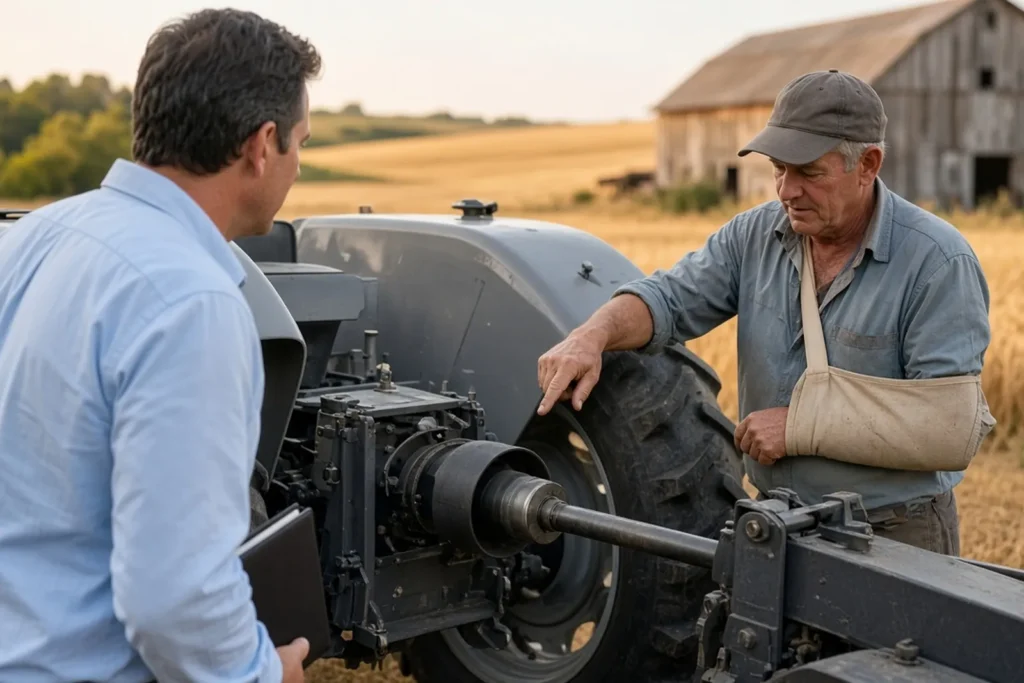
Power take-off shaft entanglements are among the most devastating agricultural equipment injuries, frequently producing traumatic amputations, degloving injuries, and fatalities when a rotating PTO shaft catches clothing, hair, or a limb. Inadequate PTO shaft guarding is a known and documented design deficiency in many agricultural equipment models, and manufacturers who failed to provide adequate shielding bear product liability for the catastrophic injuries that result.
Tractor rollovers are the leading cause of agricultural fatalities in Kentucky and nationwide. When a tractor is not equipped with a rollover protective structure, or when a defective ROPS fails to provide the required protection during a rollover, the manufacturer bears product liability for the resulting injuries. Farm operators who removed or disabled ROPS equipment may bear concurrent negligence liability. Both theories are frequently pursued simultaneously in tractor rollover cases.
Grain augers and conveyor systems that lack adequate guarding at intake points produce amputations and crush injuries that are entirely foreseeable and frequently preventable with properly designed shielding. Manufacturers who produce auger systems without adequate intake guards, and farm operators who remove or bypass existing guards, bear liability for the catastrophic injuries these mechanisms produce.
Grain bin entrapment and engulfment incidents, in which workers are pulled beneath the grain surface and suffocate or are crushed, give rise to claims against grain bin manufacturers for inadequate safety system design, against farm operators for failure to implement required confined space entry procedures, and against grain bin maintenance contractors whose work created the conditions for the entrapment.
Combine harvester injuries involving header mechanisms, feeder house components, and rotating cutting elements produce amputations and crush injuries when inadequate guarding allows operator or bystander contact with moving parts. Defective interlock systems that fail to stop the machine when access panels are opened are a specific product liability issue that has been documented across multiple major manufacturer platforms.
Hydraulic system failures in tractors, loaders, and implement lift systems that cause sudden, unexpected movement of heavy equipment components produce crush injuries and fatalities when operators or bystanders are in the path of the collapsing or swinging component. These cases involve both equipment design liability and, in cases of deferred maintenance, farm operator negligence.
CALL NOW — Free Case Evaluation Request Your Free Consultation
Farm and agricultural equipment injuries produce some of the most severe and most permanent harm in all of personal injury litigation. Traumatic amputations that require prosthetic fitting and lifelong adaptive management, crush injuries that produce permanent functional impairment, spinal cord injuries from tractor rollovers that result in paralysis, and traumatic brain injuries from equipment strikes all carry lifetime damages valuations that reflect the true cost of what defective or negligently maintained farm equipment takes from a person and their family. As a farm and agricultural equipment injury lawyer serving Kentucky farm families and agricultural workers, Forman & Associates pursues every available category of recovery from every responsible party.
In a Kentucky farm equipment injury lawsuit, recoverable damages typically include:
The life care plan is particularly consequential in farm equipment injury cases involving amputations and spinal cord injuries because the lifetime cost of prosthetic management, adaptive equipment, and modified living accommodations extends across decades and produces damages figures that are orders of magnitude larger than the acute medical costs that most early settlement offers are based on. A farm and agricultural equipment injury lawyer who retains the right life care planner and medical experts to project these costs before any settlement discussion changes the financial landscape of every serious farm injury case.
Do not allow the equipment to be repaired, returned to service, or inspected exclusively by the manufacturer’s representatives before consulting a farm and agricultural equipment injury lawyer. Do not accept any early settlement offer from the manufacturer’s insurer or the farm operator’s carrier before the full lifetime cost of your injury has been established through expert medical and economic analysis. The difference between an early settlement and the fully developed value of a serious farm injury case is regularly measured in hundreds of thousands to millions of dollars.
Agricultural equipment manufacturers, farm operation insurers, and commercial agricultural carriers evaluate serious injury claims based on one calculation: what will this case cost if it goes to a jury that sees the injury photographs, hears the medical testimony, and understands what defective equipment has done to this person and their family? When they know your farm and agricultural equipment injury lawyer is Larry Forman, who has won 95% of the jury trials he has tried, that calculation produces a fundamentally different settlement number than when they face a firm that settles every case before the expert reports are complete.
Larry Forman has tried 50+ jury trials and won 95% of them. That track record is known in Kentucky legal circles — and it changes how the other side negotiates.
The defective equipment, its maintenance records, the operator's training documentation, prior service reports, and any internal manufacturer safety communications related to the specific equipment model are all time-sensitive.
Kentucky's strict product liability framework, OSHA agricultural equipment safety standards, ASABE equipment safety standards, the manufacturer's duty to warn, the adequacy of existing safety guards, and the negligence theories applicable to farm operators and custom contractors are not abstract concepts to our team.
From expert witness retention to pattern-of-misconduct research, we build cases designed to win at trial — not just settle quickly to move to the next file.
You pay nothing out of pocket. Our firm advances all costs, and we only collect if we secure a recovery on your behalf. Zero financial risk to you.
Larry Forman is one of the most-watched legal voices online. He knows how to tell your story — in front of a jury, a judge, or a national audience.
CALL NOW — Free Case Evaluation Request Your Free Consultation
Farm injuries often involve more than one responsible party: the maker of a tractor or baler, the dealer that serviced it, a landowner, or another driver on a rural road. Each has its own defenses, and the clock runs on all of them at once.
Most Kentucky personal injury claims must be filed within one year after the injury (KRS 413.140(1)(a)). If the injury happened on a public road, for example a car rear-ending a slow-moving tractor, the two-year motor vehicle deadline may apply instead (KRS 304.39-230(6)).
When a machine’s design or warnings are the problem, Kentucky treats it as a product liability action (KRS 411.300). A manufacturer is responsible only for harm that would have happened with the product in its original condition, and removed guards or skipped maintenance are common defense arguments (KRS 411.320). That is why the machine should be kept as it was, photographed, and not repaired until it has been inspected.
Kentucky divides fault by percentage. The jury assigns a share to each party, and an injured person’s own share reduces the award rather than barring it (KRS 411.182).
Talk with our team about what happened. The consultation is free.