
Reviewed by Larry Forman, Attorney
Louisville winters don't bring much snow, but they bring plenty of ice: freezing rain, overnight refreezes and slush that turns hard by evening. For decades, Kentucky property owners could usually get an ice and snow slip and fall case thrown out by arguing that ice is natural and obvious. That changed in 2015. Today the question is whether the owner acted reasonably, and that's usually a question for a jury.
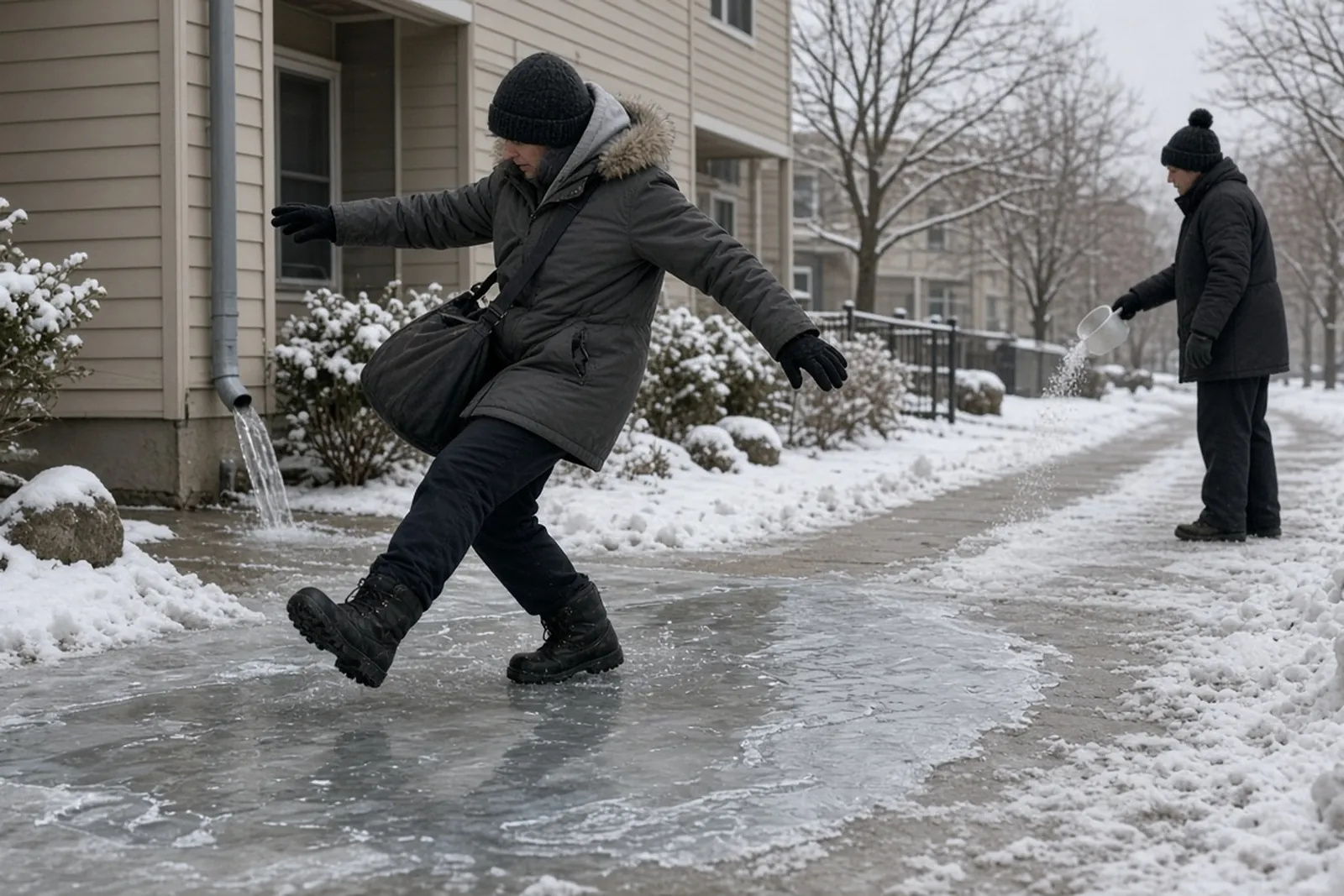
This page explains how Kentucky law treats winter falls now, what property owners are expected to do, who may be responsible, and the evidence that matters. For falls of every kind, see our main slip and fall page.
In Standard Oil Co. v. Manis (1968), Kentucky's highest court adopted a no-duty rule: natural outdoor hazards that are as obvious to a visitor as to the owner weren't "unreasonable risks" that the owner had to remove or warn about. In 2000, PNC Bank v. Green applied that rule to an icy bank sidewalk and upheld judgment for the bank.
That rule came from the era of contributory negligence, when any fault by the injured person barred recovery entirely. Kentucky moved to comparative fault in 1984, and the legislature codified it in 1988 (KRS 411.182).
The Kentucky Supreme Court rebuilt the "open and obvious" rules in three steps:
What that means for you: a property owner can't win just by saying "everyone knows ice is slippery." Under Carter, as the Supreme Court later restated in Grubb v. Smith (2017), dismissal is reserved for rare cases, such as when the injured person's own conduct was clearly the only cause, or when it's beyond dispute that the owner did everything reasonable.
An owner still isn't an insurer of everyone's safety. You have to show the owner fell short of reasonable care, and your own care is part of the comparison.
There's no fixed checklist. Juries look at the circumstances, including:
An unpublished 2024 Court of Appeals decision shows how this plays out. In Boyd v. Tates Creek Crossings, an apartment tenant slipped several days after a storm. The landlord's contractor had cleared and salted several times, but ice remained on the tenant's likely path to her car, and she cut across snowy grass to avoid it. The court sent the case back for trial. Whether the landlord did enough, and whether her shortcut was foreseeable, were questions for a jury.
Some of the strongest winter cases involve ice the property itself produced:
Repeated ice at the same spot, and prior complaints about it, help show the owner knew and didn't act.
Falls in parking lots often involve both the lot owner and a contractor. See parking lot accidents. If you fell at a workplace you don't work for, see third-party workplace injuries.
Louisville's snow ordinance. Louisville Metro Code § 97.113 says people and businesses that own or occupy property along a public street must remove snow from the sidewalk in front of it within 24 hours after it falls (LMCO § 97.113). Whether a violation helps a particular injury claim isn't settled. We evaluate it case by case, alongside the owner's other conduct.
Government property. Claims against a local government face immunity questions and short notice rules. For example, KRS 411.110 requires notice within 90 days for injuries from defective city sidewalks and streets (KRS 411.110), and it may come up depending on who controls the spot. Claims against state agencies go to the Kentucky Board of Claims, generally within one year (KRS 49.120).
Insurers will point to your shoes, your phone, your speed or a shortcut. Under Kentucky's pure comparative fault rule, your share of fault reduces your recovery but doesn't bar it. That's true even if you knew the ice was there, especially when you had no reasonable way around it.
Ice melts and refreezes, sometimes within hours, so the evidence disappears faster than in almost any other fall case.
Send preservation requests early. See evidence to preserve after an accident and insurance adjuster tactics.
Falls on ice often happen backward or sideways, with no time to brace. We regularly see wrist, hip and ankle fractures, head injuries, back and disc injuries, and knee and shoulder injuries. For how damages are valued, see Kentucky personal injury case value.
Most Kentucky premises claims must be filed within one year of the fall (KRS 413.140). Government claims can require notice far sooner. See our statute of limitations guide.
Learn more about Larry Forman, see our case results (past results don't guarantee a similar outcome), or read about premises liability generally.
Possibly. Since Carter v. Bullitt Host (2015), natural ice and snow are no longer an automatic defense. The question is whether the owner acted reasonably, and any fault on your part is compared.
Kentucky has no fixed rule. The question is what was reasonable, and timing matters. A fall in the middle of a storm is viewed differently than one after hours or days with no salting or clearing, or after a predictable refreeze.
Often, yes. Knowing about a hazard may increase your share of fault, but under pure comparative fault it doesn't bar recovery, especially if there was no reasonable way around it.
Landlords and managers are generally responsible for common areas they control, like lots, walkways and stairs. Hiring a snow contractor doesn't automatically excuse them.
It depends on who owns and controls the spot. Louisville's code requires abutting owners or occupants to clear sidewalk snow within 24 hours, and claims involving government property have special notice rules.
Generally one year from the fall under KRS 413.140. Claims involving government property can require written notice within 90 days or less, so act quickly.
The ice will melt. We'll make sure the evidence doesn't disappear with it. No fee unless we win. Get a free case evaluation or call (502) 931-6788. Our office is at 1139 S. 4th St., Louisville, KY 40203.
This page is general information about Kentucky law and Louisville ordinances as of October 2026, not legal advice.