
Reviewed by Larry Forman, Attorney
Your knees and shoulders do a lot of quiet work: climbing stairs, kneeling to work on a car, lifting a toddler, reaching a top shelf, sleeping on your side. When a crash or fall tears a ligament, tendon or cartilage in one of those joints, everyday life gets hard fast.
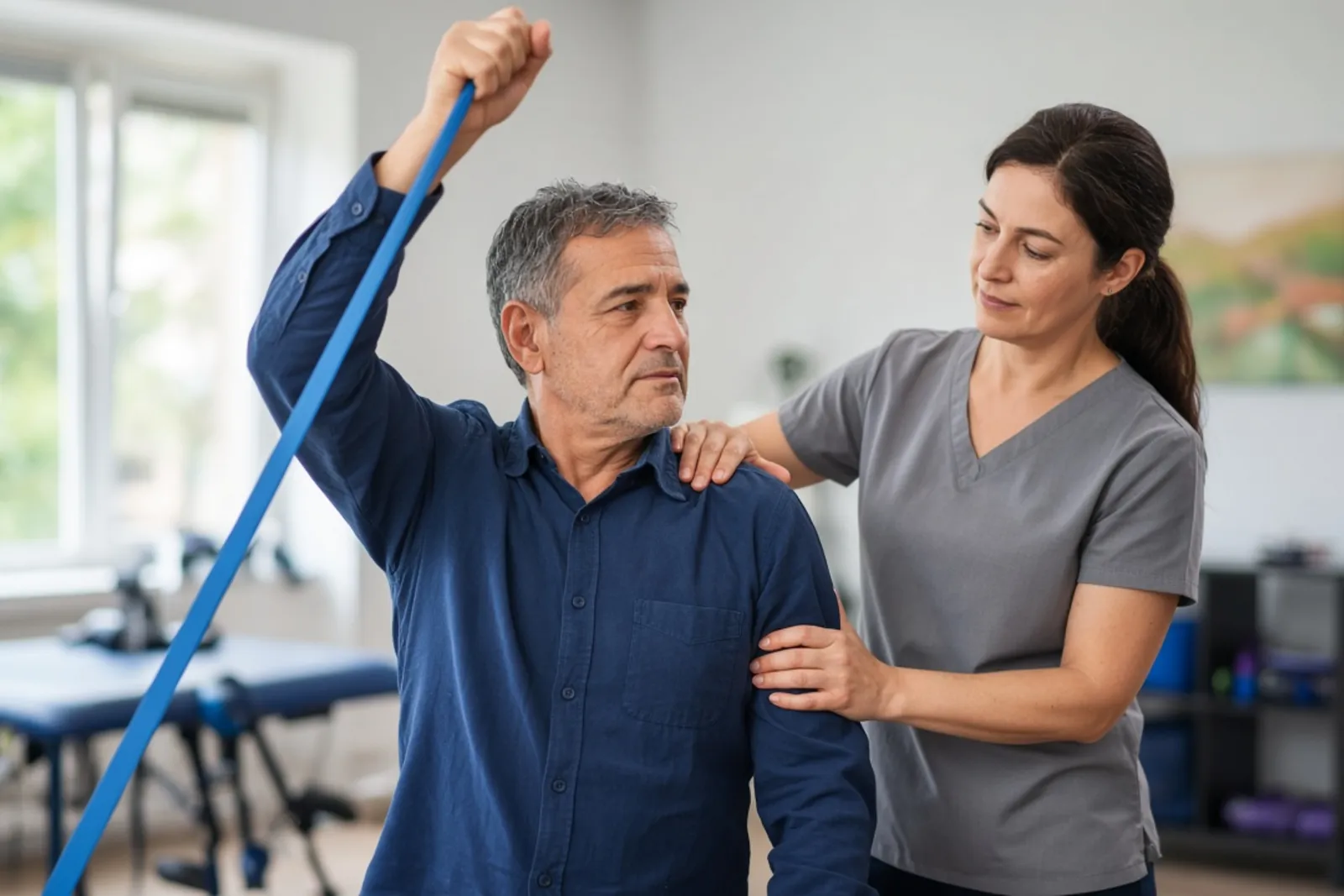
These injuries are also some of the most argued-about in injury claims. Insurers often say a torn meniscus or rotator cuff is “just wear and tear.” This page explains the common knee and shoulder injuries after accidents, how they’re diagnosed and treated, how long recovery can take, and how Kentucky law applies.
AAOS explains that the knee is held together by four main ligaments: the anterior and posterior cruciate ligaments (ACL and PCL) inside the joint, and the medial and lateral collateral ligaments (MCL and LCL) on the sides. Two wedge-shaped pieces of cartilage, the menisci, cushion the joint.
According to AAOS, the PCL keeps the shinbone from sliding backward. Injuring it takes a powerful force, and a common cause is a bent knee hitting a dashboard in a car crash. Symptoms include pain and swelling soon after the injury, stiffness, a limp, and a feeling that the knee may give out.
AAOS says PCL injuries can be subtle and harder to evaluate than other knee ligament injuries, and often happen along with damage to cartilage, other ligaments or bone. Many partial PCL tears can heal without surgery. When surgery is needed, AAOS notes full recovery typically takes 6 to 12 months.
AAOS also points out that X-rays and MRI may appear normal if the injury happened more than three months before the tests. If your knee hit the dashboard and still hurts, don’t wait to get it checked.
AAOS reports ACL tears affect more than 200,000 people a year in the U.S. and represent more than half of all knee injuries. Many happen in sports, but AAOS lists direct contact or collision among the causes. People often hear a pop and feel the knee give out, with swelling within 24 hours. ACL injuries often happen with damage to the MCL or menisci. Treatment ranges from physical therapy to surgical reconstruction or repair.
AAOS explains the meniscus can tear from sudden trauma or from degenerative changes over time. Many people can still walk after the tear, but over two to three days the knee becomes stiffer and more swollen. Common symptoms include pain, catching or locking, the knee giving way, and trouble moving it fully. AAOS calls MRI the preferred method for diagnosing meniscus tears caused by injury.
Treatment depends on the type and location of the tear. AAOS notes the outer third of the meniscus has a good blood supply and may heal or be repaired, while the inner two-thirds generally can’t heal on its own. Surgical options include trimming (partial meniscectomy), repair with stitches, and in some cases transplant. AAOS estimates rehabilitation takes about 3 to 6 months after a repair and about 3 to 6 weeks after a partial meniscectomy.
AAOS describes the rotator cuff as four muscles whose tendons cover the top of the upper arm bone and help lift and rotate the arm. AAOS reports that almost 2 million people in the U.S. see a doctor each year because of rotator cuff tears.
AAOS describes two main causes:
Symptoms include pain at rest and at night (especially lying on that shoulder), pain lifting or lowering the arm, weakness, and a crackling sensation. AAOS notes a sudden tear from a fall usually causes intense pain, sometimes with a snapping sensation and immediate weakness.
AAOS reports nonsurgical treatment relieves pain and improves function in about 80% to 85% of patients. It lists signs that surgery may be a good option, including significant weakness, a large tear, symptoms lasting 6 to 12 months, and a tear caused by a recent, acute injury.
Crashes and falls can also dislocate the shoulder or fracture the collarbone or upper arm. Fractures are covered on our broken bones page. If shoulder and arm pain comes with neck pain, numbness or tingling, the problem may start in the neck. See herniated disc and back injuries and whiplash. AAOS notes doctors may examine the neck to rule out a pinched nerve as the source of shoulder pain.
Insurers know that meniscus and rotator cuff tears often develop with age. AAOS says most rotator cuff tears result from slow wear, and older people are more likely to have degenerative meniscus tears.
That doesn’t mean your injury wasn’t caused by the accident. The evidence that answers this argument includes:
Kentucky law generally allows recovery for the worsening of a pre-existing condition caused by someone else’s negligence. (See Flags.)
Most people injured in a Kentucky crash can claim up to $10,000 in PIP benefits for medical bills, lost wages and similar losses, regardless of fault (KRS 304.39-020(2)). An MRI, an orthopedic visit and therapy can use that quickly. Read how Kentucky PIP works and the 2026 PIP changes.
To recover pain and suffering from the at-fault driver, you must meet Kentucky’s threshold: medical expenses over $1,000, or an injury that includes a fracture, permanent injury within reasonable medical probability, permanent loss of bodily function, or certain other injuries (KRS 304.39-060(2)(b)). Most torn-ligament cases with imaging and treatment exceed $1,000. An avulsion fracture, which AAOS describes as a ligament pulling off a piece of bone, would also meet the fracture part of the threshold.
The threshold doesn’t apply to falls and other non-vehicle claims.
Kentucky’s pure comparative fault rule reduces your recovery by your share of fault but doesn’t bar it (KRS 411.182). In fall cases, expect the property owner to argue you should have seen the hazard. See how to prove property owner negligence.
If a third party, such as another driver, a property owner or an equipment maker, caused your knee or shoulder injury on the job, you may have a claim in addition to workers’ compensation. See third-party workplace injuries.
We work with your orthopedic providers to document how the accident caused or worsened your injury, gather proof of how active you were before, and push back on the “wear and tear” argument with evidence. We prepare every case as if it will go to trial. Larry Forman has tried 50+ jury trials. Learn more about Larry.
It can. AAOS lists falling on an outstretched arm and lifting with a jerking motion as causes of acute tears, and notes tears can occur along with dislocations and fractures. Whether a crash caused your tear, or made an existing one symptomatic, is a medical question your doctors answer with your history, exam and imaging.
It’s a common name for a knee injury, often to the PCL, caused when a bent knee strikes the dashboard in a crash. AAOS lists this as a common cause of PCL injuries.
It depends on the injury and treatment. AAOS estimates about 3 to 6 weeks of rehab after a partial meniscectomy and about 3 to 6 months after a meniscus repair. After PCL reconstruction, AAOS says full recovery typically takes 6 to 12 months.
No. Degenerative tears are common, but if you were using the joint without problems before the accident and it changed afterward, you may still have a claim for the harm the accident caused. Your medical records and your surgeon’s opinion are key.
No. AAOS reports most rotator cuff tears improve without surgery, and many PCL and meniscus injuries are treated without it. Make treatment decisions with your doctors, not based on a claim.
There’s no standard amount. It depends on the injury, treatment, recovery, your work, the evidence of fault and the insurance available.
Call Forman & Associates at 502-931-6788 or 1-844-77-4-HURT, or contact us online for a free case evaluation. We’re at 1139 S. 4th St., Louisville, KY 40203.
This page is general information, not legal or medical advice.