
Reviewed by Larry Forman, Attorney
A mattress flies off a pickup on I-64. A ladder slides off a contractor's truck. A tire tread peels off a semi and slams into your windshield. A road debris accident happens in a second, and the vehicle that caused it often never stops. Kentucky law requires drivers to secure their loads, and the people responsible can be held accountable, but these cases come with a specific insurance trap you should know about.
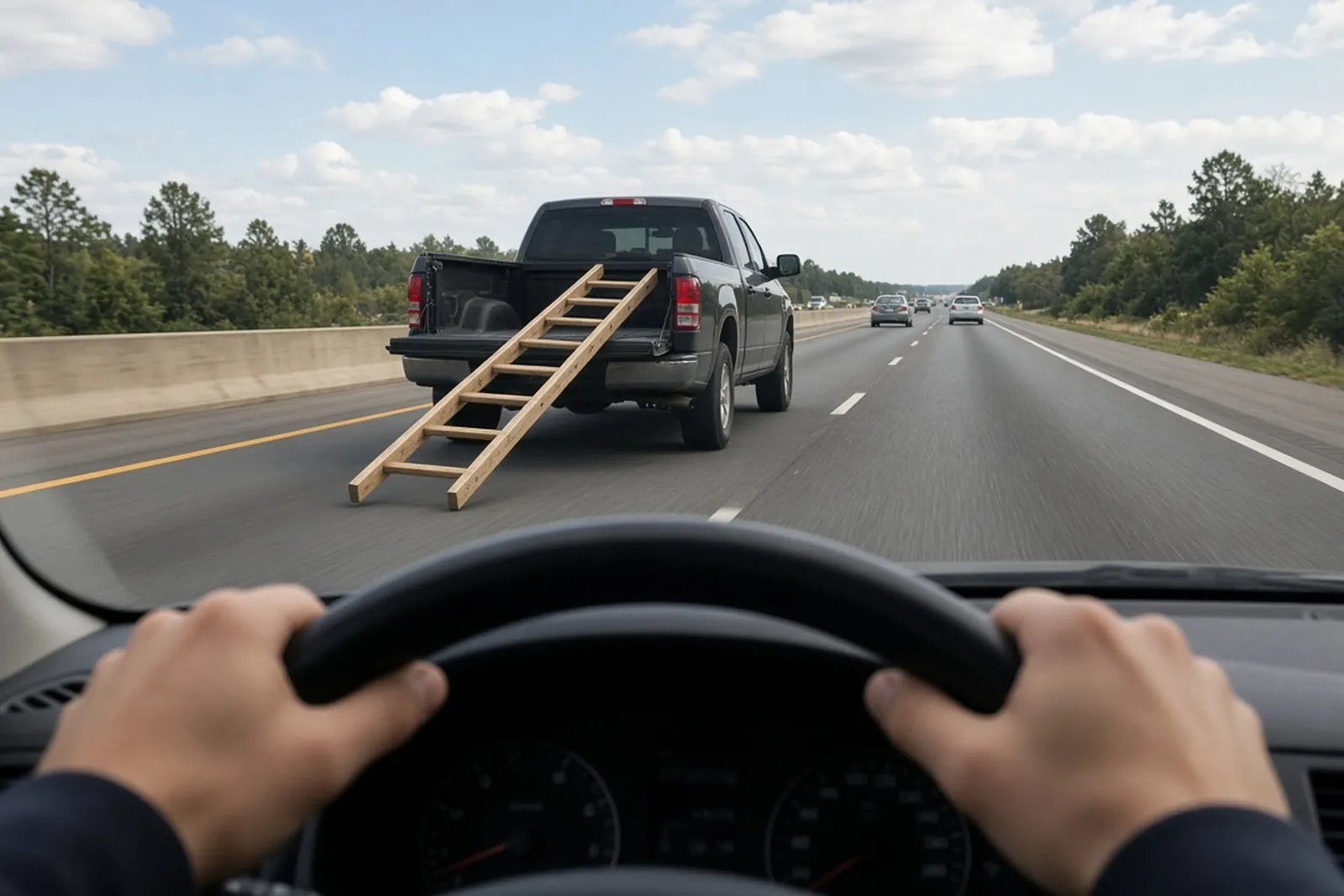
Debris on an interstate can also start a chain reaction. See multi-vehicle pileups.
Kentucky law is direct about this (KRS 189.150):
"No vehicle shall be operated upon any highway unless it is so constructed as to prevent its contents from escaping."
And: "No vehicle shall be operated upon any public highway for a distance of over one (1) mile whose load is susceptible to shifting or spillage unless said load is covered with a device suitable for prevention of spillage."
Commercial trucks have their own federal rule. Under 49 CFR 393.100(b), each truck must be loaded and its cargo secured "to prevent the cargo from leaking, spilling, blowing or falling from the motor vehicle."
When someone violates a safety statute and it causes your injury, Kentucky lets you recover damages from the violator (KRS 446.070).
Depending on the facts:
This is where road debris cases get hard. If the driver is never identified, you'd normally turn to your own uninsured motorist (UM) coverage. But many Kentucky policies cover hit-and-run crashes only if the unknown vehicle actually strikes you or your car.
In Masler v. State Farm, 894 S.W.2d 633 (Ky. 1995), an unidentified truck threw a rock into the insured's windshield. The Kentucky Supreme Court enforced a policy requiring that the hit-and-run vehicle "strike" the insured or the insured's vehicle, said that means "actual, direct, physical contact," and declined to extend it to indirect contact. Coverage was denied.
What that means for you:
See our hit-and-run lawyer and uninsured motorist pages, and what to do after a hit-and-run.
We work fast to identify the vehicle, trace the cargo back to the company that loaded it, and read every policy for coverage. We prepare cases for trial from the start. Larry Forman has tried 50+ jury trials and won 95% of them. Learn more about Larry Forman, see our case results (past results don't guarantee a similar outcome), or return to our car crash lawyer page.
Usually the driver, the vehicle owner or the trucking company whose load wasn't secured. Kentucky and federal law both require loads to be secured.
Yes. KRS 189.150 bars operating a vehicle that isn't built to keep its contents from escaping, and requires covering shifting or spilling loads driven over a mile.
It depends on your policy. Many require actual contact by the hit-and-run vehicle, and Kentucky's Supreme Court has enforced that requirement for a thrown rock.
You may still have a claim against whoever left the debris, if they can be identified. Your PIP and collision coverage may also apply.
Possibly, if the agency knew about the hazard and failed to act, but those claims have special rules, caps and short deadlines.
Generally two years from the crash or the last PIP payment for car crash claims. Claims against government agencies can be shorter.
Let us help you find who's responsible. Get a free case evaluation or call (502) 931-6788. No fee unless we win.
This page is general information about Kentucky law as of October 2026, not legal advice.