
Reviewed by Larry Forman, Attorney.
Emergency vehicles are allowed to break some traffic rules, but not to drive carelessly. When an ambulance, fire truck or police car causes a crash, the first questions are who owned and operated the vehicle and whether that owner has immunity under Kentucky law. A Louisville Metro EMS ambulance, a suburban fire district truck and a private ambulance company can lead to very different claims. Forman & Associates is a Louisville based trial firm that handles emergency vehicle accident claims for drivers, passengers, pedestrians and people injured while being transported.
Key takeaways
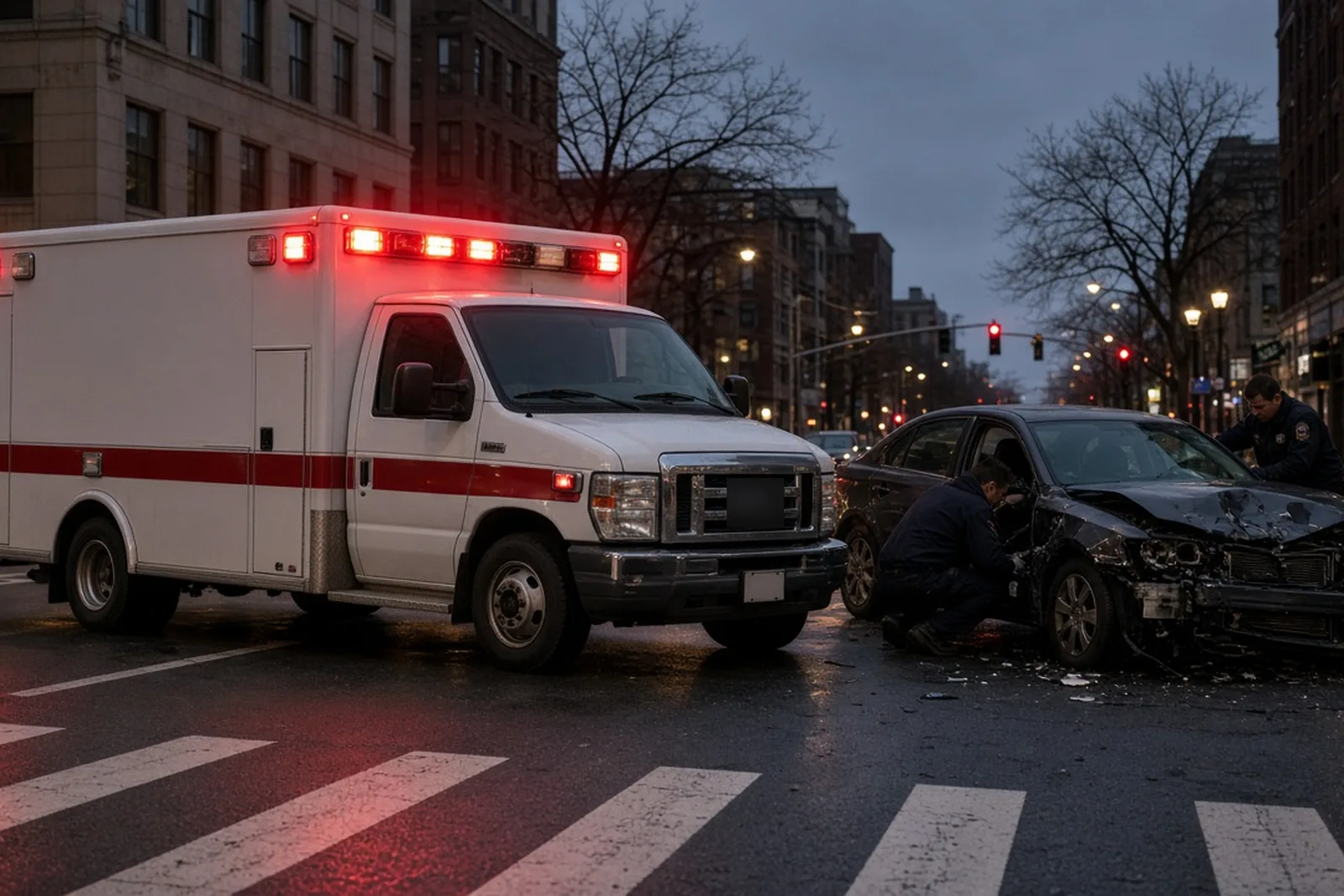
Kentucky lets emergency vehicle drivers who are responding to an emergency and using lights and sirens exceed speed limits, proceed past red signals after slowing as needed, and disregard some other rules. But the law also says these privileges do not relieve the driver of the duty to drive with due regard for the safety of all persons (KRS 189.940). Other drivers must yield and pull over for an approaching emergency vehicle using its lights and siren (KRS 189.930).
Many emergency vehicle crash claims turn on whether the lights and siren were on, how fast the vehicle was going and whether the driver slowed before entering an intersection. Dash cameras, vehicle data and dispatch records can answer those questions, so they should be requested quickly.
Louisville Metro EMS is part of Louisville Metro Government. Kentucky law gives the consolidated Louisville Metro government the same sovereign immunity that counties have (KRS 67C.101(2)(e)), and the Claims Against Local Governments Act preserves that county immunity (KRS 65.2001). As a result, a direct claim against Metro itself is often barred.
That doesn’t always end the case. The Kentucky Supreme Court has held that driving a vehicle is generally a ministerial act, so a government employee can be personally liable for negligent driving (Jones v. Lathram, 150 S.W.3d 50 (Ky. 2004)). Kentucky law also addresses when local governments provide for the defense of employees sued for acts in the scope of their employment (KRS 65.2005). Whether a claim fits these rules depends on the facts, so get advice early.
Other public agencies, including cities, fire protection districts and state agencies, have their own immunity rules. Cities are generally liable for negligent ministerial acts (KRS 65.2003), while claims involving state agency vehicles go to the Kentucky Board of Claims, which has a one-year filing deadline and caps damages at $250,000 per person and $400,000 per occurrence (KRS 49.120 and 49.040). See our government vehicle accident page.
Many ambulances on Louisville-area roads, including some non-emergency transport vans and hospital transfer units, are operated by private companies. Private companies don’t have sovereign immunity. They are responsible for their drivers’ negligence and, in some cases, for poor training, maintenance or scheduling. The vehicle markings don’t always make ownership clear, so we confirm it through the crash report, dispatch records and insurance information.
Patients can be hurt when an ambulance crashes, brakes hard or when they aren’t properly secured on a stretcher. Those claims may involve both the driving and the patient care. If the care itself was the problem, see our emergency room errors page for related issues.
Most Kentucky personal injury claims must be filed within one year (KRS 413.140). Most motor vehicle injury claims have two years from the injury or the last PIP payment, whichever is later (KRS 304.39-230). Government claims may have shorter or different deadlines and procedures. Kentucky uses pure comparative fault: your share of fault reduces your recovery but doesn’t bar it (KRS 411.182). Use our statute of limitations calculator to estimate your dates.
Claims against Metro itself are often barred by sovereign immunity, but the driver may be personally liable for negligent driving, and other coverage may apply. The details matter.
Other drivers must yield to an emergency vehicle using lights and siren, but the emergency driver still has to drive with due regard for everyone’s safety.
Without lights and siren on an emergency run, the driver generally must follow the same traffic laws as everyone else.
Your no-fault (PIP) coverage generally pays your first medical bills regardless of fault, and your underinsured motorist coverage may matter too.
Immunity rules make these claims complicated. Call us for a free case review.
Get a free case evaluation or call 502-931-6788.
This page is general information about Kentucky law as of October 2026, not legal advice. Every case is different.