Reviewed by Larry Forman, Attorney
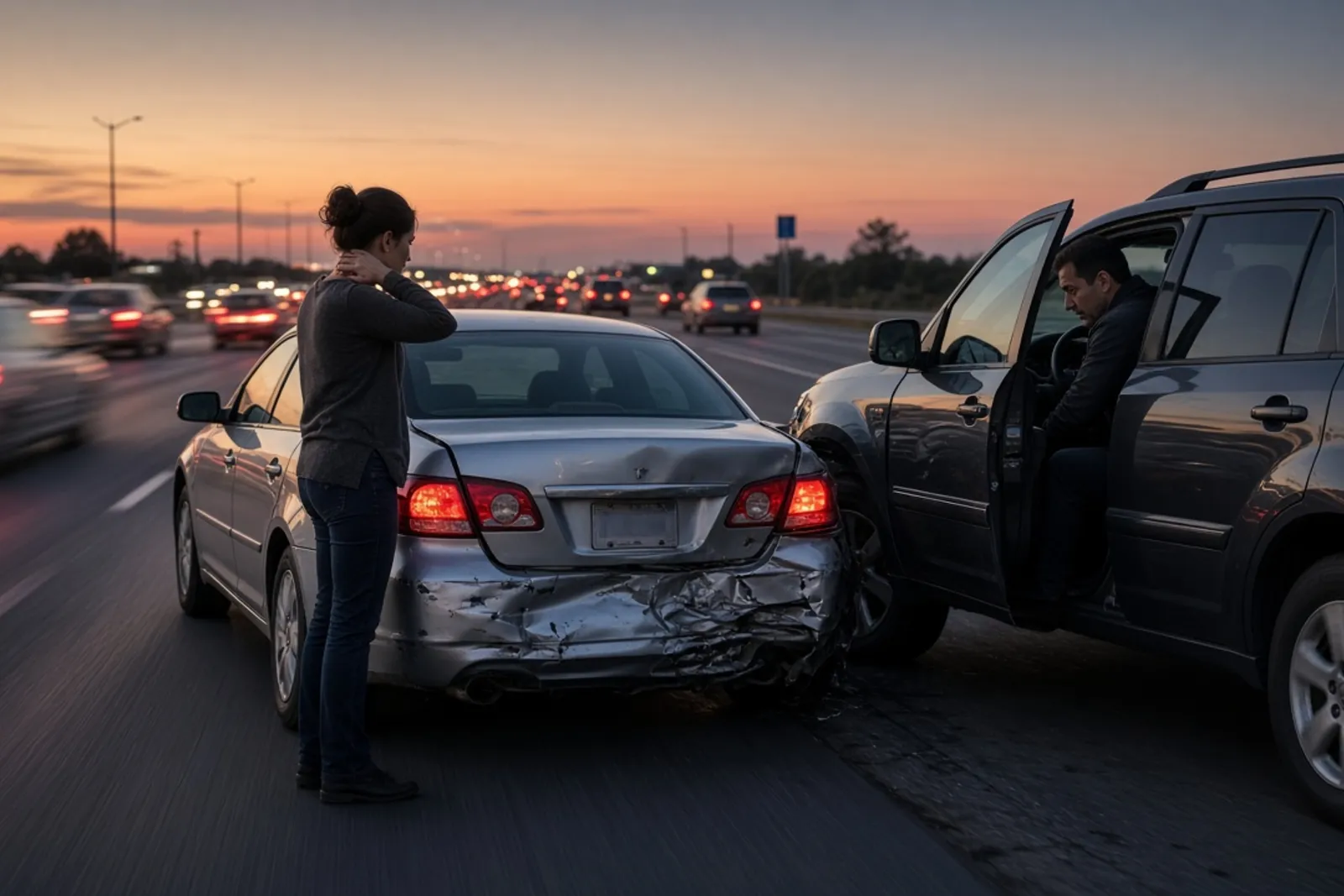
You were stopped at a light on Bardstown Road, or crawling through traffic on the Watterson, and the next thing you felt was the jolt from behind. Rear-end crashes are some of the most common collisions on Louisville roads. They’re also among the most underestimated.
Insurers often treat them as simple. They’ll say the bumper barely has a scratch, so you can’t really be hurt. Or they’ll argue you stopped too suddenly. Forman & Associates helps people hurt in rear-end collisions across Louisville and Kentucky push back on both arguments. This page explains how Kentucky decides fault, why these crashes cause more injury than the damage suggests, and what evidence matters.
How common are rear-end crashes in Kentucky?
Kentucky State Police data shows how often the habits behind rear-end crashes show up. In KSP’s 2024 Collision Facts report, officers listed following too close as a factor in 7,239 collisions statewide, and driver inattention in 42,363, more than a third of all reported collisions. See our Kentucky car crash statistics for the full data.
In Louisville, rear-end crashes cluster where traffic stops and starts without warning:
Busy surface corridors with constant signals and driveways, such as Dixie Highway, Preston Highway and Shelbyville Road. See our post on Dixie Highway crashes.
Construction zones, where lanes narrow and traffic stops abruptly.
Who is at fault in a Kentucky rear-end collision?
The following-distance rule
Kentucky law says a driver “shall not follow another vehicle more closely than is reasonable and prudent, having regard for the speed of the vehicle and the traffic upon and condition of the highway” (KRS 189.340(9)(a)). Trucks, buses and heavy construction equipment traveling outside business or residential districts must generally stay at least 250 feet back (KRS 189.340(9)(b)). Every driver must also operate “in a careful manner, with regard for the safety and convenience of pedestrians and other vehicles” (KRS 189.290(1)).
When a driver violates a safety statute and causes injury, Kentucky law allows the injured person to recover damages caused by the violation (KRS 446.070).
It’s usually the rear driver, but not automatically
In most rear-end crashes, the evidence points squarely at the driver who hit from behind. Kentucky’s statutes don’t make that automatic, though. Fault is decided under pure comparative fault (KRS 411.182), and insurers know it. Common defense arguments include:
“You stopped for no reason.” A sudden, unnecessary stop can shift some fault. Stopping for a light, a pedestrian or traffic ahead is what drivers are supposed to do.
“Your brake lights were out.” Expect them to inspect your car.
“You cut in front of me.” If a lane change left too little room, fault can be shared. Video and witnesses often settle this.
“I was pushed.” In chain-reaction crashes, the driver who started the chain may carry most of the fault, and more than one driver can be responsible.
Chain-reaction crashes on the interstate can involve several drivers and insurers. Kentucky has each party pay its own “equitable share” based on its percentage of fault (KRS 411.182(3)). That’s why it matters to identify every driver who contributed, not just the one who touched your bumper. When a semi is involved, see our truck wreck page.
“There’s barely any damage, so you can’t be hurt”
This is the argument insurers use most in rear-end cases. It’s also misleading. Modern bumpers are built to absorb impact and spring back, so a car can look fine while the people inside were thrown forward and back in a fraction of a second.
Common rear-end injuries include:
Symptoms often get worse over the first few days. That’s why it’s important to get checked promptly and to follow through with care. Gaps in treatment are one of the main ways insurers devalue these claims. See common insurance adjuster tactics.
Evidence that wins rear-end cases
Rear-end cases are often won or lost on evidence that disappears quickly:
Vehicle data. Many vehicles have an event data recorder in the airbag control module. It can capture speed, braking and throttle in the seconds before impact. That data can show whether the rear driver ever braked.
Video.Dashcams, business cameras, doorbell cameras and traffic cameras. Much of it is overwritten within days or weeks.
Phone records. Many rear-end crashes come down to a driver looking at a phone. Proving it takes fast action. See our page on distracted driving accidents.
Photos of both vehicles, including the underside and the bumper reinforcement, not just the cover.
Kentucky is a no-fault state. In most cases your PIP coverage pays first, up to $10,000 per person for medical bills and lost wages, no matter who was at fault. See how Kentucky PIP works.
To bring a claim against the driver who hit you for pain and suffering, your injury has to meet Kentucky’s threshold. That means more than $1,000 in medical expenses, a broken bone, or a permanent injury, among other qualifying injuries (KRS 304.39-060(2)(b)). If the at-fault driver’s insurance isn’t enough, your own underinsured motorist coverage may help.
Deadline: most Kentucky crash lawsuits must be filed within two years of the crash or the last PIP payment, whichever is later. A spouse’s separate claim can have a shorter deadline. See the Kentucky statute of limitations guide.
How we handle rear-end collision cases
Send preservation letters for vehicle data and video right away
Get the full medical picture, including imaging and opinions from your treating doctors
Answer the “low-impact” argument with medical and crash evidence
Identify every at-fault driver and every policy, including your own UIM
Coordinate PIP and health insurance so bills are handled
File suit when the insurer won’t be fair. Larry Forman has tried 50+ jury trials and won 95% of them.
Usually, but not automatically. Kentucky requires drivers to keep a reasonable and prudent following distance (KRS 189.340), but fault is decided under comparative fault, so a sudden stop, a cut-in or broken brake lights can shift some responsibility.
Can I be hurt if there’s little damage to my car?
Yes. Bumpers are built to absorb impact, so vehicle damage often doesn’t reflect the force on your neck and back. Medical evidence, not repair photos, should decide what your injury is.
Who pays my medical bills after I’m rear-ended in Kentucky?
Usually your PIP coverage pays first, up to $10,000, regardless of fault. Claims against the at-fault driver cover what PIP doesn’t, once you meet the no-fault threshold.
What if I was hit in a chain-reaction crash?
More than one driver may share fault, and each pays its own share under KRS 411.182. Identify every driver and insurer involved.
How long do I have to file a rear-end collision claim in Kentucky?
Generally two years from the crash or the last PIP payment, whichever is later. Other deadlines can be shorter, so don’t wait.
Should I talk to the other driver’s insurance company?
You can give basic information, but you don’t owe the other driver’s insurer a recorded statement. Talk to a lawyer first.
Rear-ended in Louisville? Let’s talk
Tell us what happened. We’ll explain your options, protect the evidence, and handle the insurers. No fee unless we win. Get a free case evaluation or call (502) 931-6788. Our office is at 1139 S. 4th St., Louisville, KY 40203.
This page is general information about Kentucky law, not legal advice.