Kentucky Traffic Laws That Decide Fault After a Crash
The Kentucky traffic laws that most often decide fault after a crash: right-of-way, signals, following distance, texting, school buses, move-over and more.
Reviewed by Larry Forman, Attorney
After most crashes, the question of who’s at fault comes down to a rule of the road: who had the right-of-way, who was following too closely, who was on their phone. Most Kentucky traffic laws are in KRS Chapter 189, and a broken traffic law is often the strongest evidence in an injury case.
This guide covers the Kentucky traffic laws that come up most in crash claims, what they say and how they’re used to prove fault. For motorcycle and bicycle rules, see our Kentucky motorcycle and bicycle laws guide.
How Kentucky traffic laws are used in an injury claim
A traffic ticket and an injury claim are separate. The ticket is handled in criminal or traffic court. The injury claim is a civil case for money damages. But the same statute often matters in both.
Under KRS 446.070, a person injured by someone else’s violation of a statute can recover damages caused by the violation. This is called negligence per se. In practice:
A broken traffic law can establish that the other driver was careless.
You still have to show the violation caused your injuries.
A ticket helps, but isn’t required. And a driver who wasn’t ticketed can still be found at fault.
Every driver must “operate the vehicle in a careful manner, with regard for the safety and convenience of pedestrians and other vehicles upon the highway” (KRS 189.290). Even when no specific rule fits, this one usually does.
When two vehicles reach an intersection at about the same time, the driver on the left yields to the driver on the right.
At a stop sign, stop at the line, then yield to any vehicle close enough to be an immediate hazard.
At a yield sign, slow down and stop if needed. A collision after driving past a yield sign without stopping is “prima facie evidence” of failure to yield.
A driver turning left yields to oncoming traffic that’s in the intersection or close enough to be an immediate hazard.
A driver pulling out of a driveway, parking lot or other place that isn’t a road yields to all vehicles on the road.
Traffic signals are covered in KRS 189.338. Drivers turning on a green light must still yield to vehicles and pedestrians lawfully in the intersection. For how these rules play out in left-turn and red-light crashes, see our post on intersection crashes in Kentucky.
Following too closely. Drivers may not follow “more closely than is reasonable and prudent,” considering speed, traffic and the road. Outside business and residential districts, trucks and buses may not follow within 250 feet of another vehicle. See our rear-end collision page.
Passing on the left. A driver may pass on the left only when the way is clear, and must get back into the right lane before coming within 200 feet of an oncoming vehicle.
Staying in your lane. On roads with three or more marked lanes in one direction, drivers must stay in a single lane and not move until it’s safe.
The left lane is for passing. On limited-access highways with four or more lanes and a speed limit of at least 65 mph, drivers may not stay in the far-left lane except to pass, let traffic merge or avoid unsafe conditions.
Turn signals must be used for at least the last 100 feet before a turn, and no one may turn or change lanes until it’s reasonably safe (KRS 189.380).
Speed
Drivers may not go faster “than is reasonable and prudent” for traffic and road conditions, even under the posted limit (KRS 189.390). The default limits on state highways are 65 mph on interstates and parkways, 55 mph on other state highways and 35 mph in business and residential districts, unless posted otherwise. Some interstate and parkway segments may be posted at 70.
Texting and phone use
No driver may write, send or read text messages, instant messages or email while the vehicle is moving (KRS 189.292). Drivers under 18 may not use a phone at all while driving, except in an emergency (KRS 189.294). As of October 2026, Kentucky has no general hands-free law for adults. See our distracted driving page for how phone use is proved.
School buses
When a school or church bus is stopped with its stop arm and signal lights on, drivers approaching from any direction must stop and stay stopped until the bus moves again. The only exception is for opposite-direction traffic on a highway of four or more lanes divided by a raised barrier or unpaved median (KRS 189.370). A center turn lane isn’t a median.
Emergency vehicles and the move-over law
When an emergency vehicle approaches with lights or siren, drivers must pull to the edge of the road and stop until it passes (KRS 189.930).
When approaching a stopped emergency or public safety vehicle with flashing lights, or a disabled vehicle with flashers or flares, drivers must move to a lane not next to it if they safely can on a road with at least four lanes, or slow down otherwise.
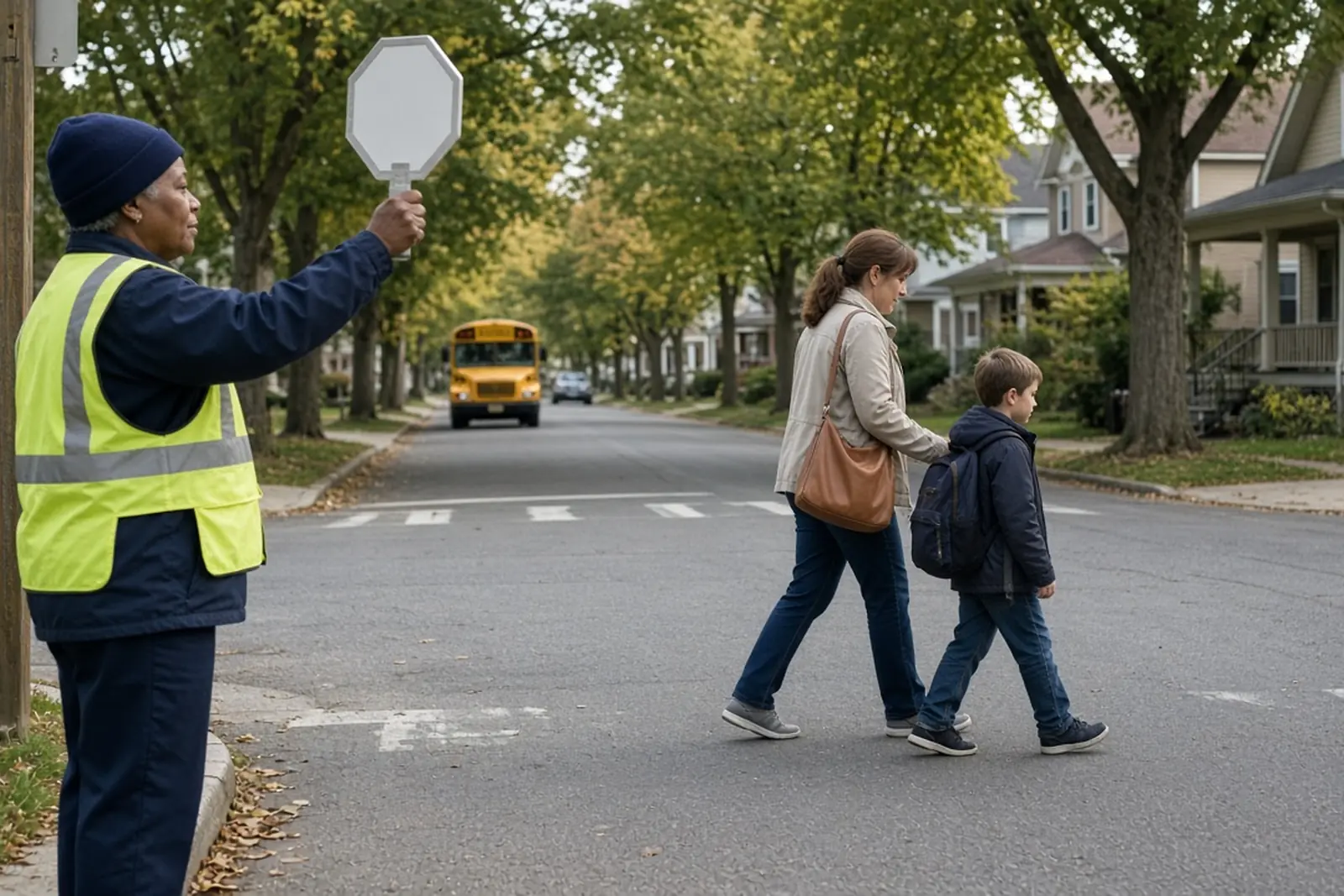
Drivers must yield to pedestrians crossing where there’s no working signal, must not pass a vehicle stopped at a crosswalk for a pedestrian, and must yield to pedestrians on sidewalks (KRS 189.570). Pedestrians have duties too. See our bicycle and pedestrian page.
Seat belts and child seats
Kentucky requires drivers and all passengers to wear seat belts, and requires child restraints and booster seats by height and age (KRS 189.125). Two points matter in injury cases:
Not wearing a seat belt “shall not constitute negligence per se,” and a child’s lack of a car seat or booster can’t be used as evidence in a civil case.
An insurer can still argue that not wearing a belt made an adult’s injuries worse. The Kentucky Supreme Court allows that argument only with competent evidence that it was a substantial factor in the injuries (Wemyss v. Coleman, 729 S.W.2d 174 (Ky. 1987)). It reduces damages; it doesn’t bar the claim. See our passenger injury page.
Duties after a crash
A driver in a crash involving injury or damage must stop, check on injuries, give reasonable help and share their registration number and names and addresses on request. On interstates and parkways, if nobody’s hurt, vehicles that can be moved should be moved off the road (KRS 189.580). The police report often records which laws the officer believed were broken. See how to get a Kentucky accident report.
Quick reference: Kentucky traffic laws in crash cases
Situation
Statute
Careless driving (general duty)
KRS 189.290
Right-of-way, stop and yield signs, turns
KRS 189.330
Traffic signals
KRS 189.338
Following, passing, lanes, left lane
KRS 189.340
Turn signals
KRS 189.380
Speed
KRS 189.390
Texting; drivers under 18
KRS 189.292; 189.294
School and church buses
KRS 189.370
Pedestrians
KRS 189.570
Emergency vehicles, move-over
KRS 189.930
Work zones
KRS 189.960
Seat belts and child seats
KRS 189.125
Duties after a crash
KRS 189.580
How Forman & Associates uses traffic laws to prove fault
We match the evidence to the rule: scene photos, video, phone records, vehicle data, the police report and witness statements. Then we show the jury which law was broken and why it caused the crash. Larry Forman has tried 50+ jury trials and won 95% of them. Learn more about Larry Forman, see our case results (past results don’t guarantee a similar outcome), or visit our main car crash page.
Kentucky traffic laws FAQs
Does a traffic ticket prove the other driver was at fault?
Not by itself, but the broken law behind the ticket can be strong evidence of fault. A driver who wasn’t ticketed can still be found at fault.
Who has the right-of-way at a four-way stop in Kentucky?
Each driver must stop and then yield to vehicles close enough to be an immediate hazard. If two arrive at about the same time, the driver on the left yields to the driver on the right.
Is it illegal to talk on the phone while driving in Kentucky?
For adults, texting, emailing and messaging are illegal while moving, but hand-held calls aren’t banned statewide as of October 2026. Drivers under 18 can’t use a phone at all except in an emergency.
Do I have to stop for a school bus on a four-lane road?
Yes, unless you’re going the opposite direction and the road is divided by a raised barrier or an unpaved median.
Can I still recover if I wasn’t wearing a seat belt?
Yes. Not wearing a belt isn’t negligence per se in Kentucky. It may reduce damages only if the defense proves it made your injuries worse.
What is Kentucky’s move-over law?
When approaching a stopped emergency vehicle with flashing lights or a disabled vehicle with warning signals, move over a lane if it’s safe on a four-lane road; otherwise slow down.
Talk to a Louisville car accident lawyer
If the other driver broke a traffic law and you were hurt, the clock is already running. See our statute of limitations guide, then get a free case evaluation or call (502) 931-6788. No fee unless we win. Our office is at 1139 S. 4th St., Louisville, KY 40203. More guides are in our Kentucky Injury Resource Center.
This page is general information about Kentucky law as of October 2026, not legal advice.