
Reviewed by Larry Forman, Attorney
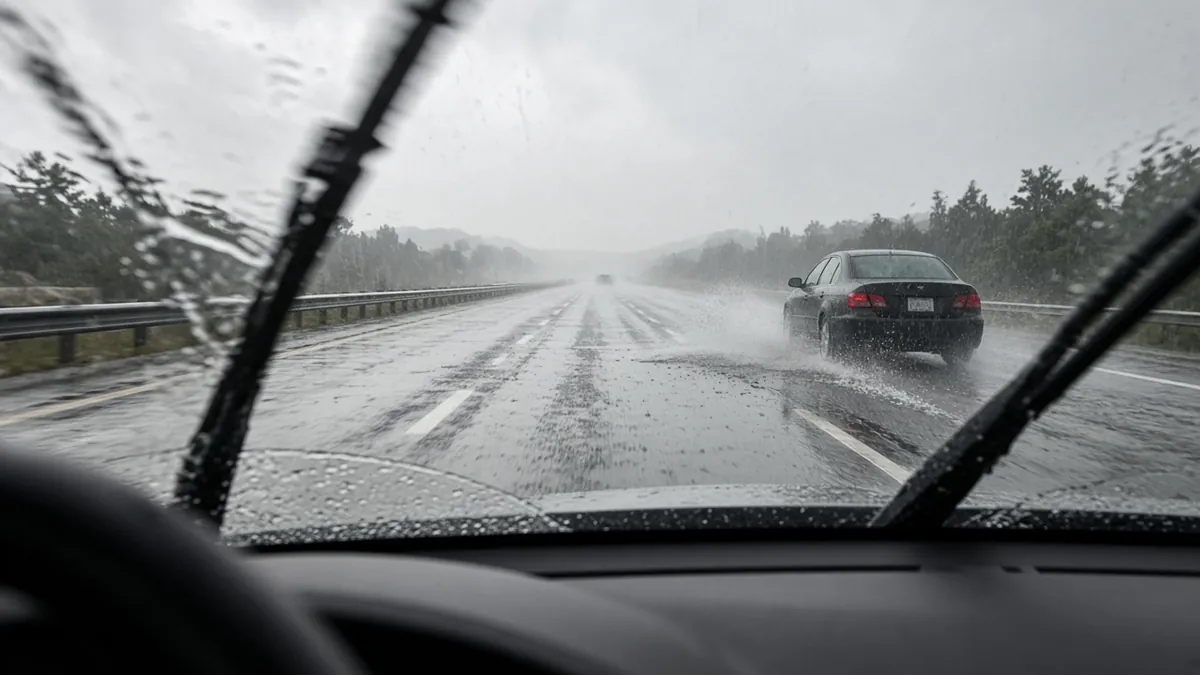
A hard rain can turn a Louisville interstate into a sheet of water in minutes. When a car's tires ride up on that water instead of gripping the road, the driver loses steering and braking all at once. If another driver's car slid into you in a hydroplaning accident, you'll probably hear that it was "just the weather." In Kentucky, that usually isn't a defense. Drivers have to adjust to the rain, and when they don't, they're responsible for what happens.
How common are wet-road crashes in Kentucky?
Very. In 2024, Kentucky State Police recorded 22,235 collisions on wet roads, nearly 1 in 5 of all crashes in the state, including 87 fatal crashes. Another 800 happened on standing or moving water. Officers also listed "too fast for conditions" as a factor in 3,487 collisions (KSP, 2024 Kentucky Traffic Collision Facts).
What causes hydroplaning?
Hydroplaning happens when water builds up in front of a tire faster than the tread can push it away, and the tire lifts onto a thin layer of water. The biggest factors are:
- Speed. The faster a car goes, the less time the tread has to clear water.
- Worn tires. Shallow tread can't channel water away.
- Low tire pressure, which changes how the tire meets the road
- Standing water, especially in ruts, low spots and poorly drained lanes
- Sudden moves, like hard braking or a quick lane change on a flooded stretch
Most of those are within a driver's control.
Is weather a defense?
Usually not. Kentucky's speed law doesn't stop at the posted limit. Drivers "shall not drive at a greater speed than is reasonable and prudent, having regard for the traffic and for the condition and use of the highway" (KRS 189.390(2)). Rain is a condition of the highway. A driver doing 70 in a downpour can be negligent even where 70 is legal.
Other rules apply in the rain too:
- Following distance. A driver can't follow "more closely than is reasonable and prudent, having regard for the speed of the vehicle and the traffic upon and condition of the highway" (KRS 189.340(9)(a)). Wet roads take longer to stop on, so the gap has to grow. See rear-end collisions.
- Headlights. Kentucky requires headlights at night and "at such other times as atmospheric conditions render visibility as low as or lower than" at night (KRS 189.030(1)(b)). Heavy rain can meet that test.
- Working wipers. Every windshield must have a device for clearing rain, controlled by the driver (KRS 189.110(11)).
Our Kentucky traffic laws guide covers the other rules of the road.
What about a "sudden emergency"?
The other driver's insurer may argue that hydroplaning was a sudden emergency the driver couldn't have prevented. Kentucky still recognizes that doctrine, but the Kentucky Supreme Court has said it "does not excuse fault; it defines the conduct to be expected of a prudent person in an emergency situation," and a jury hears about it only when the evidence supports it (Regenstreif v. Phelps, 142 S.W.3d 1 (Ky. 2004)). Rain that had been falling for an hour, on a road where other cars were slowing down, is rarely sudden. Evidence of the conditions and the driver's speed usually decides the issue.
Who is at fault in a hydroplaning accident?
Usually the driver who lost control, because the loss of control usually comes back to speed, following distance or tires. Fault can also fall on:
- A trucking company whose driver kept highway speed in a storm. Wet pavement is a common factor in jackknife truck accidents.
- The owner of the car, if bald tires or broken wipers were part of the cause
- Several drivers at once, in chain-reaction crashes. See multi-vehicle pileups.
- The government or a contractor, when the road itself caused the water to pool
Kentucky's pure comparative fault rule lets a jury split fault among everyone who contributed, and your damages are reduced only by your own share. See our Kentucky negligence law guide.
When the road is to blame
Some stretches flood every time it rains because of clogged drains, worn ruts, poor grading or a construction project that changed how water runs off. If a known drainage problem caused the water that made a car hydroplane, the road owner may share responsibility. These claims have special rules. For a defect in a city street, written notice must reach the city within 90 days (KRS 411.110). State roads go to a different forum with its own deadline and limits. See our road defect accident page.
Evidence that matters after a hydroplaning accident
- Photos and video of the water, the lane and the drains, taken as soon as it's safe. Puddles dry up fast.
- Weather records showing how long and how hard it had been raining
- The other car's tires, which show tread depth. The car has to be preserved before it's repaired or sold.
- Vehicle data and reconstruction showing speed before the slide. See accident reconstruction.
- Dashcam footage. See dashcam footage after a crash.
- The police report, which may note road conditions and speed. See how to get your accident report.
Our list of evidence to preserve after an accident has more.
Who pays your medical bills?
Kentucky's no-fault coverage pays first, no matter who caused the crash. See how Kentucky PIP works. After that, a claim against the at-fault driver's liability insurance can cover the rest. If the driver who slid into you kept going, your uninsured motorist coverage may help.
What to do after a hydroplaning accident
- Turn on your hazard lights and get to a safe spot if you can. Wet shoulders are dangerous.
- Call 911. Ask the officer to note the road conditions and any standing water.
- Take photos of the water, the lanes and both cars' tires.
- Get witnesses' names. Drivers who slowed down for the rain can describe how fast the other car was going.
- Get checked by a doctor. Symptoms like neck pain and concussion signs can show up later. See gaps in treatment and delayed symptoms.
- Don't accept "it was the weather" from an adjuster as the final word.
How Forman & Associates helps
We document the conditions before they change, preserve the vehicles and their tires, and use weather records and vehicle data to show how fast the other driver was going for the conditions. When a drainage problem played a part, we identify the road owner and its deadline right away. We prepare cases for trial from the start. Larry Forman has tried 50+ jury trials and won 95% of them. See our car crash lawyer page for more.
Rain and hydroplaning accident FAQ
Is the driver at fault if they hydroplaned into me?
Usually. Kentucky requires drivers to adjust speed and following distance to the conditions, so hydroplaning often means the driver was going too fast for the rain or had worn tires.
Can a driver blame the weather for a crash in Kentucky?
They can try, but rain is a condition drivers are expected to handle. A "sudden emergency" argument applies only when the evidence supports it, and steady rain is rarely sudden.
What if the road was flooded because of bad drainage?
The road owner may share responsibility. Claims over city streets require written notice within 90 days, and state roads follow different rules, so talk to a lawyer quickly.
Does Kentucky require headlights when it's raining?
Kentucky requires headlights whenever weather makes visibility as low as it is at night. Heavy rain can meet that standard, and a driver without lights may be partly at fault.
How long do I have to file a claim after a hydroplaning accident?
Generally two years from the crash or the last PIP payment for Kentucky car crash claims. Claims involving a defective city street need notice within 90 days.
Hurt in a hydroplaning accident?
Let us show what really caused it. Get a free case evaluation or call (502) 931-6788. No fee unless we win.
This post is general information about Kentucky law, not legal advice.