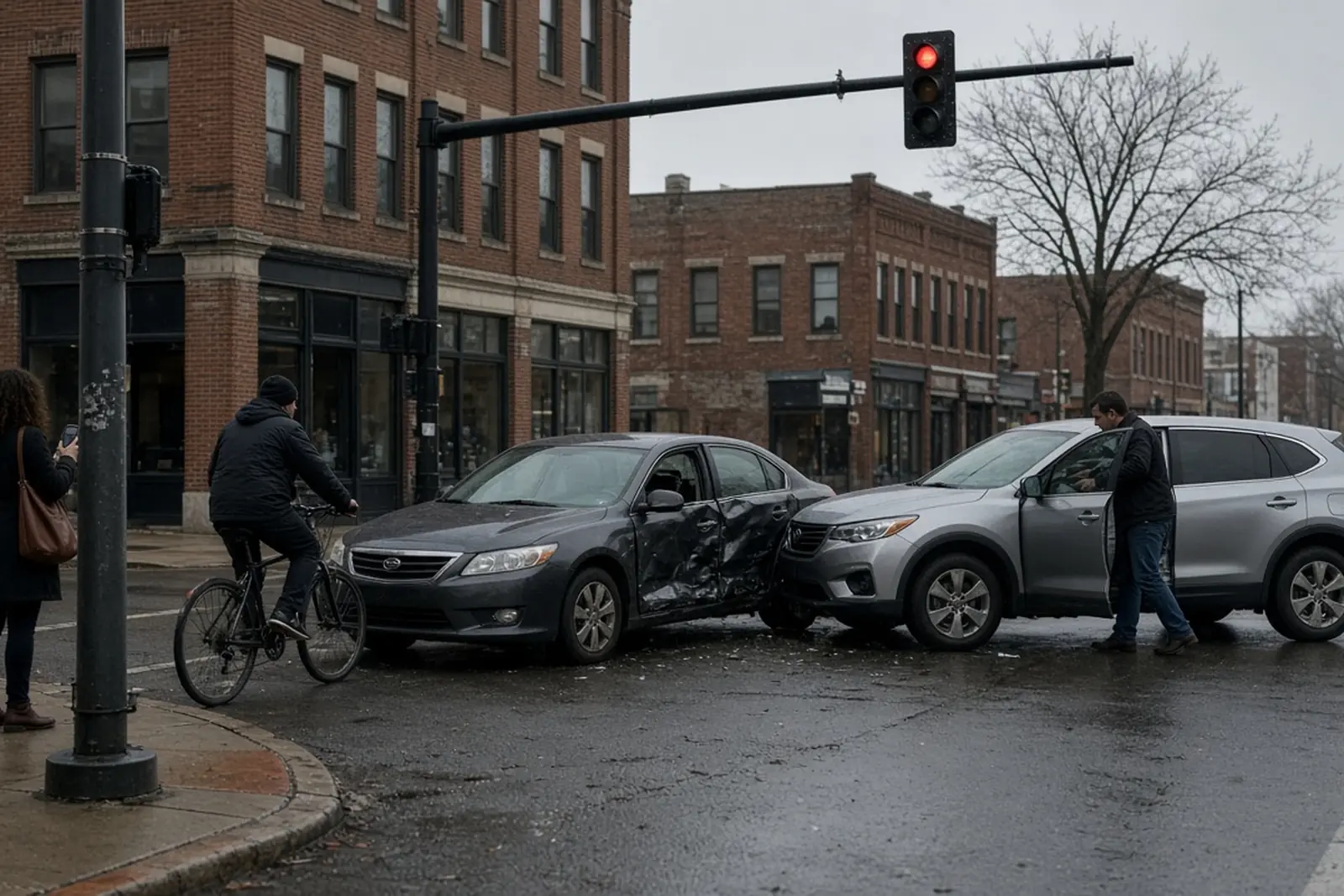
In a T-bone accident, the front of one vehicle slams into the side of another, usually in an intersection. There’s very little between the people on the struck side and the vehicle that hits them: a door, a window and a few inches of space. That’s why these crashes so often cause serious injuries, even at city speeds.
Forman & Associates represents people hurt in T-bone and side-impact crashes across Louisville and Kentucky. This page explains why these crashes are so dangerous, how Kentucky’s right-of-way laws decide fault, and the evidence to secure before it disappears.
How dangerous are side-impact crashes?
Kentucky State Police data shows these crashes are both common and deadly. In KSP’s 2024 Kentucky Traffic Collision Facts, angle collisions, the category that includes T-bones, made up about 32% of all two-vehicle collisions and about 44% of fatal two-vehicle collisions, the highest share of any crash type. See our Kentucky car crash statistics.
The reason is physics. The front of a car has a long crumple zone to absorb energy. The side doesn’t. Federal safety standards regulate side-impact protection specifically “to reduce the risk of serious and fatal injury to occupants … in side impacts” (FMVSS 214, 49 CFR 571.214). Side airbags and stronger doors help, but they can’t change how close the occupants sit to the point of impact.
Who is at fault in a T-bone accident?
“T-bone” describes what the crash looks like, not who caused it. Fault depends on who had the right-of-way. Our article on intersection crashes in Kentucky covers left turns and red lights in detail. In short:
Left turns. A driver turning left must yield to oncoming traffic that’s in the intersection or close enough to be an immediate hazard (KRS 189.330(9)).
Red lights. Traffic facing a steady red must stop and stay stopped until it gets a green (KRS 189.338). Even on a green, drivers must yield to vehicles and pedestrians lawfully in the intersection. A driver who entered on a green or yellow may finish a left turn after the light turns red.
Three more rules decide many T-bone cases:
Stop signs. A driver must stop, then yield to any vehicle in the intersection or approaching closely enough to be an immediate hazard (KRS 189.330(4)). Stopping isn’t enough. Pulling out into a gap that’s too small is a failure to yield.
Yield signs. If a driver goes past a yield sign without stopping and collides with a vehicle in the intersection, Kentucky law treats the collision as prima facie evidence that the driver failed to yield (KRS 189.330(5)).
Driveways and parking lots. A driver entering a road from anywhere other than another road, such as a driveway, gas station or shopping center exit, must yield to all vehicles on that road (KRS 189.330(10)). Many side-impact crashes on busy corridors happen exactly this way. See also our parking lot accident page.
A driver who violates a traffic statute and injures someone can be held liable for the resulting damages (KRS 446.070). But fault can be shared. A driver with the right-of-way who was speeding, distracted or “beating” a yellow may be assigned part of the fault under Kentucky’s comparative fault rule (KRS 411.182).
When someone besides the other driver is responsible
A malfunctioning signal, such as conflicting greens, a dark signal or bad timing, may point to the agency or contractor responsible for it. Claims against government bodies have special notice rules, deadlines and immunity issues. See our statute of limitations guide.
Blocked sightlines, from overgrown landscaping, a business sign or vehicles parked too close to a corner, may involve the property owner.
Commercial vehicles. When the vehicle that ran the light or stop sign was a work truck, delivery van or company car, the employer may be responsible and usually carries much more insurance. See our commercial vehicle crash page.
Intersection crashes often turn into one driver’s word against the other’s: “My light was green.” That’s why objective evidence matters, and much of it disappears quickly:
Video from intersection cameras, nearby businesses, buses, doorbells and dash cams. Many systems record over themselves within days.
Signal timing and phase records from the agency that maintains the light (usually Louisville Metro or the Kentucky Transportation Cabinet). These records show what each direction was showing and when, and they may not be kept indefinitely.
Vehicle data showing speed and braking in the seconds before impact.
Damage photos taken before the vehicles are repaired or salvaged. The intrusion into the passenger compartment helps prove both how the crash happened and how badly you were hurt.
Independent witnesses, including people waiting at the light.
Injuries depend heavily on where you were sitting:
On the struck side (near side): head injuries from hitting the window or door pillar, and traumatic brain injuries. Also rib fractures, collapsed lungs and internal injuries such as spleen or liver damage. Pelvis and hip fractures are common because the door is pushed in at hip level, along with shoulder injuries and broken bones in the arm and leg.
On the far side: being thrown sideways against the belt, the center console or another passenger, which causes neck, back and head injuries.
Children in the back seat are often on the struck side. Their injuries need careful follow-up even when they seem fine at first.
When a side-impact crash is fatal, the family’s claim is brought by the estate’s personal representative. See our wrongful death page.
Who pays after a T-bone accident
PIP pays up to $10,000 per person for medical bills and lost wages, regardless of fault. See how Kentucky PIP works.
The at-fault driver’s liability coverage pays for the rest of the losses it’s responsible for, up to its limits.
Your underinsured motorist coverage may pay when those limits fall short. See our underinsured motorist page.
Most Kentucky car crash claims must be filed within two years of the injury or the last PIP payment, whichever is later. Claims involving government agencies and wrongful death follow different rules. See our statute of limitations guide. The video and signal records in a T-bone case can be gone in days, so don’t wait.
How Forman & Associates handles T-bone accident cases
Send preservation requests for video, signal timing records and vehicle data
Reconstruct the timing to show who entered the intersection first and on what signal
Look beyond the other driver to employers, property owners and the agencies responsible for signals
Document injuries for the long term with your doctors
Prepare every case for trial. Larry Forman has tried 50+ jury trials and won 95% of them.
Usually the driver who failed to yield the right-of-way: by running a red light or stop sign, turning left in front of oncoming traffic, or pulling out of a driveway. Fault can be shared if the other driver was speeding or distracted.
Is the driver who hit the side of my car automatically at fault?
No. The shape of the crash doesn’t decide fault. It depends on who had the right-of-way, as shown by signals, signs, witnesses, video and vehicle data.
What if both drivers say they had a green light?
Then objective evidence decides it: video, signal timing records, independent witnesses and vehicle data. These can disappear quickly, so they need to be requested right away.
What if I went through on a yellow light?
A yellow is a warning that the light is about to turn red. Entering on a yellow isn’t necessarily a violation. But the other side may argue you should have stopped, and a jury can divide fault.
Why are T-bone crashes so dangerous?
The side of a vehicle has far less crush space than the front or rear, so the people on the struck side absorb more of the force. Head, chest, pelvis and internal injuries are common.
How long do I have to file a T-bone accident claim in Kentucky?
Generally two years from the injury or the last PIP payment. Government and wrongful death claims have different deadlines.
Hit from the side? Let’s talk
We’ll move quickly to lock down the video and signal records. Get a free case evaluation or call (502) 931-6788. No fee unless we win. Our office is at 1139 S. 4th St., Louisville, KY 40203.
This page is general information about Kentucky law as of October 2026, not legal advice.