
Reviewed by Larry Forman, Attorney
Golf carts feel harmless, but they have no doors, little protection and almost no crash structure. A golf cart accident can throw riders onto pavement, roll the cart on a slope, or leave a cart crushed by a car that never saw it. These crashes happen on golf courses, in subdivisions and lake communities, at campgrounds and events, and on public roads where cities allow them. Kentucky law on carts is patchy, and the insurance can be confusing, so knowing who's responsible matters.
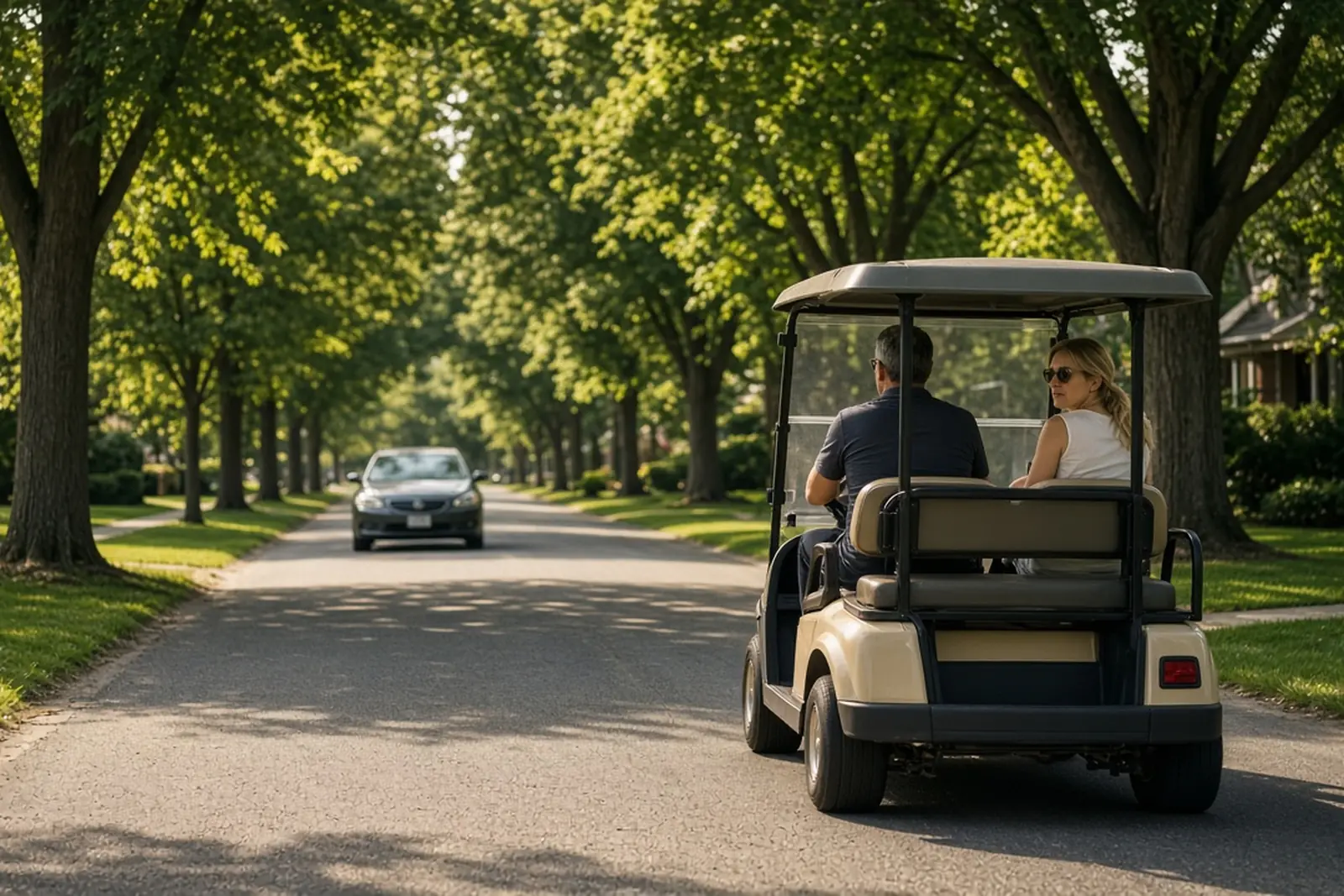
Serious injuries are common: head injuries, broken bones, and crush injuries in rollovers. Off-road side-by-sides and ATVs are a different vehicle; see our ATV injury lawyer page.
Only where a local government allows it. Under KRS 189.286, a city or county may pass an ordinance "specifying each roadway that is open for golf cart use." Where it does:
Local governments can add stricter rules. Check your city or county's ordinance before driving a cart on any public street.
That depends on where the golf cart accident happened and who was at fault:
Kentucky's pure comparative fault rule (KRS 411.182) means you can still recover if you were partly at fault, reduced by your share.
It isn't settled. Kentucky's no-fault law defines a "motor vehicle" as a vehicle that transports people or property "upon the public highways" (KRS 304.39-020(7)), and the golf cart statute requires carts on designated roads to be insured, but neither says whether a cart is a motor vehicle for PIP. If a car hit you, PIP from that car's policy or your own may apply. On a course or private property, it may not. See how Kentucky PIP works and our auto insurance coverage guide.
If the at-fault driver had no insurance, your own uninsured motorist coverage may help. Have every policy read before you give up on coverage.
Kids often ride or drive carts in neighborhoods, camps and at family events. A child's injury claim usually has to be approved by a court before it settles. See our minor settlement guide.
We look at every possible source of coverage, inspect the cart before it's repaired, and get course or community records about paths and rules. We prepare cases for trial from the start. Larry Forman has tried 50+ jury trials and won 95% of them. Learn more about Larry Forman or see our case results (past results don't guarantee a similar outcome).
Golf carts are not allowed on public roads in Kentucky unless the local government has passed an ordinance allowing them, and then only on roads it designates (KRS 189.286). The statute also lists equipment a cart must have to be driven on a road, including headlamps, tail lamps, stop lamps and turn signals, and it requires the driver to hold a valid license.
Those rules matter after a crash. A cart driven on a road where the city or county never allowed it, or without the required lights at night, can be evidence of fault. Ask the city or county clerk whether a golf cart ordinance exists and which roads it covers, and photograph the cart’s lights and equipment before it is repaired.
Fault is shared by percentage in Kentucky, so a rider’s own mistakes reduce but do not bar a claim (KRS 411.182).
Only on roads a city or county has opened by ordinance, with a permit, inspection, insurance and a licensed driver, on roads posted 35 mph or less.
Usually the car's driver, if they were careless. Their liability insurance applies, and your own coverage may also help.
Sometimes. Many policies limit coverage for motorized vehicles away from home. The policy wording decides it, so have it read.
Possibly, if unsafe paths, a poorly maintained cart or the course's rules contributed. A waiver you signed may not end the claim.
Your child may have a claim, and adults who let an unfit driver take the cart may share fault. Court approval is usually needed to settle.
It depends on the claim. Many Kentucky injury claims must be filed within one year, and car crash claims generally within two.
Let us sort out who's responsible and what coverage applies. Get a free case evaluation or call (502) 931-6788. No fee unless we win.
This page is general information about Kentucky law as of October 2026, not legal advice.