
Reviewed by Larry Forman, Attorney.
Mopeds are cheap to run and easy to park, and in Louisville they are everywhere from the Highlands to the university. They also leave riders with almost no protection when a car turns in front of them. Kentucky treats mopeds differently from cars and motorcycles in ways that change who pays your medical bills and how your claim works.
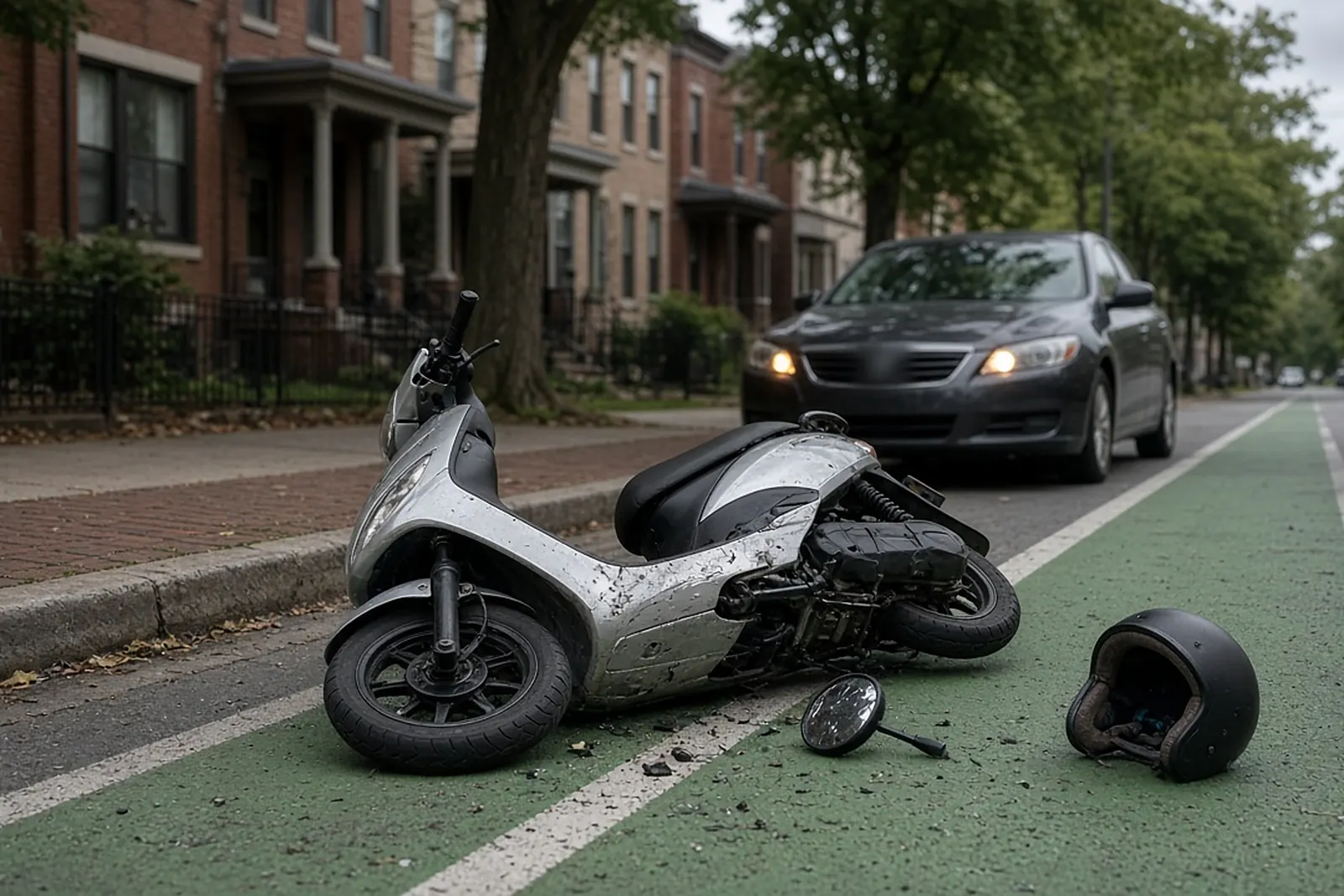
Under KRS 186.010, a moped is a motorized bicycle (with pedals, or a step-through frame) that has:
A scooter that goes faster or has a bigger engine is generally a motorcycle under Kentucky law, with motorcycle registration, insurance and helmet rules. Whether your vehicle is a “moped” or a “motorcycle” can change your claim, so we pin that down first. Bring the make, model and any paperwork you have.
Kentucky’s no-fault law excludes mopeds from the definition of “motor vehicle” (KRS 304.39-020(7)). That has an important consequence: when a car hits a moped rider, the rider is generally treated like a pedestrian. In Howard v. Hicks, 737 S.W.2d 711 (Ky. App. 1987), the Court of Appeals treated a moped rider hit by a truck as a pedestrian. A pedestrian’s PIP comes from the insurance on the vehicle that struck them, up to $10,000 (KRS 304.39-050). See how Kentucky PIP insurance works.
Beyond PIP, the at-fault driver’s liability insurance pays for pain and suffering, lost income and the rest of your losses. If that driver had no insurance or too little, your own auto policy’s uninsured or underinsured motorist coverage may apply. Insurers sometimes test these points, so expect pushback.
Moped riders often suffer head injuries, broken bones, road rash and knee and shoulder injuries. Kentucky uses pure comparative fault: if you share some blame, your recovery is reduced by your share but not wiped out (KRS 411.182).
Most Kentucky motor vehicle injury lawsuits must be filed within two years after the injury or the last PIP payment, whichever is later (KRS 304.39-230(6)). Because mopeds sit in a gray area of the no-fault law, the right deadline can be argued. Don’t wait. Call as soon as you can.
Related pages: motorcycle accident lawyer, e-bike accident lawyer, e-scooter crash lawyer and Kentucky motorcycle and bicycle laws.
Not for a vehicle that meets Kentucky’s moped definition (50 cc or less, automatic, top speed of 30 mph or less). Faster scooters are treated as motorcycles and need registration and insurance.
Kentucky’s no-fault law doesn’t treat mopeds as motor vehicles, and a Kentucky court has treated a moped rider as a pedestrian. That generally means PIP comes from the vehicle that hit you, up to $10,000, and the at-fault driver’s liability insurance covers the rest.
Kentucky’s helmet law is written for motorcycles. A qualifying moped rider isn’t required to wear one, but not wearing one can come up in arguments about a head injury.
No. Mopeds can’t be ridden on limited-access highways.
Tell us what happened. We’ll explain your options and what to do next. The consultation is free.
Get a free case evaluation or call 502-931-6788. Our office is at 1139 S. 4th St., Louisville, KY 40203.
This page is general information about Kentucky law as of October 2026, not legal advice. Every case is different.