
Reviewed by Larry Forman, Attorney.
Log trucks carry massive, heavy loads from Kentucky forests to mills, often on narrow rural roads and from unpaved logging roads onto highways. When tie-downs fail or a load shifts, logs can roll off or the truck can overturn. Forman & Associates represents people hurt in a logging truck accident anywhere in Kentucky.
Key takeaways
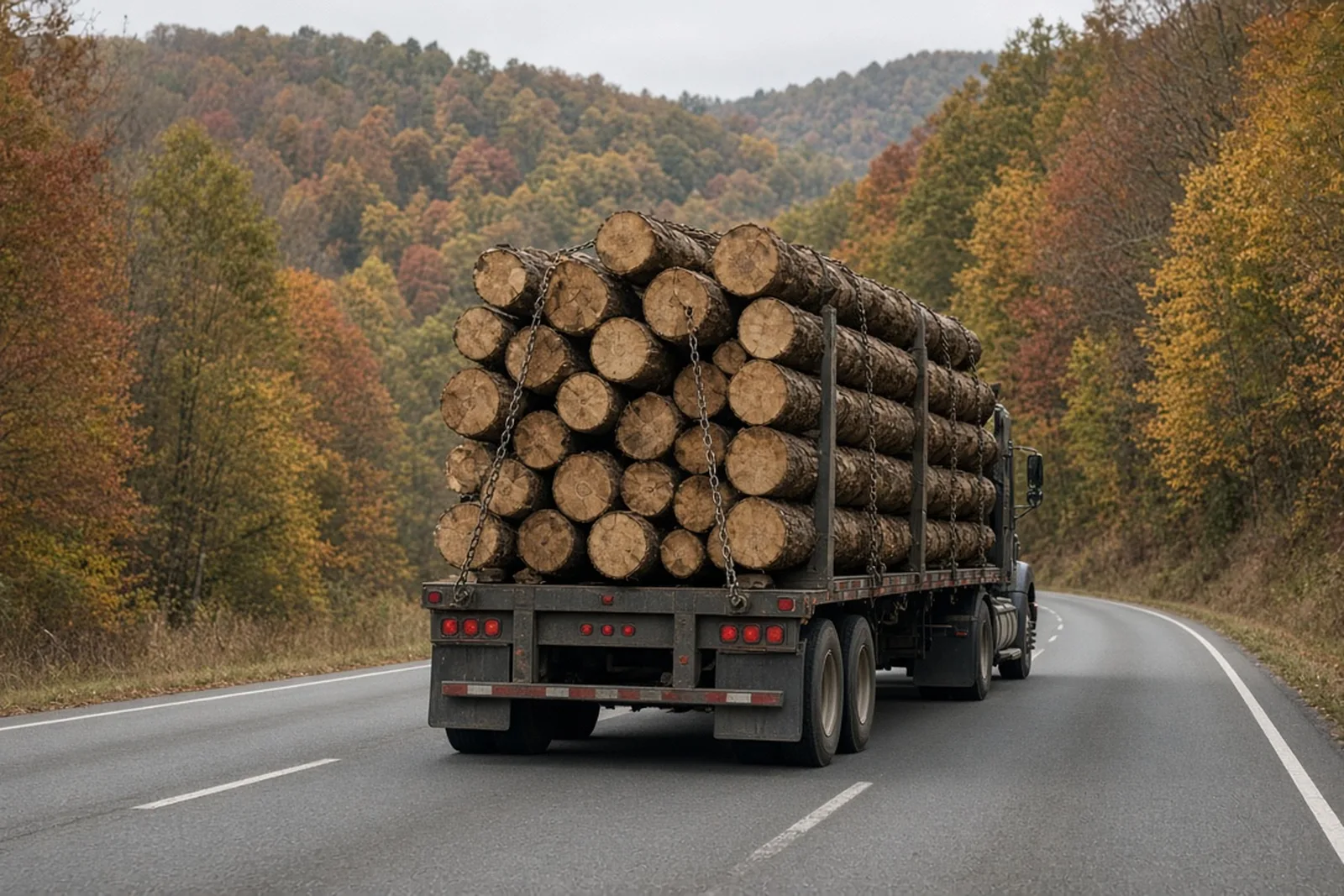
Federal regulations set out specific securement requirements for logs on commercial vehicles, including how logs are cradled and how many tiedowns are needed (49 CFR § 393.116). Kentucky also prohibits driving any vehicle loaded so that its contents can drop or shift (KRS 189.150).
Kentucky law gives some vehicles hauling primary forest products, such as logs, from their point of origin to first market certain weight allowances off the interstates (KRS 189.222). Those allowances aren’t a license to overload, and they don’t change the duty to secure the load.
Trucking cases often involve more than the driver: the motor carrier, the company that loaded the truck, a broker, a maintenance shop or a parts manufacturer may share responsibility. See trucking company liability and black box evidence.
In logging cases, that may include the trucking company or owner-operator, the logging contractor that loaded the truck and, depending on the facts, the mill or landowner that arranged the haul.
Most Kentucky motor vehicle injury claims must be filed within two years of the crash or the last PIP payment, whichever is later (KRS 304.39-230). Wrongful death and claims against government entities can follow different rules. Estimate your dates with our statute of limitations calculator, then confirm them with a lawyer.
Usually the hauler, and possibly whoever loaded and secured the logs.
Many are, when operating in interstate commerce above federal thresholds. Kentucky law applies on Kentucky roads either way.
Drivers entering a roadway from a private road or driveway must yield to traffic on the highway (KRS 189.330(10)).
Yes. We represent clients across Kentucky.
We investigate the load, the securement and every company involved.
Get a free case evaluation or call 502-931-6788.
This page is general information about Kentucky law as of October 2026, not legal advice. Every case is different.