
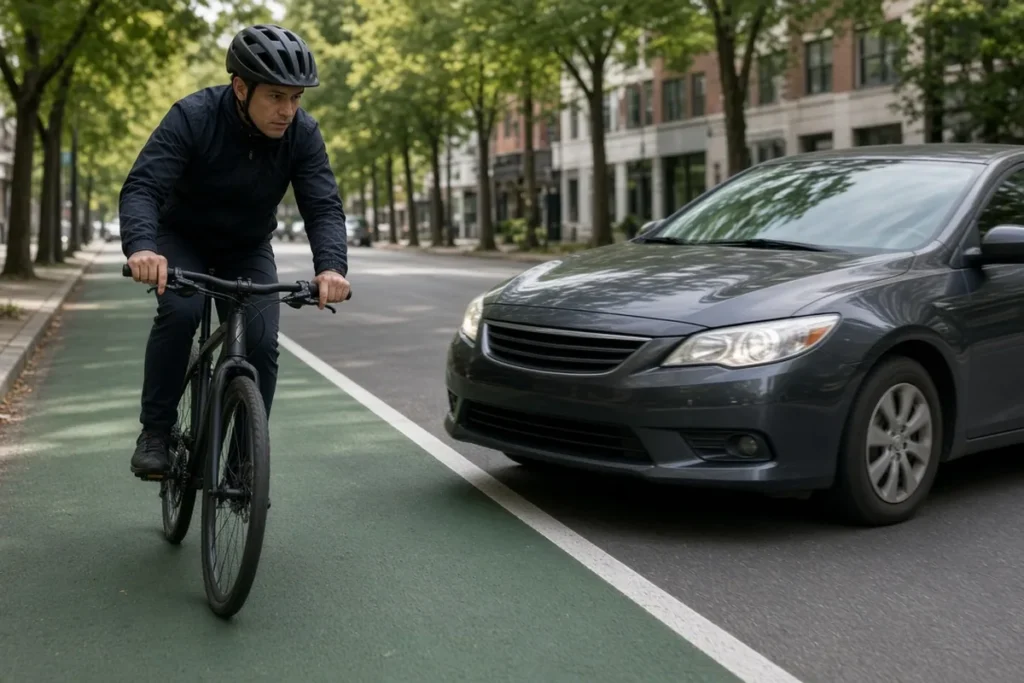
A car weighs a couple of tons. A bike and rider weigh a fraction of that, with no airbags, no seat belt and no steel frame around them. When a driver turns across your path, passes too close or opens a door into the bike lane, the injuries are serious, and the insurance company starts arguing about your lane position, your lights and your helmet almost immediately.
A Louisville bicycle accident lawyer at Forman & Associates Accident Injury Lawyers answers those arguments with evidence and Kentucky law, and builds every case as if a jury is already watching. Free consultation. No fee unless we win.
Reviewed by Larry Forman, Attorney
You may have a claim when someone else’s carelessness caused your crash: a driver who turned across the bike lane, passed too close, pulled out of a driveway without looking, ran a light or opened a door into your path. Claims can also involve a dangerous road, a defective bike part or another rider.
Kentucky treats a bicycle on the road much like a vehicle: it is “operated in the same manner as a motor vehicle,” with special rules for shoulders and bike lanes (601 KAR 14:020 § 7). That cuts both ways. Drivers must share the lane and yield to you like any other traffic, and insurers will look for any rule you didn’t follow.
Under Kentucky’s pure comparative fault rule (KRS 411.182), you can recover even if you share some of the blame; your award is reduced by your share, not wiped out. Learn how pure comparative fault works.
Riding an e-bike? See our e-bike accident lawyer page, because e-bikes raise extra questions about PIP and deadlines. Hit while walking or running? See our Louisville pedestrian accident lawyer page. Scooter riders: e-scooter and micromobility crashes.
Hurt on a bike in Louisville or anywhere in Kentucky? Talk with a bicycle accident lawyer on our team today. Every case is reviewed at no charge, and we never collect a fee unless we win.
The driver’s insurer opens a file right away. Adjusters ask for recorded statements while you’re still hurting and comb the police report for anything that shifts blame to you: “no lights,” “not in the bike lane,” “came out of nowhere.”
From the day we take your case, we send preservation letters, document the scene and identify every policy that could apply. See evidence to preserve after an accident and how to get a Kentucky accident report.
Get checked right away, even if you rode home. Head and wrist injuries are easy to underestimate (see traumatic brain injury). Call the police so there is a report, and get the driver’s name, insurance and plate.
Photograph the vehicle, the bike lane or shoulder, signals, your bike and your injuries. Note any business or home cameras nearby. Keep the bike and helmet as they are.
Don’t give a recorded statement or sign a release first. A bicycle accident lawyer can handle the PIP, liability and uninsured motorist claims while you heal.
Most serious bicycle crashes start with a driver’s mistake. If any of these played a role, you may have a strong claim.
A driver passes you and turns right across your path, or turns left in front of you at an intersection. These are among the most common crashes on Louisville arterials.
A driver overtaking a bicycle must move into another lane when one is available and it's safe, or leave at least three feet of clearance (KRS 189.340(2)).
A driver or passenger opens a car door into the bike lane without looking. Kentucky's bike-lane rule lets riders move left to avoid the door zone for exactly this reason.
Phones and screens pull a driver's eyes off the road. We move fast on phone and vehicle data. See distracted driving accidents.
Drivers pulling out of driveways, parking lots and side streets look for cars, not cyclists, and pull across the bike lane or shoulder.
Drivers in an injury crash must stop and help (KRS 189.580). If the driver fled, see our hit-and-run accident page.
Every driver must operate carefully and with regard for traffic and road conditions (KRS 189.290). Speed shortens reaction time and makes every impact worse.
Drivers who are distracted or speeding run down riders from behind, especially on unlit roads and at dusk. Lights and reflectors become a key fight in these cases.
Potholes, debris, drain grates and broken pavement can throw a rider. Claims over public roads have special notice rules. See road defect accidents.
Louisville Metro adds its own rules on top of state law:
Crashes cluster where bikes meet heavy traffic: Bardstown Road and Frankfort Avenue, with parked cars and constant turns across bike lanes; Main and Market downtown; Broadway; River Road; Dixie Highway; and Louisville Loop crossings where the path meets the street grid. Statewide, Kentucky recorded 454 collisions involving pedalcyclists in 2024 (Kentucky crash statistics).
A Louisville bicycle accident lawyer knows where local proof lives: LMPD crash reports, 911 records and business video along these corridors.
Kentucky’s bicycle regulation (601 KAR 14:020) is where most fault arguments start. A rider may use the shoulder. Where a lane is marked for bicycles, the rider generally must use it, except to turn left, pass, avoid a hazard, avoid the door zone of a parked car, or at a driveway or intersection where cars may turn right across the bike lane (§ 7(1)). In a shared lane, a rider keeps to the right, but may move left when the lane is less than 14 feet wide, to prevent unsafe passing, near right-turn conflicts, to avoid hazards, or when keeping pace with traffic (§ 7(3)). No more than two riders may ride abreast in a lane (§ 7(2)).
A driver overtaking a bicycle in the same direction must move into another lane when one is available and it’s reasonably safe. If not, the driver must pass with at least three feet between the vehicle and the bicycle and keep that distance until safely past (KRS 189.340(2)).
When lights are required, a bike needs a front light visible for 500 feet and a rear red light visible for 500 feet; on a highway or shoulder it also needs a rear red reflector or light visible for 100 feet (601 KAR 14:020 § 2). Insurers use a missing light to argue comparative fault. It reduces a claim at most. It doesn’t erase the driver’s duty to look.
Kentucky has no statewide helmet law for adult cyclists. An insurer may still argue a helmet would have lessened a head injury; under pure comparative fault that can reduce a recovery, not bar it. See Kentucky motorcycle and bicycle laws.
A cyclist isn’t “making use of a motor vehicle,” so Kentucky’s no-fault law treats you as a pedestrian. Your PIP comes from the insurance on the vehicle that struck you, up to $10,000. If that insurer doesn’t pay within 30 days of reasonable proof, you can claim under your own household policy (KRS 304.39-050). If no policy applies, Kentucky’s assigned claims plan may (KRS 304.39-160). More: how Kentucky PIP works.
Kentucky auto policies must include uninsured motorist coverage unless a named insured rejected it in writing (KRS 304.20-020). Your household’s uninsured and underinsured motorist coverage often protects you on a bike, too. Check the declarations page before you assume you have no coverage.
With a car or truck involved: generally two years from the injury or the last PIP payment, whichever is later (KRS 304.39-230(6)). Without one, such as a pothole crash or a collision with another rider: generally one year (KRS 413.140(1)(a)). A defective city street may require written notice within 90 days (KRS 411.110). See the statute of limitations guide.
Every file a bicycle accident lawyer builds starts here:
Bicycle crashes cause head injuries, broken collarbones and wrists, road rash, spinal injuries and internal injuries. Early offers rarely reflect that. Recoverable damages in a Kentucky case can include:
Don’t accept the first offer until you know the full medical picture and have talked with a bicycle accident lawyer about what the claim is worth. We also resolve medical liens.
Insurers settle bicycle claims differently depending on who represents the rider. When the other side knows your bicycle accident lawyer prepares every case for trial, the conversation about what your claim is worth changes.
Larry Forman has tried 50+ jury trials and won 95% of them. Insurers know which lawyers will go to court, and it shows in how they negotiate.
Video, ride data, the bike and the vehicle: we send preservation demands and start our own investigation the day we take your case.
Lane position, lights, helmets and "came out of nowhere": we answer each one with Kentucky's bike rules, scene measurements and reconstruction.
The driver's liability coverage, PIP, and your household uninsured and underinsured motorist coverage. Riders are often covered by more than they think.
You pay nothing up front. We advance case costs, and we're paid only if we recover money for you.
Larry Forman's videos have been viewed hundreds of millions of times. He knows how to explain your case clearly to a judge, a jury or an adjuster.
Over $5,000,000 recovered for injured people.
Past results do not guarantee, predict or warrant a similar outcome in any future case. Each case depends on its own facts and the law.
It helps to talk with one first. The adjuster's job is to limit what the company pays, and a recorded statement can be used to argue you were outside the bike lane or hard to see. A consultation is free, and we never collect a fee unless we win.
Usually, yes. A cyclist isn't using a motor vehicle, so Kentucky treats you like a pedestrian and PIP comes from the striking vehicle's insurance, up to $10,000. If that insurer doesn't pay within 30 days, your own household policy may pay.
Yes. Kentucky has no statewide helmet law for adult cyclists. An insurer may argue a helmet would have lessened a head injury, but under pure comparative fault that can reduce a recovery, not eliminate it.
You may still have a strong claim. Kentucky lets riders leave the bike lane to turn, pass, avoid hazards or avoid the door zone, and state rules allow sidewalk riding unless a local law says otherwise. Louisville bars sidewalk riding for riders 11 and older. Either way, it's a comparative fault argument, not a bar.
A driver overtaking a bicycle must change lanes when one is available and it's safe. Otherwise the driver must leave at least three feet and keep that distance until safely past.
Possibly. Kentucky requires a front light and a rear red light when lights are needed, and the insurer will raise it. But drivers still have to drive carefully and watch the road. A missing light can reduce a recovery; it doesn't automatically end the claim.
Report it to the police right away. Your household's uninsured motorist coverage may pay, depending on the policy, and PIP may come from your household policy or Kentucky's assigned claims plan.
Generally two years from the injury or last PIP payment if a motor vehicle was involved, and one year if not. A claim over a defective city street can require written notice within 90 days.
Talk to a Louisville bicycle accident lawyer before you give a statement, sign a release or let anyone repair your bike. A free consultation with Forman & Associates Accident Injury Lawyers costs you nothing.
Forman & Associates Accident Injury Lawyers
1139 S. 4th St., Louisville, KY 40203
Phone: (502) 931-6788 · Fax: 419-574-7156
Email: larry@larryformanlaw.com
This page is general information about Kentucky law and Louisville ordinances as of October 2026, not legal advice.