
Reviewed by Larry Forman, Attorney
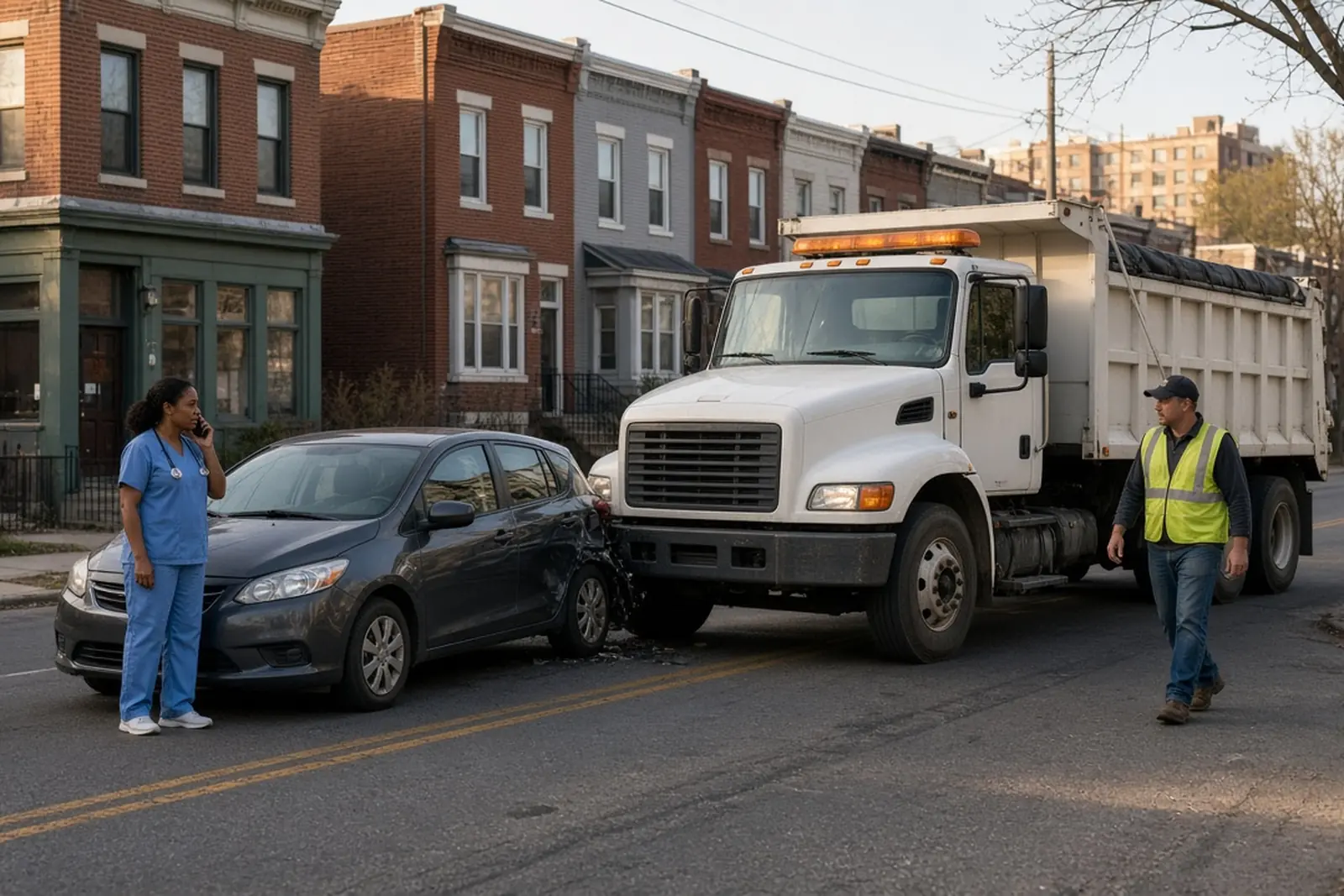
A government vehicle accident starts out like any other crash: a city truck runs a light, a police cruiser turns across your lane, a state work truck drifts out of its lane. What happens next is different. Depending on which government owns the vehicle, your claim may go to a special state board instead of a jury, face damage caps, or run into immunity that blocks a suit entirely. And some of the deadlines are shorter than the usual two years.
Forman & Associates represents people hurt by public vehicles in Louisville and across Kentucky. This page explains how claims against the state, cities, counties, Louisville Metro and the federal government differ, and what to do in the first few weeks.
Kentucky State Police counted 1,249 emergency vehicles and another 225 other publicly owned vehicles involved in crashes in 2024 (KSP 2024 Kentucky Traffic Collision Facts). That doesn’t count buses, which have their own page: see TARC and school bus accidents and our bus wreck page.
The first question in every case is who owns the vehicle and who employs the driver. The answer decides where the claim goes and what you can recover.
| Vehicle owner | Examples | Where the claim goes | Key limits |
|---|---|---|---|
| The Commonwealth (state) | KYTC trucks and snowplows, Kentucky State Police cruisers, state agency cars, state university vehicles | Kentucky Board of Claims | 1-year filing deadline, $250,000 cap, no pain and suffering |
| A city (other than Louisville Metro) | Police, fire and public works vehicles in Jeffersontown, St. Matthews, Shively and other cities | Circuit court | Cities generally can be sued for negligent driving |
| A county | Sheriff’s and road department vehicles | Usually a suit against the driver, plus the county’s vehicle insurance | Counties keep immunity |
| Louisville Metro Government | LMPD cruisers, Metro Solid Waste and Public Works trucks | Usually a suit against the driver | Metro has the same immunity as a county |
| The federal government | Postal trucks, federal agency vehicles | Written claim to the agency first, then federal court | 2-year claim deadline, no jury |
Negligence claims against the Commonwealth and its agencies go to the Kentucky Board of Claims, which has “primary and exclusive jurisdiction” over claims that a state employee negligently performed a ministerial act (KRS 49.070). Driving a vehicle is the classic ministerial act. The Board’s rules are very different from a jury trial:
Whether you can also sue the state employee personally in circuit court, where pain and suffering is recoverable, is an unsettled question under the current version of the Board of Claims Act. It’s one of the first things we analyze, because it can change the value of the case.
Kentucky’s highest court abolished general city tort immunity decades ago (Haney v. City of Lexington, 1964). Under Kentucky’s Claims Against Local Governments Act, cities remain liable for “negligence arising out of acts or omissions of its employees in carrying out their ministerial duties” (KRS 65.2003). Driving is ministerial, so a crash caused by a careless city driver generally proceeds like an ordinary negligence case. Damages are reduced by any fault the jury assigns to others (KRS 65.2002).
Counties keep their sovereign immunity (KRS 65.2001(2)), and the law gives Louisville Metro “the same sovereign immunity granted counties” (KRS 67C.101). Claims against counties can’t go to the Board of Claims, either. That doesn’t leave you without a remedy:
Crashes with federal vehicles fall under the Federal Tort Claims Act. You must first present a written claim to the agency within two years, then sue within six months after a written denial (28 U.S.C. 2401(b)). The claim must state a specific dollar amount, and a later lawsuit generally can’t ask for more (28 U.S.C. 2675). A judge, not a jury, decides the case, and punitive damages aren’t available (28 U.S.C. 2674).
Emergency vehicles running lights and sirens may exceed the speed limit, go through red lights after slowing, and use the wrong side of the road when lanes are blocked. But Kentucky law repeats, again and again, that none of that relieves the driver of “the duty to drive with due regard for the safety of all persons” (KRS 189.940). The privileges also apply only when the warning lights, and usually the siren, are actually on.
So the key questions are whether the vehicle was truly on an emergency run, whether lights and siren were working, how fast it entered the intersection, and whether you had a fair chance to see and hear it. Dash camera and body camera video, computer-aided dispatch logs and the vehicle’s own data usually answer them. Those records have to be requested quickly.
Large public trucks make wide turns, back up constantly and stop without warning. Many crashes involve a truck backing into a car or pedestrian, swinging into the next lane on a turn, or pulling away from the curb into traffic. The same evidence rules apply as in any commercial vehicle crash: cameras, GPS route data, maintenance records and the driver’s training file. When a private contractor operates the route, the contractor is a private company and doesn’t share the government’s immunity. The same is true of private companies running delivery vehicles under government contracts.
If a dangerous road, not a driver, caused the crash, the rules shift again. See our road defect accident page. When a crash with a public vehicle is fatal, see our wrongful death page. Spouses’ and children’s claims are explained in our loss of consortium guide.
Learn more about Larry Forman, see our case results (past results don’t guarantee a similar outcome), or visit our main car crash page.
Usually, yes. Kentucky cities can generally be held liable when an employee drives negligently. Louisville Metro is different: it has county-level immunity, so the claim usually proceeds against the driver, whose judgment Metro generally must pay.
Not in regular court. Claims that a state employee drove negligently go to the Kentucky Board of Claims, which must receive the claim within one year, caps awards at $250,000 per claim and can’t award pain and suffering.
The emergency privileges in KRS 189.940 apply only when the required warnings are given, and even then the officer must drive with due regard for everyone’s safety. Driving a cruiser is a ministerial act, so the officer isn’t shielded by official immunity.
Yes, and it may be short: one year for the Board of Claims, two years for a written federal claim. Cities also have a 90-day notice rule for road defects (not driver negligence). Get advice early.
PIP pays first, up to the policy’s limits, no matter who was at fault. If you were riding in the government vehicle, its coverage pays first. Otherwise your own policy does.
That claim is against the United States. You must file a written claim with the Postal Service within two years and state an exact dollar amount before you can sue in federal court.
We’ll identify the right agency, forum and deadline in our first conversation. Get a free case evaluation or call (502) 931-6788. No fee unless we win. Our office is at 1139 S. 4th St., Louisville, KY 40203.
This page is general information about Kentucky law as of October 2026, not legal advice.