
Reviewed by Larry Forman, Attorney
Some of the most dangerous injuries after a crash are the ones you can’t see. You walk away from the wreck. You tell the officer you’re fine. Hours later, your belly feels tight and you’re dizzy when you stand up.
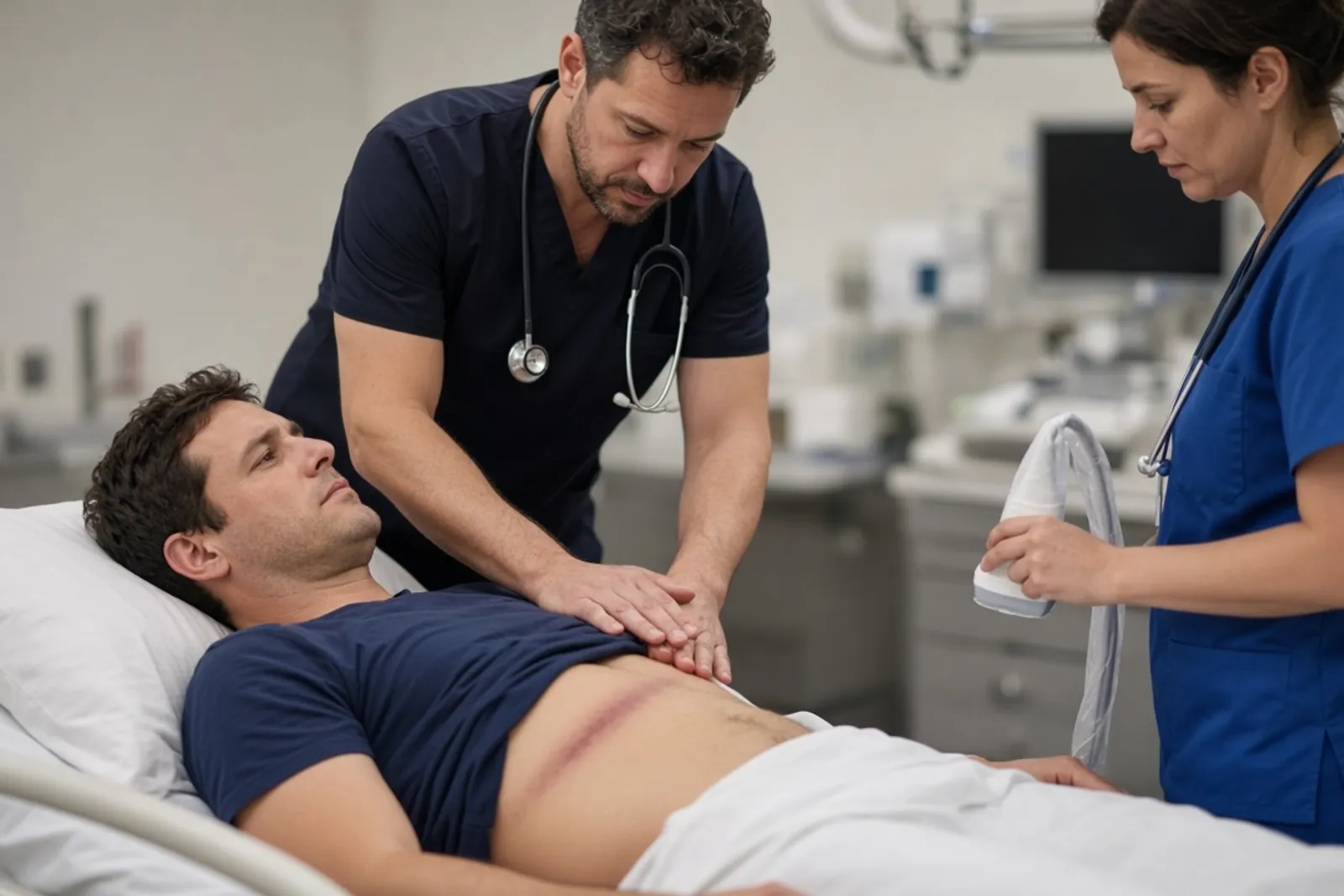
Internal injuries, such as bleeding, a torn spleen or liver, or damage to the bowel, can be life-threatening and can take time to show themselves. This page explains the warning signs, how these injuries are diagnosed and treated, and what Kentucky law means for your claim, including what happens if a hospital misses the injury.
If you have signs of internal bleeding after an accident (dizziness, fainting, shortness of breath, a fast heartbeat, a swollen or rigid belly, or blood in your urine, stool or vomit), call 911 or go to the emergency room now.
“Internal injuries” covers damage inside the body’s chest, abdomen and pelvis. After a blunt impact, the most common concerns are:
Bleeding inside the skull is a brain injury and is covered on our traumatic brain injury page.
Cleveland Clinic explains that a person may have no symptoms with smaller blood loss. As bleeding increases, early signs can include:
More severe blood loss can cause confusion, seizures, loss of consciousness and shock. Cleveland Clinic also lists location-specific signs:
Don’t wait these out. Cleveland Clinic advises calling 911 or going to the emergency room for these symptoms.
Seat belts save lives. StatPearls notes the National Highway Traffic Safety Administration estimates they reduce the risk of fatal injury by about 43%. But in a violent crash, the belt transfers enormous force to the body.
StatPearls describes “seat belt syndrome” as a range of injury patterns, from bruising and scrapes along the path of the belt (the “seat belt sign”) to intra-abdominal injuries, collapsed lung and spinal fractures. It notes:
If you have a seat belt bruise across your belly or chest, make sure a doctor sees it, and photograph it.
StatPearls describes how trauma teams evaluate these patients: checking airway, breathing and circulation; monitoring vital signs closely; using bedside ultrasound (a FAST exam) for unstable patients; and using CT scans, which play a vital role in blunt trauma when the patient is stable enough.
Cleveland Clinic explains treatment depends on the cause and severity and may include surgery, IV fluids and blood transfusions. Minor bleeding can sometimes stop on its own, but moderate to severe internal bleeding needs immediate hospital treatment.
In Louisville, UofL Health – UofL Hospital describes itself as the region’s only American College of Surgeons–verified adult Level I trauma center and one of two in Kentucky.
Many spleen injuries are now treated without removing the spleen. StatPearls explains that nonoperative care, sometimes with a procedure to block the bleeding vessel (embolization), is the standard for stable patients. When the spleen must be removed, StatPearls notes the patient faces a lifelong increased risk of serious infection and needs specific vaccinations. Those future medical needs belong in any claim.
Recovery depends on the injury. Some people go home after observation. Others need surgery, a stay in intensive care, follow-up imaging, and weeks or months before returning to work. StatPearls notes some patients benefit from physical, occupational or psychological therapy afterward, including support for post-traumatic stress. See our page on PTSD and emotional distress.
Internal injuries can be hard to spot early. But when warning signs were there and a provider didn’t act, a delayed diagnosis can turn a treatable injury into a much worse one.
If that happens, you may have two claims: one against whoever caused the crash, and a medical negligence claim against the provider. These cases are complex and require medical review. Read medical malpractice after a car accident and our medical malpractice page.
Kentucky’s deadline for negligence claims against a physician, surgeon or licensed hospital is generally one year. The clock starts when the injury is first discovered or reasonably should have been discovered, but the claim must be filed within five years of the negligent act (KRS 413.140(1)(e) and (2)).
Your PIP coverage pays up to $10,000 per person for medical bills, lost wages and similar losses regardless of fault (KRS 304.39-020(2)). An ambulance ride, a CT scan and a night of observation can use much of that, and surgery can exceed it. See how Kentucky PIP works and the 2026 PIP changes.
To claim pain and suffering from the at-fault driver, your injury must meet Kentucky’s threshold: more than $1,000 in medical expenses, or an injury such as a fracture, permanent injury, permanent loss of bodily function, loss of a body member, or death (KRS 304.39-060(2)(b)). Most internal injury cases easily exceed $1,000 in medical expenses.
Kentucky’s minimum auto liability coverage is $25,000 per person and $50,000 per accident for bodily injury (KRS 304.39-110). Trauma surgery and a hospital stay can exceed that. We look for every policy, including your own underinsured motorist coverage. Learn the difference between UM and UIM coverage.
Kentucky’s pure comparative fault rule reduces your recovery by your share of fault but doesn’t eliminate it (KRS 411.182).
No one can value a claim from a diagnosis alone. The specifics of your injury, treatment, recovery, the evidence of fault and the available insurance all matter.
We gather the medical records, review whether there were missed warning signs, identify every responsible party and every insurance policy, and work with your doctors to explain the injury and your recovery. We prepare each case as if it’s going to trial. Larry Forman has tried 50+ jury trials. Learn more about Larry.
Symptoms can be delayed. Cleveland Clinic explains internal bleeding can build slowly, StatPearls notes some lab values may be normal in the first few hours after severe trauma, and StatPearls also reports delayed splenic rupture can occur up to 10 days after injury. If you develop belly pain, dizziness, shortness of breath or other warning signs after a crash, go to the emergency room right away.
It’s bruising or scraping across the abdomen or chest in the pattern of a seat belt. StatPearls explains it can be associated with internal injuries such as bowel, mesentery and spinal injuries, and that doctors should keep a high index of suspicion when it’s present.
StatPearls describes the spleen as the most frequently injured solid organ in abdominal trauma and notes most splenic trauma in the U.S. comes from motor vehicle collisions. It also warns that delayed splenic rupture can happen up to 10 days after an injury, so new left-sided belly pain after a crash needs prompt attention.
You may have a medical negligence claim in addition to your claim against the driver. In Kentucky, these claims generally must be filed within one year of when the injury was or reasonably should have been discovered, and no later than five years after the negligent act (KRS 413.140). Talk to a lawyer quickly.
It depends on the injury, whether surgery was needed, any lasting effects, lost income, the evidence of fault and the insurance available. Because these injuries can be severe, finding all available insurance coverage is often as important as proving fault.
PIP pays up to $10,000 per person for medical bills and other economic losses. Many internal injury cases exceed that. Health insurance, the at-fault driver’s liability coverage and your own underinsured motorist coverage may cover the rest.
Call Forman & Associates at 502-931-6788 or 1-844-77-4-HURT, or contact us online for a free case evaluation. We’re at 1139 S. 4th St., Louisville, KY 40203.
This page is general information, not legal or medical advice. If you have symptoms of internal bleeding, call 911.