Reviewed by Larry Forman, Attorney.
Fog and sun glare car accidents are a real risk on Kentucky roads. Fall and winter mornings around Louisville bring two hazards that drivers underestimate: low sun right at eye level on the morning and evening commute, and thick river-valley fog. After a sun glare accident or fog crash, the other driver often says “the sun was in my eyes” or “I couldn’t see a thing,” as if that settles it. Under Kentucky law, poor visibility does not automatically excuse unsafe driving.
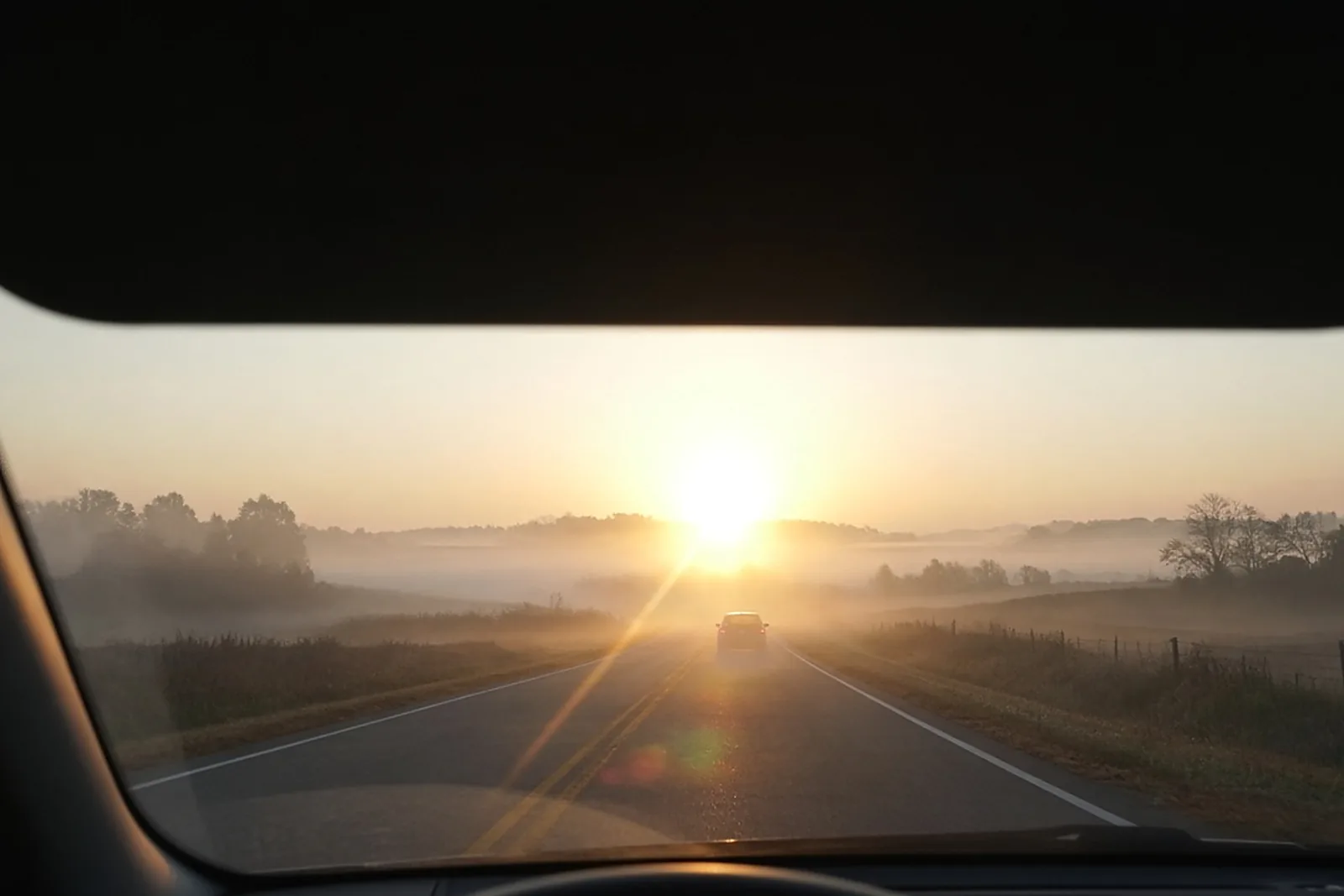
Reported contributing factors in Kentucky’s 2024 crashes
Kentucky’s 2024 Traffic Collision Facts lists the following human and environmental contributing factors. These are collisions in which police listed the factor at least once; a collision may have more than one factor.
| Factor (2024) | All collisions | Fatal collisions |
|---|---|---|
| Glare (sun) | 1,279 | 7 |
| View obstructed or limited due to weather conditions | 850 | 11 |
| Glare (other) | 180 | 1 |
| Too fast for conditions | 3,487 | 30 |
Source: 2024 Kentucky Traffic Collision Facts, printed pp. 27–28.
For more statewide numbers, see Kentucky car crash statistics.
Poor visibility does not automatically excuse unsafe driving
Kentucky’s basic speed rule says no one may drive faster than is “reasonable and prudent” for the conditions, no matter what the posted limit is (KRS 189.390(2)). When visibility drops, a careful driver slows down, leaves more space, uses low-beam headlights and is ready to stop. A driver who keeps going at full speed into glare or fog they can’t see through may be found to have acted unreasonably, depending on the evidence.
In Regenstreif v. Phelps, 142 S.W.3d 1 (Ky. 2004), the Kentucky Supreme Court held that comparative negligence did not eliminate the sudden-emergency doctrine. An instruction may be appropriate when evidence shows an unanticipated peril, not caused by the driver’s own fault, that changes the duties reasonably expected in the circumstances. Predictable glare or fog still requires reasonable care; liability depends on the evidence.
Common sun glare accident and fog crash scenarios
- Rear-end crashes when a blinded driver doesn’t see stopped traffic. See rear-end collisions.
- Pedestrians and cyclists hit in crosswalks during the low-sun hours. See pedestrian accidents.
- Left turns across oncoming traffic the turning driver couldn’t see.
- Chain-reaction pileups in dense fog on interstates. See multi-vehicle pileups.
Proving fog and sun glare car accidents
- The time and direction of travel, which can be matched against sunrise and sunset data
- Weather records and road-condition reports
- Dashcam and TRIMARC camera footage
- Vehicle data showing the speed before impact. See accident reconstruction
- Whether the driver had a dirty or cracked windshield, worn wipers or no headlights on
What if both drivers were affected?
Kentucky uses pure comparative fault, so a jury assigns each driver a percentage and your recovery is reduced only by your share (KRS 411.182). See how Kentucky’s pure comparative fault rule works. Hurt in a glare or fog crash? Talk to a Louisville car accident lawyer.
Your PIP benefits pay medical bills and lost wages regardless of fault. See how Kentucky PIP works. For rain crashes, see rain and hydroplaning accidents. Most Kentucky car accident lawsuits must be filed within two years after the injury or the last PIP payment, whichever is later (KRS 304.39-230(6)).
Sun glare accident FAQs
Is a driver at fault for a sun glare accident?
It depends on whether the driver acted reasonably for the visibility and other conditions. Kentucky requires drivers to go no faster than is reasonable for the conditions (KRS 189.390(2)). Low sun is predictable, so a driver is generally expected to slow down, use the visor and be ready to stop.
Who is at fault in a fog pileup?
Often several drivers share fault, especially those driving too fast for visibility or following too closely. Kentucky divides fault by percentage (KRS 411.182).
Can weather be a defense in a Kentucky car accident?
It depends on the evidence. A sudden-emergency instruction may be appropriate where an unanticipated peril arises, but predictable fog, rain or glare still requires reasonable care.
Hit by a driver who “couldn’t see”? Call us.
Tell us what happened. We’ll explain your options and what to do next. The consultation is free. No fee unless we win. Get a free case evaluation or call (502) 931-6788. Our office is at 1139 S. 4th St., Louisville.
This post is general information about Kentucky law, not legal advice. Every case is different.