
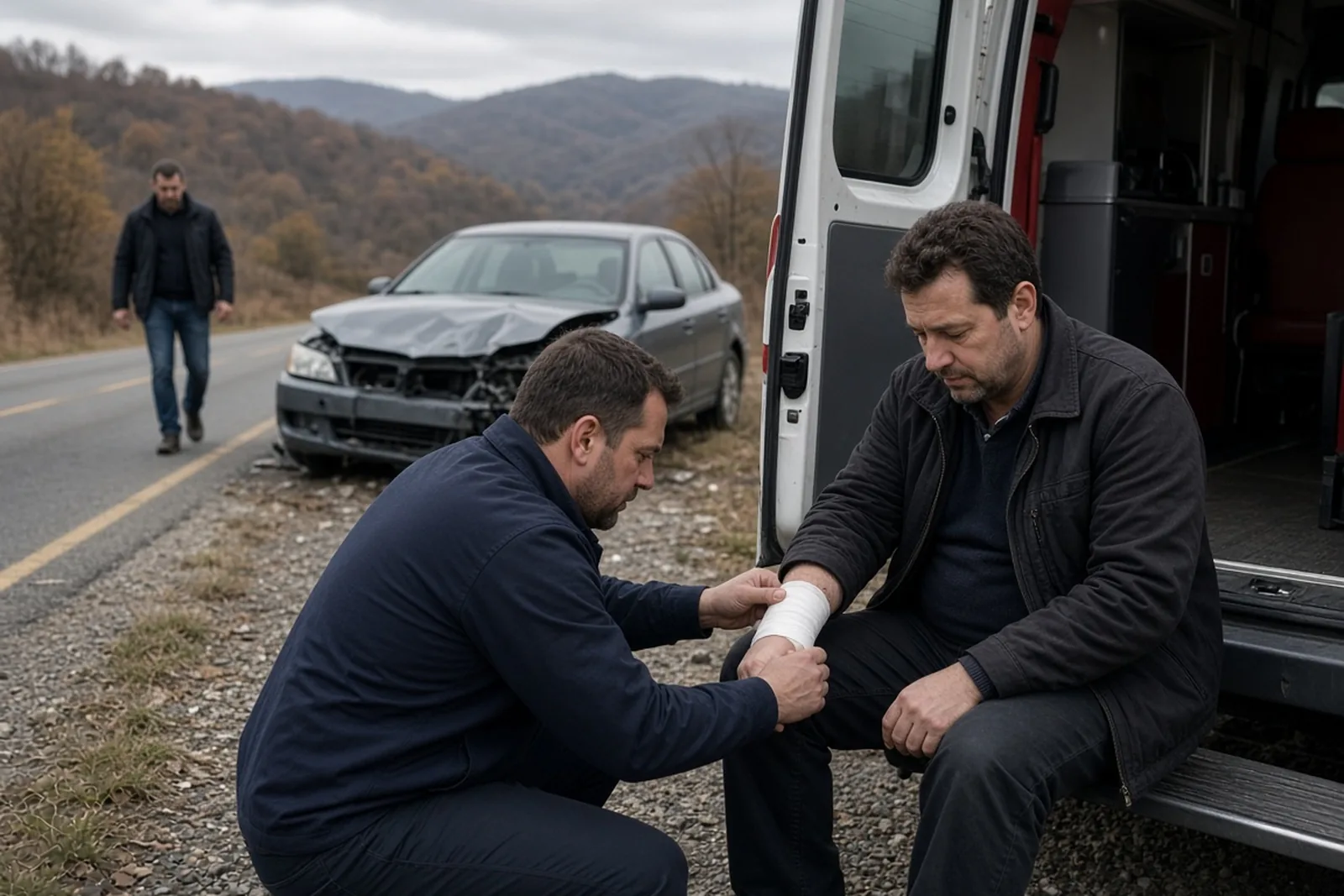
After a Kentucky car crash, two different systems start running at the same time, and many injured drivers confuse them. One pays your medical bills and lost wages through personal injury protection (PIP), and it does so largely without regard to who caused the wreck. The other is your right to sue the at-fault driver for pain and suffering, which exists only if your injury meets a threshold set by statute. Kentucky’s no-fault law governs how those two systems interact, rather than leaving you to choose between them by intuition.
PIP is automatic. The right to sue for pain and suffering is conditional, and it turns on how serious your Kentucky crash injury is. Knowing which track your crash is on shapes everything that follows: whether fault evidence matters right now, whether a demand letter carries leverage, and when to protect a claim the other side may argue you already gave up.
This guide walks through Kentucky’s no-fault system section by section, from what PIP actually covers to the $1,000 medical expense test, the injury thresholds, the DOI rejection wrinkle, and the special rules for motorcycles. If you are unsure which track applies to you, a car wreck attorney can help you sort it out before deadlines and defenses harden.
Two Tracks, One Crash: What Kentucky’s No-Fault System Really Does
Most injured drivers assume Kentucky lets them pick: collect insurance or sue. The statute offers no such choice, and that misunderstanding is a common cause of bad early decisions after a wreck.
PIP, or personal injury protection, is first-party coverage paying medical bills and lost wages regardless of fault. The tort threshold is a separate test deciding whether you may recover pain and suffering from the at-fault driver.
Kentucky’s framework sits in KRS 304.39, and the Kentucky Department of Insurance publishes a plain-language summary of both halves.
Getting the tracks straight first shortens every later conversation, including fault after weather crashes.
What No-Fault Actually Means in Kentucky
No-fault answers one question: who pays first. It is a payment sequence, not immunity for the driver who hit you. Under KRS 304.39-030, a person hurt in a Kentucky motor vehicle accident has a right to basic reparation benefits unless he or she rejected the tort limits, and KRS 304.39-040 says those benefits are paid without regard to fault. Basic PIP of $10,000 per person per accident comes from the insurer of the vehicle you occupied, or the vehicle that struck you as a pedestrian.
A separate section, KRS 304.39-060, limits when you can recover pain and suffering, so a personal injury claim depends on the medical proof, not on how the crash felt. Kentucky deferred fault rather than abolishing it: once the threshold is met, ordinary negligence proof applies, the same duty-and-breach analysis any interchange crash case turns on.
One caution: the Department of Insurance summary words the limits more broadly than the statute. Under KRS 304.39-060(2), the threshold controls recovery of pain and suffering, while tort liability for economic losses is abolished only to the extent PIP benefits are payable.
Track One: PIP Pays the Bills Regardless of Who Caused the Wreck
With that distinction noted, Track One is straightforward. PIP pays medical expenses and lost wages for you, your passengers, and pedestrians struck by a covered vehicle, subject to policy limits, deductibles, and coordination terms. Fault does not decide who pays first, so a range of crash types can trigger the same first-party coverage. Basic PIP is $10,000 per person per accident; higher limits are optional, so check your policy before a crash. PIP is not a settlement, though read anything you sign. Keep every bill, provider statement, and wage record, and submit them on time. Those same records later prove the medical-expense threshold, and health coverage sequencing affects net recovery.

Track Two: The Tort Threshold That Decides Whether You Can Sue
PIP pays the bills. The right to sue is a separate, conditional question.
That right is not automatic. The right to recover pain and suffering opens only when the injury meets a test in KRS 304.39-060, which the Kentucky Department of Insurance summarizes as $1,000 in medical expenses, a broken bone, permanent disfigurement, permanent injury, or death. The statute adds compound, comminuted, displaced, or compressed fractures, loss of a body member, and permanent loss of bodily function. 806 KAR 39:030 sets out the no-fault rejection form rather than listing threshold categories of its own.
The tests are written as alternatives, so meeting one can be enough; you also need not wait for treatment to end before assessing the record.
Severity is not how the crash felt that day. It is what the medical record and the statute can prove. If you rejected Kentucky’s no-fault limits, other rules apply.
The $1,000 Medical Expense Test
The $1,000 test tracks documented medical expenses, not your out-of-pocket share or the settlement value.
Ambulance transport, emergency department charges, diagnostic imaging, and follow-up visits all add up. What matters is what the records show, not how the treatment felt. If you receive free medical and surgical care, the statute treats the test as met when that treatment has an equivalent value of at least $1,000.
Because PIP is already paying those bills, the records gathered for PIP are the natural starting point for the threshold figure, so assembling them early serves both tracks. Gaps in treatment, or visits that never generated a bill, can leave the documented total under $1,000 even where the injury was genuine.
Have a car wreck attorney audit the itemized billing before assuming the threshold is met or unmet, and compare what attorney fees actually cost before retaining one.

The Injury Tests: Fractures, Disfigurement, and Permanent Injury
Beyond billing totals, some injuries clear the threshold alone.
A broken bone qualifies by itself. KRS 304.39-060 names compound, comminuted, displaced, and compressed fractures, so the serious variants in imaging reports count. Keep a copy of the radiology report itself, because it names the type of fracture.
Permanent disfigurement counts as well: scarring, visible deformity, or a lasting change in appearance. Photographs and treating-provider descriptions carry this category.
Permanent injury is the broadest test, and it is often disputed. The statute requires permanent injury “within reasonable medical probability,” which takes medical proof of duration and prognosis, not a discharge summary label. Soft-tissue injuries can qualify, but the record must show the injury will not resolve, typically through specialist documentation, consistent treatment, and an explanation for any treatment gap.
Get permanency opinions in writing and early. An opinion drafted a year after the crash is easier to attack, so learn to challenge a bad IME opinion before the defense doctor frames the record.
Death, Loss of a Body Member, and Permanent Loss of Function
Permanent injury is not the only category that changes the claim. Death is a category of its own, and it raises questions about beneficiaries, deadlines, and damages that differ from an injury claim. Kentucky’s wrongful death claim rules control that track, and under KRS 411.130 the claim is brought by the personal representative of the estate. For a fatal crash, the two-year motor vehicle deadline in KRS 304.39-230(6) runs from the death or the last PIP payment, whichever is later.
Loss of a body member and permanent loss of bodily function are proved from the medical record rather than from argument. Permanent loss of bodily function usually needs a functional assessment beyond a diagnosis. Each category overlaps permanent injury yet is pleaded and proved differently, changing the complaint’s allegations and the experts retained. Assess the threshold before filing, while you can still shape the record, not after the defense sets the terms.

How a Kentucky Crash Injury Is Measured Against the Threshold
Beyond those categories, the threshold question turns on what the record shows at the time it is measured, not on a surgery scheduled for next year. Treatment notes, billing statements, imaging reports, and operative notes answer it. Anything not in the file is not part of the analysis, which is why gaps in treatment documentation can matter.
For example, a single emergency department visit with imaging can clear $1,000 quickly, while a short course of care with few billed visits may not. Clearing the threshold unlocks noneconomic damages such as pain and suffering. Below it, and without a qualifying injury, you cannot recover pain and suffering from the at-fault driver, though economic losses that PIP does not cover may still be claimed.
The measure is specific to each injured person. One passenger may clear the threshold while another in the same vehicle cannot, making household-wide assumptions dangerous.

The Rejection Wrinkle: Drivers Who Filed a Form with the DOI
That measure assumes no one opted out. Some drivers did.
A driver can reject the tort limits by filing a written rejection with the Kentucky Department of Insurance before any crash. The filing changes which rules govern that driver’s crash.
Rejections stay effective until revoked in writing. Pre-June 30, 1980 filings remain effective until revoked, so an old filing can reshape a 2026 crash.
A rejecting driver is not entitled to basic PIP but can buy PIP back as added coverage. That trade can make policies in one household behave differently. If every member of a household rejects, the policy must include guest PIP coverage so guest passengers and pedestrians still have basic PIP benefits.
For a minor, a parent or guardian’s failure to file a rejection within six months is treated as acceptance of the tort limits. The deadline passes quietly.
Treat rejection status as something to check, not assume. The Department of Insurance offers written verification, and a car wreck lawyer should request it early rather than guess. Requests go on the department’s No Fault Rejection Verification (NFV-1) form with a $5 fee.

How Kentucky’s No-Fault Rules Treat Motorcycle Crashes
Motorcycles follow special rules. Under KRS 304.39-040, basic PIP is optional for motorcycles, and neither the operator nor a passenger can collect basic PIP from any source unless that coverage was purchased. The Department of Insurance warns that a motorcycle owner who skips PIP and files no rejection form may be unable to recover the first $10,000 of a motorcycle injury claim from the at-fault party.
KRS 304.39-060(2)(c) also says the tort limits do not apply to injury to a motorcycle passenger arising from that motorcycle’s use, and KRS 304.39-060(9) lets a rider file a rejection that applies only to motorcycle use.
Agency summaries are helpful starting points, but the statute and regulations control when the wording differs.
How to Tell Which Track Your Crash Is On
Those motorcycle rules are the exception. For most crashes, five steps establish the track.
- Identify the PIP payer: the insurer of the vehicle you occupied, or the one that struck you as a pedestrian. Confirm its limit and coordination terms.
- Total medical expense benefits payable, not billed charges, against the $1,000 test. Include ambulance, imaging, emergency, and follow-ups.
- Ask the treating provider whether an injury is permanent or disfiguring, documented in the chart, not by phone.
- Request written verification from the Department of Insurance on whether a rejection form exists for you or the other driver.
- Match your facts to a statutory category, noting what you can prove today versus later. A documented fracture proves it now; permanency may take months. Many crashes sit on both tracks at once, with PIP paying while the proof develops.
What Changes Downstream Once You Know the Track
The track determines everything that follows. On the PIP-only track, fault evidence matters less in the short run but never stops mattering: it still shapes reimbursement questions, and it resurfaces if the threshold argument returns later. On the tort track, fault evidence drives everything. Kentucky uses pure comparative fault under KRS 411.182, so any share of blame assigned to you reduces the recovery without barring it. Scene documentation, witness statements, dash camera footage, and vehicle data become central rather than background.
Demand-letter leverage depends on the track as well. A letter asserting pain and suffering from a claimant who has not cleared the threshold hands the adjuster an easy response and costs credibility on the parts of the claim that are real.
Preservation follows the same logic. Evidence irrelevant to a PIP claim can be decisive to a tort claim, and it can disappear in weeks when a vehicle is repaired, sold, or scrapped. A personal injury law strategy built on the wrong track burns the early window, exactly when the strongest evidence still exists and the other side has not locked into a story.
When to Protect the Claim the Other Side Says You Gave Up
Those early preservation steps also build the record that defeats a waiver argument. Insurers construct waiver defenses from recorded statements, broad releases, and open-ended authorizations, so read every document before signing and reject verbal assurances about what it means.
Applying for PIP is not the same as signing a release, though a carelessly worded release can end the tort claim before the threshold question is reached. The deadline for a tort claim runs on its own timetable. Under KRS 304.39-230(6), a crash injury lawsuit generally must be filed within two years after the injury or the last PIP payment, whichever is later, so waiting for a permanency opinion can consume it. Preservation letters go out early, because vehicles get repaired or sold and camera footage overwrites. If the threshold is disputed, document now and argue later. A claim preserved with records is negotiable; one preserved with memory is not.
The Short Version: Two Tracks, Three Things to Check
With the record preserved, here is the compressed version.
PIP runs fault-blind, and the tort threshold separately decides whether you can recover pain and suffering from the at-fault driver.
Check three things first:
- The PIP insurer and limit.
- Documented medical bills against the $1,000 test.
- Any rejection form on file with the Department of Insurance.
Keep gathering tort-track evidence while PIP pays, and treat every signed document as a potential waiver argument until someone reads it.
To have the threshold assessed against your own records, call Larry Forman’s firm at (502) 931-6788 for a free consultation. Our car accident fee is 30 percent for cases settled before a lawsuit is filed. No fee unless we win.
Conclusion
Kentucky car crash claims run on two tracks. PIP pays medical bills regardless of fault, but it does not answer whether you can sue for pain and suffering. The tort threshold does, and it turns on medical expenses over $1,000 or one of the injury tests described above. A rejection form, a carelessly signed release, and the independent statute of limitations can change the outcome, so preserve records early.
Check three things first: the PIP insurer and limit, medical bills against the $1,000 test, and any rejection form on file. Larry Forman has 13 years of experience and has tried 50+ jury trials and won 95% of them. For a free consultation on your Kentucky crash injury, call (502) 931-6788. No fee unless we win. Protect the evidence now, then get the answer before time decides for you.
Reviewed by Larry Forman, Attorney.