
Reviewed by Larry Forman, Attorney.
The most common serious crash between a car and a motorcycle happens when a driver turns left across the rider’s path. The driver usually says the same thing: “I never saw the motorcycle.” That isn’t a defense under Kentucky law. Forman & Associates represents riders hurt in a left-turn motorcycle accident anywhere in Kentucky.
Key takeaways
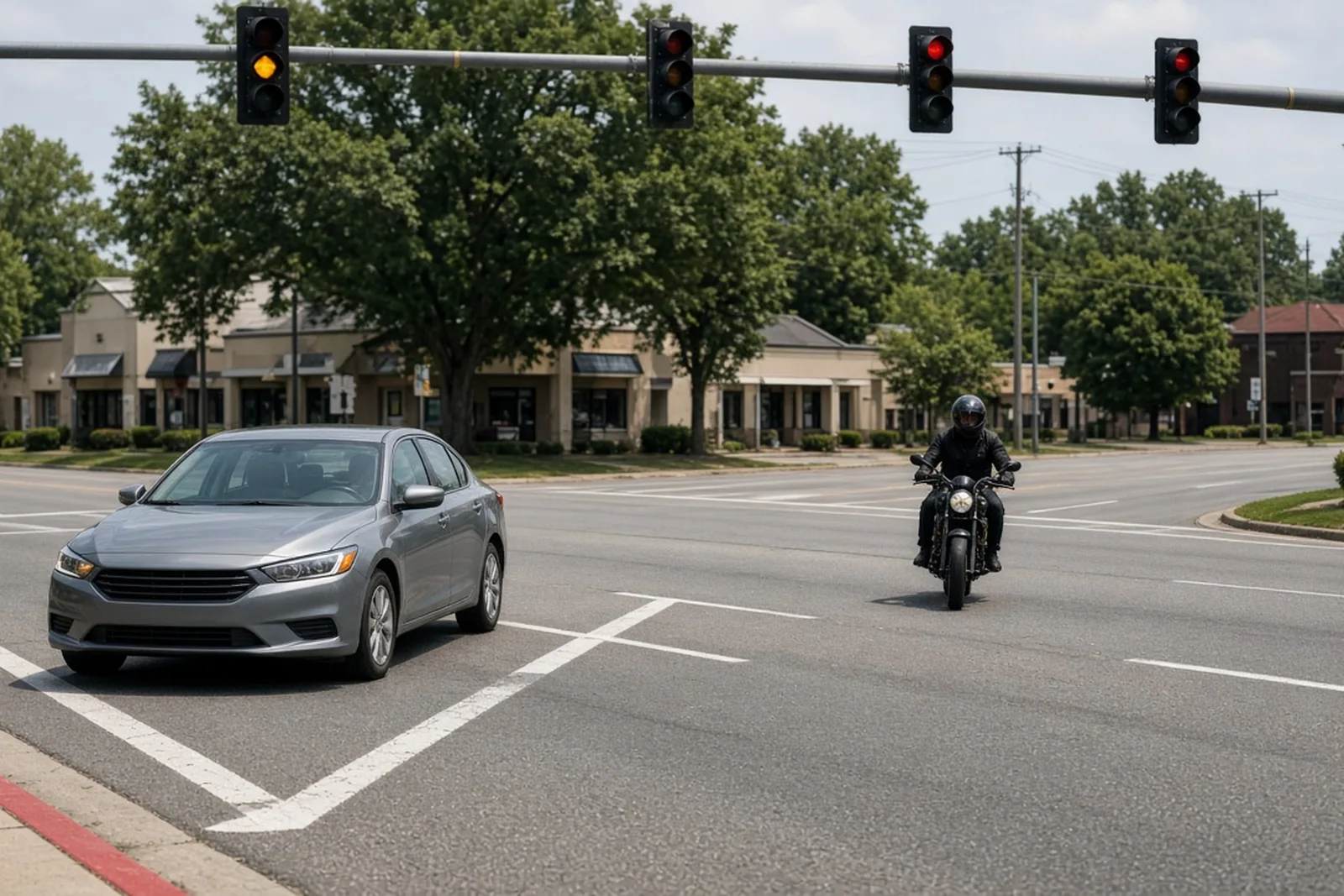
Under KRS 189.330(9), the driver of a vehicle intending to turn left within an intersection must yield the right-of-way to any vehicle approaching from the opposite direction that is within the intersection or so close as to be an immediate hazard. Motorcycles are vehicles with the same right-of-way as cars. Drivers must also signal before turning (KRS 189.380).
Motorcycles are smaller and harder to judge, but drivers have a duty to look and to see what is there to be seen. A driver who turns without seeing an approaching motorcycle in daylight on a straight road usually wasn’t looking carefully enough. Witnesses, intersection cameras and the motorcycle’s headlight help prove the motorcycle was visible.
The insurer may say the rider came “out of nowhere” because he was speeding. We answer with evidence: surveillance and dash camera video, motorcycle and car electronic data, skid and scrape marks, crush damage and accident reconstruction. See accident reconstruction in Kentucky and evidence to preserve. Even if a rider is found partly at fault, Kentucky’s pure comparative fault rule only reduces damages by that percentage (KRS 411.182).
Riders often strike the side of the turning car or are thrown over it. Leg and pelvis fractures, arm and wrist injuries, road rash, brain injuries and spinal injuries are common. See motorcycle injuries. If you weren’t wearing a helmet, read Kentucky’s helmet law; it doesn’t bar your claim.
Usually, but not always. Fault depends on the signal, the speed and position of the motorcycle and visibility. Evidence decides it.
A protected green arrow changes the analysis, because oncoming traffic should have a red. Signal timing records and video can show who had the right-of-way.
Possibly. The question is whether speed caused the crash and how much. Kentucky reduces damages by any share of fault but doesn’t bar recovery.
Usually two years from the crash or last PIP payment for motor vehicle claims in Kentucky. Use our statute of limitations calculator and confirm with a lawyer.
We gather the video and data that prove you had the right-of-way.
Get a free case evaluation or call 502-931-6788.
This page is general information about Kentucky law as of October 2026, not legal advice. Every case is different.