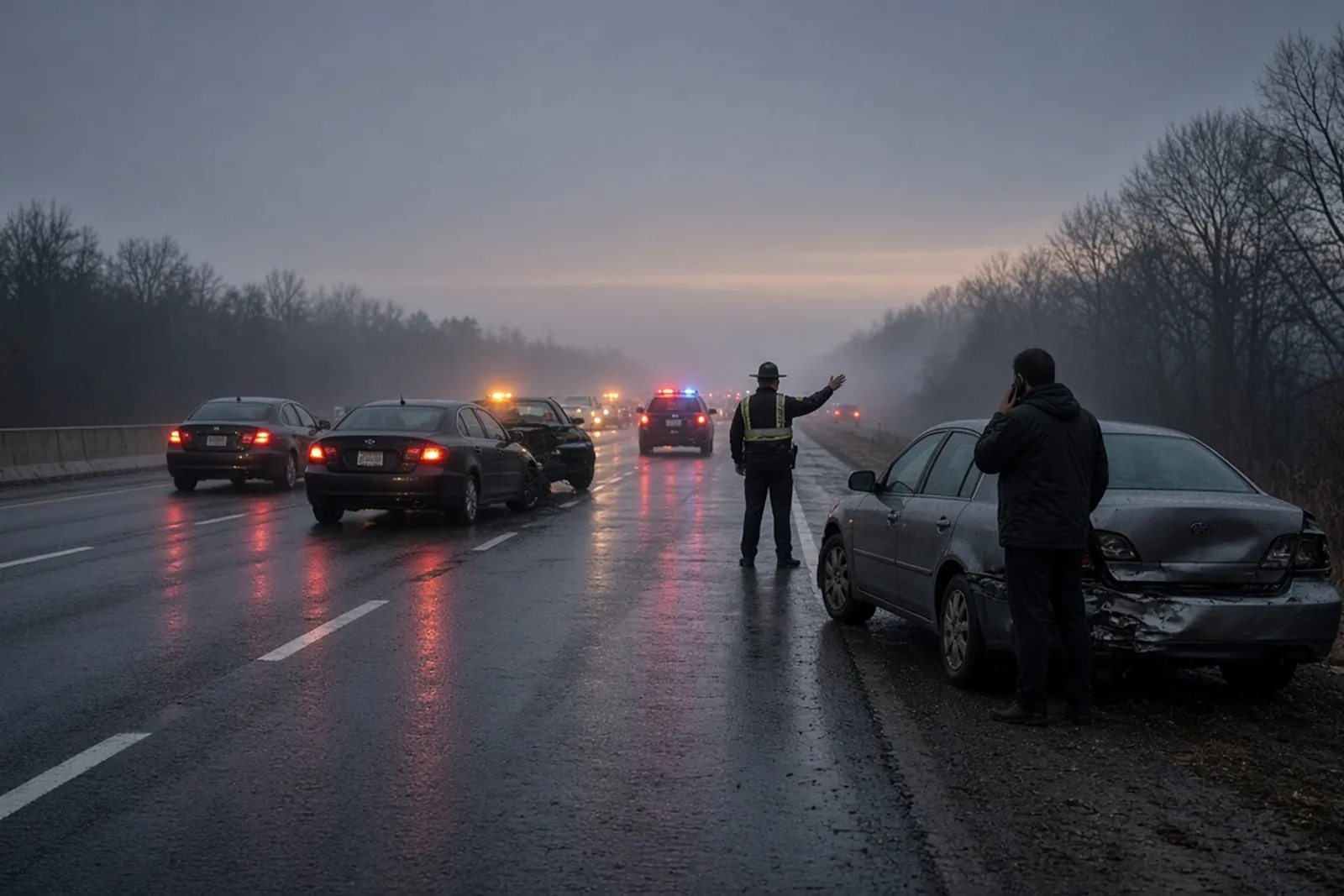
Hurt in a multi-vehicle pileup in Kentucky? Learn how fault is split among drivers, how limited insurance gets shared, and what to do to protect your claim.
A multi-vehicle pileup is one of the most confusing crashes to sort out. Three, five or twenty vehicles may be involved, each driver blames the next, and several insurers start pointing fingers before anyone knows what happened. Kentucky law lets you recover from every driver who caused your injuries, but only for each one’s share of the fault, so it matters a great deal that every responsible driver is identified and the order of impacts is proven.
How pileups happen on Kentucky roads
Pileups usually start with one sudden stop and a line of drivers who can’t react in time:
Following too closely. Kentucky law says a driver “shall not follow another vehicle more closely than is reasonable and prudent, having regard for the speed of the vehicle and the traffic upon and condition of the highway” (KRS 189.340(9)(a)).
Speed too fast for fog, rain, snow or glare. A driver “shall not drive at a greater speed than is reasonable and prudent, having regard for the traffic and for the condition and use of the highway” (KRS 189.390(2)), even if they’re under the posted limit.
Often more than one driver. Kentucky uses pure comparative fault. In a case with several parties, the jury decides the percentage of fault for each driver, and for you if you were partly at fault (KRS 411.182). The statute tells the jury to consider “both the nature of the conduct of each party at fault and the extent of the causal relation between the conduct and the damages claimed.”
Two things follow:
Each driver generally pays only their share. Since Dix & Associates Pipeline Contractors, Inc. v. Key (Ky. 1990), Kentucky has applied several liability: a driver found 30% at fault generally pays 30% of the damages, not the whole thing. If you leave a responsible driver out, you may not collect that driver’s share.
Your own share reduces your award, but doesn’t bar it. Even if you were partly at fault, you can still recover the rest. See our Kentucky negligence law guide.
Chain-reaction rear impacts
In a chain reaction, the driver who hit you may have been pushed into you by someone else. Proving which impact caused which injury is often the heart of the case. Evidence that helps:
Event data from each vehicle’s airbag control module (see black box evidence)
PIP first. Kentucky’s no-fault coverage pays the first $10,000 of medical bills and lost wages for each injured person, whatever the fault. See our auto insurance guide.
Shared limits. Kentucky’s minimum liability coverage is $25,000 per person and $50,000 per accident (KRS 304.39-110). In a pileup, one at-fault driver’s $50,000 may have to be divided among everyone that driver injured. Insurers sometimes ask a court to divide the limits.
Your own underinsured coverage may fill the gap when the at-fault drivers’ limits run out.
Stay in your vehicle with your seat belt on if it’s unsafe to get out, and call 911.
Get medical care, even if you feel fine.
Photograph every vehicle you can, their positions and the road conditions.
Get names of drivers and witnesses, and the trooper or officer’s report number.
Don’t give a recorded statement to any insurer before you talk to a lawyer.
Watch the deadline. Kentucky generally allows two years from the crash or the last PIP payment. See our statute of limitations guide.
How Forman & Associates handles pileup cases
We identify every vehicle and every policy, lock down event data before it’s lost, and work with reconstructionists to sort out the sequence of impacts. We prepare each case for trial from the start. Larry Forman has tried 50+ jury trials and won 95% of them. Learn more about Larry Forman, see our case results (past results don’t guarantee a similar outcome), or return to our car crash lawyer page.
Multi-vehicle pileup FAQs
Who pays when several drivers caused a pileup?
Each at-fault driver’s insurer generally pays that driver’s percentage of fault. Kentucky juries assign a percentage to every party.
Can I recover if I was partly at fault in a pileup?
Yes. Kentucky’s pure comparative fault rule reduces your award by your share but doesn’t bar recovery.
What if the at-fault driver’s insurance isn’t enough for everyone?
Limits may be divided among injured people. Your own underinsured motorist coverage may pay the difference.
How do you prove which car caused my injuries?
With vehicle event data, damage patterns, video, witness statements and accident reconstruction.
Does PIP cover me in a pileup?
Yes. Kentucky PIP pays up to $10,000 in medical bills and lost wages regardless of fault, unless you rejected it.
How long do I have to file a claim after a pileup in Kentucky?
Generally two years from the crash or the last PIP payment, whichever is later. Some claims have shorter deadlines, so check early.
Hurt in a pileup?
We’ll sort out who’s responsible and go after every policy. Get a free case evaluation or call (502) 931-6788. No fee unless we win.
This page is general information about Kentucky law as of October 2026, not legal advice.