Reviewed by Larry Forman, Attorney
A TARC bus and a school bus may share the same streets, but the law treats them very differently. If a TARC bus injured you, Kentucky courts have held that TARC can be sued much like a private company. A school bus accident is another story: a public school board is immune from suit in court, and claims against it go to a state board with caps and a one-year deadline that doesn’t pause for children.
Forman & Associates represents passengers, pedestrians, drivers and families in TARC and school bus cases across Louisville and Kentucky. This page explains both kinds of claims. For charter buses, intercity carriers and other private buses, see our main bus wreck page.
TARC bus accidents: TARC can be sued
The Transit Authority of River City (TARC) was created under Kentucky’s transit authority law as “a political subdivision and a public body corporate, with power … to sue and be sued” (KRS 96A.020). The law also requires a transit authority to carry public liability insurance or to self-insure (KRS 96A.180).
Many people assume TARC shares the government’s immunity. The Kentucky Court of Appeals rejected that argument in a case brought by a man struck by a TARC bus. TARC is an agency of Louisville Metro, but it doesn’t perform a function integral to state government. In the court’s words, its services are “truly local and proprietary in nature,” so TARC isn’t immune from a negligence suit (Transit Authority of River City v. Bibelhauser, 2013).
That means a TARC claim generally proceeds in circuit court, in front of a jury, under the usual rules for motor vehicle cases.
TARC owes passengers the highest degree of care
TARC is a common carrier. Kentucky law requires a bus carrier to use “the highest degree of care” to protect passengers from “dangers that foresight can anticipate,” and that duty is even greater when the carrier knows a passenger is elderly or disabled (Montgomery v. Midkiff, 1989, a case involving a TARC bus for elderly and disabled riders). That matters for riders of TARC3, TARC’s paratransit service.
Common TARC injury claims include:
Sudden starts and stops that throw standing or walking passengers
Boarding and exiting injuries, such as a bus pulling away while a rider is still on the steps, or a ramp or kneeling system that fails
Wheelchair securement failures on paratransit vans and buses
Cars hit by buses that change lanes, pull from a stop into traffic or follow too closely
School bus accident claims: suing a school board
Kentucky’s Supreme Court has held that a board of education is immune from suit in a judicial court. Instead, the Board of Claims Act lets an injured person file a claim with the Kentucky Board of Claims, “including a claim premised upon vicarious liability for the torts of the board of education’s employees” (Grayson County Board of Education v. Casey, 2005). The board’s liability insurance doesn’t change that (KRS 160.310; Casey).
The Board of Claims has strict limits:
One year to file, and the time doesn’t stop running for children. A parent, guardian or next friend must file within the same period (KRS 49.120). This is one of the most commonly missed deadlines in Kentucky.
$250,000 per claim and $400,000 for all claims from one act of negligence (KRS 49.040).
No pain and suffering, and no claims “dependent on loss to another,” such as a parent’s loss of a child’s companionship (KRS 49.020(5)).
No jury. The Board decides the claim, and appeals go to circuit court on the record.
Other people who may be responsible
The school board isn’t always the only defendant, and others don’t share its immunity or caps:
The other driver, if a car or truck caused the crash
A private bus contractor. A district that contracts out transportation must require the contractor to carry liability insurance (KRS 160.310)
A charter company hired for a field trip or game
A manufacturer, if a defect in the bus played a role
The bus driver personally. Kentucky courts have treated driving as a ministerial act, and earlier cases allowed suits against school employees for negligent ministerial acts. Whether that route survives the current Board of Claims Act is contested, so we evaluate it case by case
Drivers who pass a stopped school bus
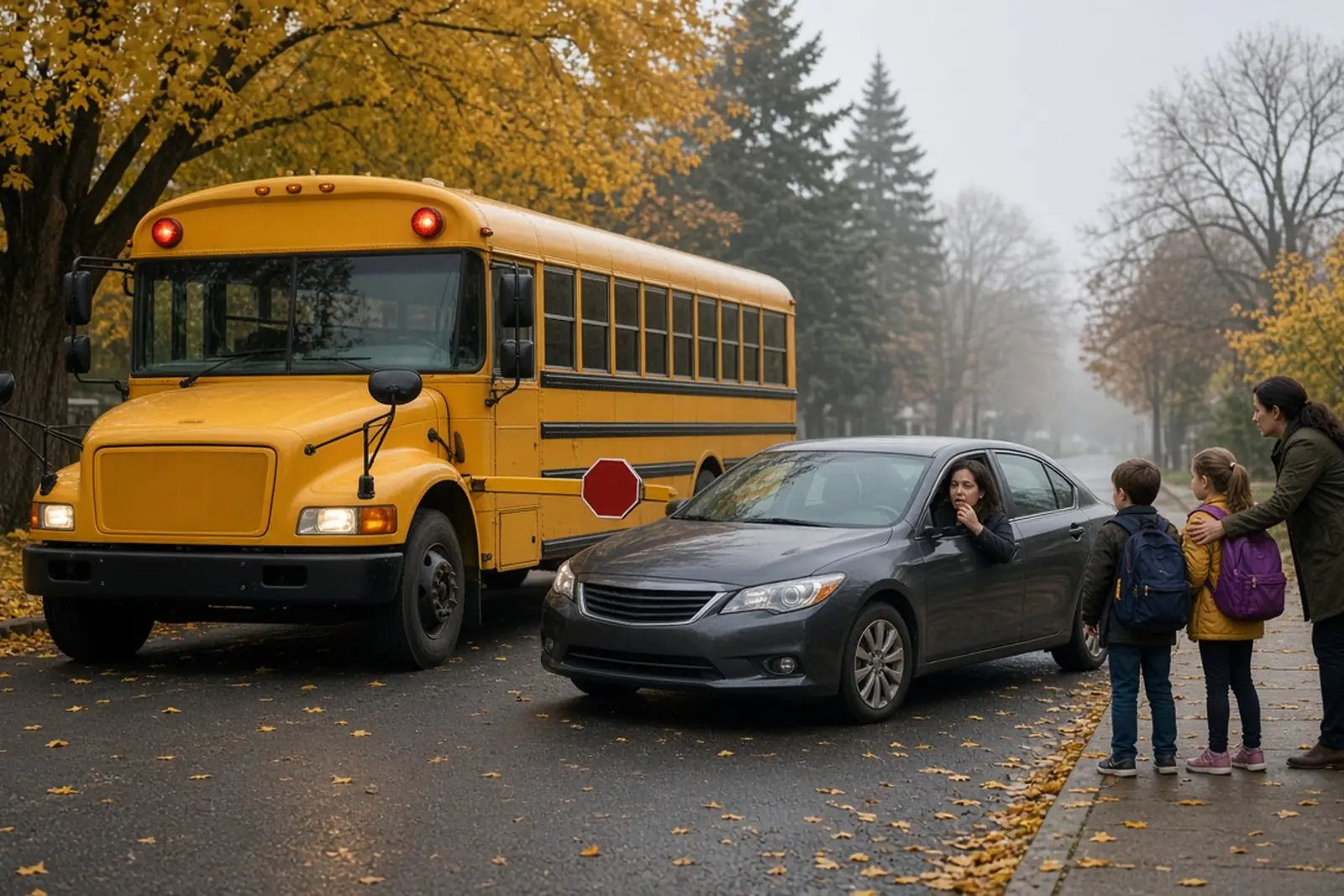
Some of the worst school bus accidents happen outside the bus. When a school bus stops with its stop arm out and red lights flashing, drivers approaching from either direction must stop and stay stopped until the bus moves again. The only exception is for traffic going the opposite way on a highway of four or more lanes divided by a barrier or unpaved median (KRS 189.370). A driver who ignores the stop arm and hits a child is liable to the family under ordinary negligence law, and that claim isn’t subject to Board of Claims limits.
How often school buses crash in Kentucky
Kentucky State Police recorded 362 collisions involving school buses in 2024, with 59 people injured and one person killed (KSP 2024 Kentucky Traffic Collision Facts). The driver factors cited most often were misjudged clearance and inattention.
Who pays medical bills after a bus accident
Kentucky’s no-fault (PIP) coverage applies to bus passengers. The definition of using a vehicle includes “occupying, entering into, or alighting from” it, so boarding and exiting injuries count. See how Kentucky PIP works. Children’s injuries are often head injuries and broken bones that need follow-up long after the crash. For more on claims by people riding in a vehicle, see passenger injury claims.
Children’s claims need extra care
Deadlines. Children usually get extra time to sue in Kentucky, but not in the Board of Claims. Calendar the one-year deadline from the day of the crash.
Settlements. A settlement for a child generally needs court approval, and the money is protected until the child turns 18.
Injuries at school. If your child was hurt at school or on a field trip rather than in a crash, see our daycare and school negligence page.
Evidence to secure right away
Onboard video. TARC buses and many school buses record inside and outside. Request it in writing immediately
GPS and stop-arm camera data, plus route and dispatch records
The driver’s training and discipline records
Maintenance records for brakes, doors, ramps and lifts
Witnesses, including other passengers and parents at the stop
Yes. The Kentucky Court of Appeals held that TARC isn’t entitled to governmental immunity because its bus service is local and proprietary. A TARC injury claim generally goes to circuit court like other motor vehicle claims.
Can I sue the school district after a school bus accident?
Not in regular court. A board of education is immune from suit, but you can file a claim with the Kentucky Board of Claims, which has a one-year deadline, a $250,000 cap and no recovery for pain and suffering. Other parties, like a negligent driver or a private bus contractor, can be sued in court.
How long do I have to file a claim for my child’s school bus injury?
For a claim against the school board, one year, with no extra time because the injured person is a child. Claims against other drivers or contractors have different deadlines. Don’t wait.
What if a car passed the school bus and hit my child?
Kentucky law requires drivers from both directions to stop for a school bus with its stop arm out, except on divided highways of four or more lanes. The driver who passed the bus can be held responsible for your child’s injuries.
I fell when the TARC bus pulled away. Do I have a claim?
You may. A bus carrier owes passengers the highest degree of care, especially passengers it knows are elderly or disabled. Video from the bus usually shows exactly what happened, so ask for it to be preserved right away.
Does PIP cover me if I was hurt getting on or off a bus?
Yes. Kentucky’s PIP law covers injuries while occupying, entering or getting out of a motor vehicle, including a bus.
Hurt on a TARC or school bus? Let’s talk
We’ll sort out who ran the bus and which deadline applies. Get a free case evaluation or call (502) 931-6788. No fee unless we win. Our office is at 1139 S. 4th St., Louisville, KY 40203.
This page is general information about Kentucky law as of October 2026, not legal advice.