
Reviewed by Larry Forman, Attorney.
An underride accident happens when a car slides beneath the back or side of a tractor-trailer. The trailer bed sits at about windshield height, so the car's bumper, crumple zones and airbags may never engage. The trailer strikes the passenger compartment directly. These are among the most devastating crashes on Kentucky interstates, and they raise questions that ordinary truck cases don't: was the trailer's guard strong enough, was it maintained, and why wasn't there one on the side?
Forman & Associates represents people hurt in underride crashes and families who have lost someone. Here's how these cases work.
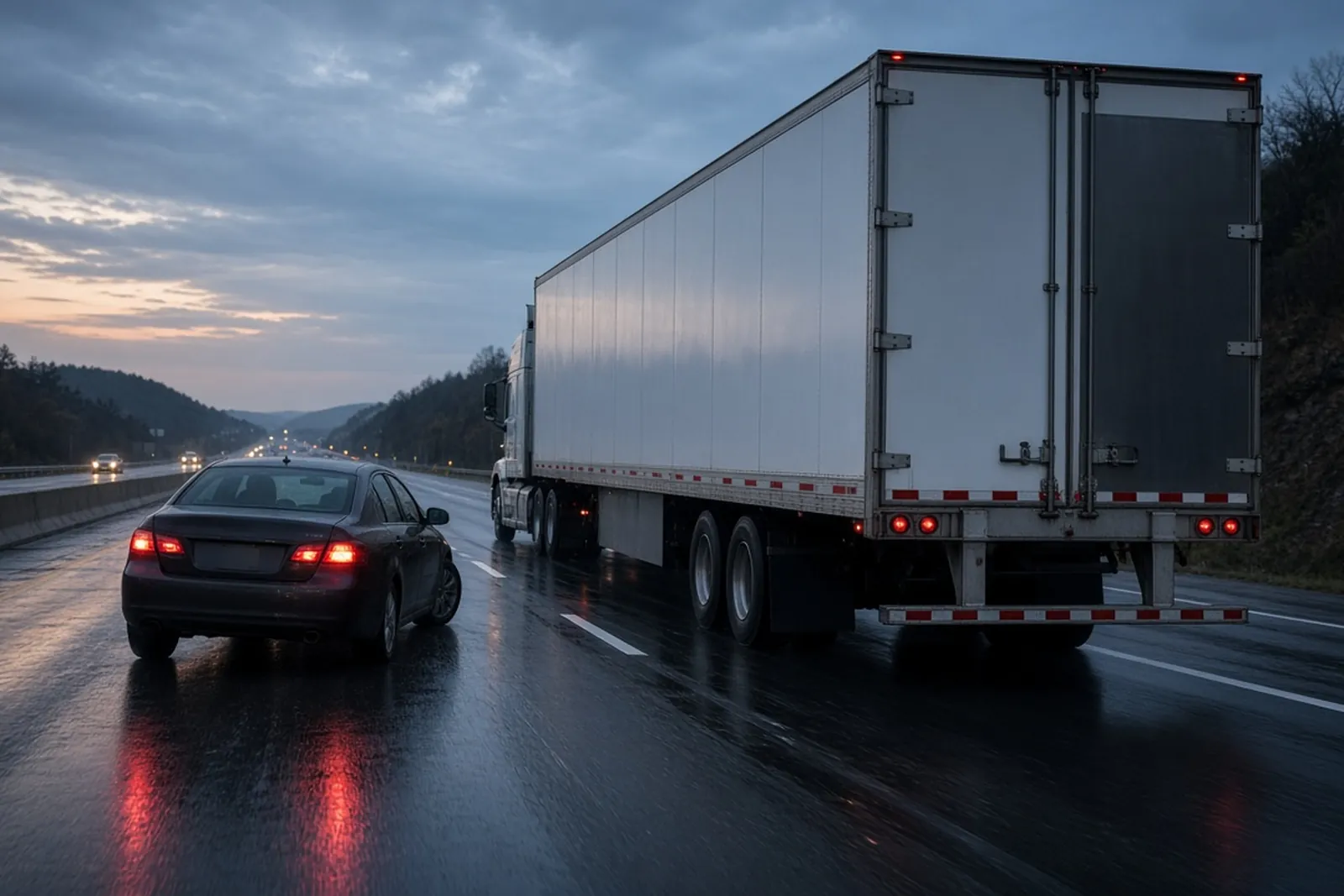
There are two main types:
Single-unit trucks, like dump trucks and box trucks, can cause underride crashes too when their beds sit high off the ground.
Federal rules require most large trailers to carry a rear impact guard, the steel bar across the back:
Stronger guards for newer trailers. In 2022, the National Highway Traffic Safety Administration upgraded the guard standards. Guards on newly built trailers must protect occupants of small cars in 35 mph crashes, both straight-on and when half the car overlaps the trailer. The compliance date was July 15, 2024 (87 FR 42339).
Guards must be inspected. Since 2021, rear impact guards have been on the list of items checked in each truck's required annual inspection (86 FR 62105; 49 CFR 396.17). A bent, rusted or missing guard is a maintenance failure.
Why guard condition matters so much. A guard only works if it holds. Corroded welds, missing bolts, a guard hanging lower on one side, or a horizontal bar that has been struck and bent can all let a car push through or slide under at speeds a sound guard would have stopped. Engineers compare the guard's condition and attachment to the standard that applied when the trailer was built, and to the damage on the car.
As of October 2026, no federal rule requires side underride guards on trailers. Congress directed the Department of Transportation to research them in the 2021 Infrastructure Investment and Jobs Act. NHTSA published an advance notice of proposed rulemaking in April 2023 (88 FR 24535) and formed an Advisory Committee on Underride Protection, but it hasn't proposed a requirement.
That doesn't end a side-underride case. The claim usually turns on how the truck was being operated: a driver pulling across a highway in the dark, backing into traffic, or blocking lanes without warning.
Insurers often argue that the driver of the car caused a rear underride crash by not stopping in time. Kentucky's pure comparative fault rule (KRS 411.182) compares everyone's share:
The question isn't only who hit whom. It's also why a crash that might have been survivable wasn't.
A preservation letter needs to go out right away. Trailers are often repaired and back on the road within days.
Underride crashes cause traumatic brain injuries, spinal cord injuries and other catastrophic injuries, and they are often fatal. See our wrongful death page. Damages can include lifetime medical care, lost earning capacity, pain and suffering and, in cases of truly reckless conduct, punitive damages.
PIP from the car's own insurance usually pays first, up to $10,000 per person. See how Kentucky PIP works.
Claims against the truck driver and carrier generally must be filed within two years of the injury or the last PIP payment (KRS 304.39-230(6)). Claims against a manufacturer may face a different and shorter deadline, so plan around one year. See our statute of limitations guide.
Learn more about Larry Forman, see our case results (past results don't guarantee a similar outcome), or return to our truck wreck and commercial vehicle crash pages.
Federal rules require post-crash drug and alcohol testing of a commercial driver after a fatal crash, and after crashes where the driver is cited and someone needs medical treatment away from the scene or a vehicle must be towed. Alcohol tests are due within 8 hours and drug tests within 32 hours (49 CFR 382.303).
Ask the carrier to keep the trailer as it is after the crash. The rear guard’s condition, height and mounting should be measured against federal standards (49 CFR 393.86) before any repair.
Yes, on most trailers. Trailers rated 10,000 pounds or more and built since January 26, 1998 must have a rear impact guard meeting federal standards, with the bottom no more than 22 inches off the ground. Some trailer types are exempt.
No. As of October 2026, federal rules don't require them. NHTSA has studied side guards since 2023 but hasn't proposed a requirement.
Possibly, if the guard failed because of how it was designed or built. Kentucky's product liability law applies, and manufacturers can rely on certain presumptions that evidence can rebut.
Possibly. Under pure comparative fault, your share reduces your recovery but doesn't bar it. An unlit trailer, missing warning triangles or a defective guard can shift much of the fault to others.
Rear guards must be checked in each annual inspection. A carrier that kept a damaged guard in service may be directly responsible.
Generally two years for claims against the driver and carrier under Kentucky's no-fault law. Claims against manufacturers may have a shorter deadline, so act quickly.
Trucking companies send investigators to the scene fast. You need someone working just as fast for you. No fee unless we win. Get a free case evaluation or call (502) 931-6788. Our office is at 1139 S. 4th St., Louisville, KY 40203.
This page is general information about federal and Kentucky law as of October 2026, not legal advice.