
Reviewed by Larry Forman, Attorney.
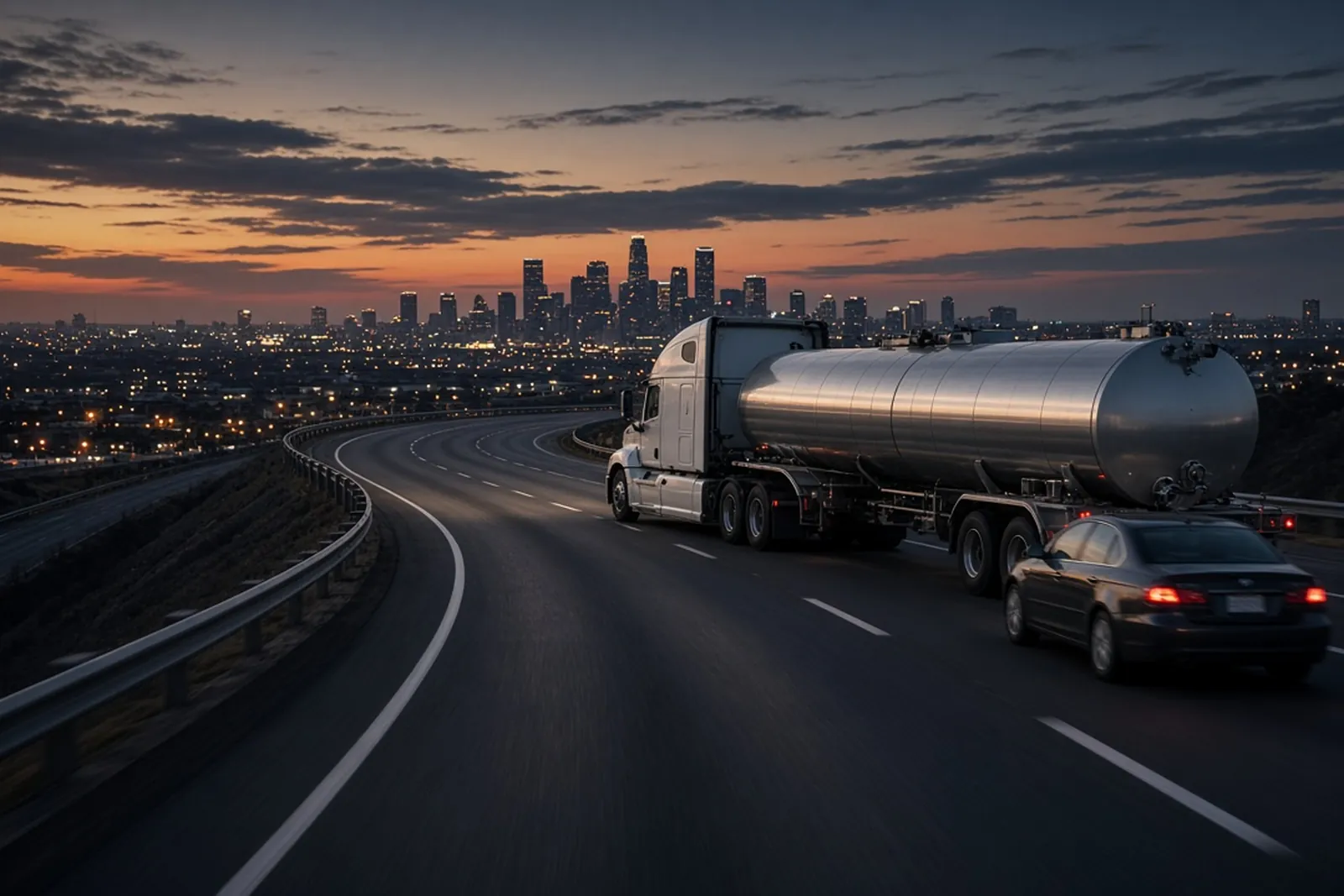
Tanker trucks carry gasoline, diesel, propane, industrial chemicals and other liquids through Louisville every day, on I-64, I-65, I-71 and I-264 and on the roads around the chemical plants in Rubbertown. A tanker truck accident can do more damage than an ordinary truck wreck. The load can shift and roll the truck, spill onto the road, catch fire or send toxic fumes into nearby neighborhoods. Federal law treats these trucks differently, and that includes how much insurance they have to carry. Learn how commercial truck wrecks differ from car crashes.
Kentucky State Police counted 176 collisions involving trucks hauling hazardous cargo in 2024, 28 of them fatal or injury crashes. Most were on interstates (39%) or U.S. and state routes (43%) (KSP, 2024 Kentucky Traffic Collision Facts).
Tanker and hazmat drivers have to meet extra requirements:
When a carrier or driver breaks one of these rules and someone gets hurt, the violation can be strong evidence of negligence. Our trucking company liability page explains how a carrier can be responsible for its own hiring, training and supervision.
Higher. Federal rules set minimum coverage by what the truck is hauling (49 CFR 387.9):
Kentucky has its own floor for in-state hazmat carriers: at least $1,000,000 per vehicle, except for bulk petroleum loads under 10,000 pounds (KRS 281.655(6)).
These are minimums. Carriers often have more, and the federal MCS-90 endorsement can make an insurer pay even when it says the policy doesn't cover the truck. See our MCS-90 endorsement guide.
Tanker cases generate records that ordinary crashes don't. The carrier must call the National Response Center within 12 hours when a hazmat incident kills someone, sends someone to the hospital, evacuates the public for an hour or more, or closes a major road for an hour or more (49 CFR 171.15). It must file a written federal incident report within 30 days after a release, or after damage to a cargo tank of 1,000 gallons or more (49 CFR 171.16).
We also go after:
For people hurt in the crash, Kentucky generally allows two years from the injury or the last PIP payment (KRS 304.39-230(6)). If you weren't in a vehicle, for example if you were exposed to fumes at home, a one-year deadline may apply instead. Our statute of limitations guide explains the differences. Don't wait on either: the truck's data and the cleanup records can disappear quickly.
We send preservation letters to the carrier, the shipper and the cleanup contractors right away, and we work with reconstruction engineers and toxicologists to show what happened and how it hurt you. We look for every policy that applies, including the higher hazmat limits. We prepare every case for trial. Larry Forman has tried 50+ jury trials and won 95% of them. Learn more about Larry Forman, see our case results (past results don't guarantee a similar outcome), or return to our truck wreck lawyer page.
Other large trucks have their own risks. See our pages on garbage truck accidents and commercial vehicle crashes. If a tanker crash took a family member's life, see our wrongful death lawyer page.
Federal rules require post-crash drug and alcohol testing of a commercial driver after a fatal crash, and after crashes where the driver is cited and someone needs medical treatment away from the scene or a vehicle must be towed. Alcohol tests are due within 8 hours and drug tests within 32 hours (49 CFR 382.303).
Tanker and hazmat drivers need a CDL endorsement, and the carrier must keep a qualification file on each driver. Ask for the file, the shipping papers for the load, and the test results in the same preservation letter.
It depends on the load. Federal rules require $5 million for many bulk hazardous loads and $1 million for oil and other hazardous materials. Kentucky requires at least $1 million for most in-state hazmat carriers.
Usually the trucking company and its driver. The shipper, the company that loaded the tank, a broker or a parts manufacturer may also share responsibility.
Possibly. People who live, work or travel near a spill can be hurt by chemical exposure. The deadline may be shorter than for people in the crash, so get advice quickly.
They identify the class of hazardous material in the tank so responders know how to handle it. Shipping papers in the cab give more detail.
Yes. They need special license endorsements, and the federal trucking and hazmat rules apply, including a ban on texting or hand-held phones with a placarded load.
Generally two years for people hurt in the crash. Other claims, like exposure claims by people who weren't in a vehicle, may have one year.
We'll find every responsible company and every policy. Get a free case evaluation or call (502) 931-6788. No fee unless we win.
This page is general information about Kentucky law as of October 2026, not legal advice.