
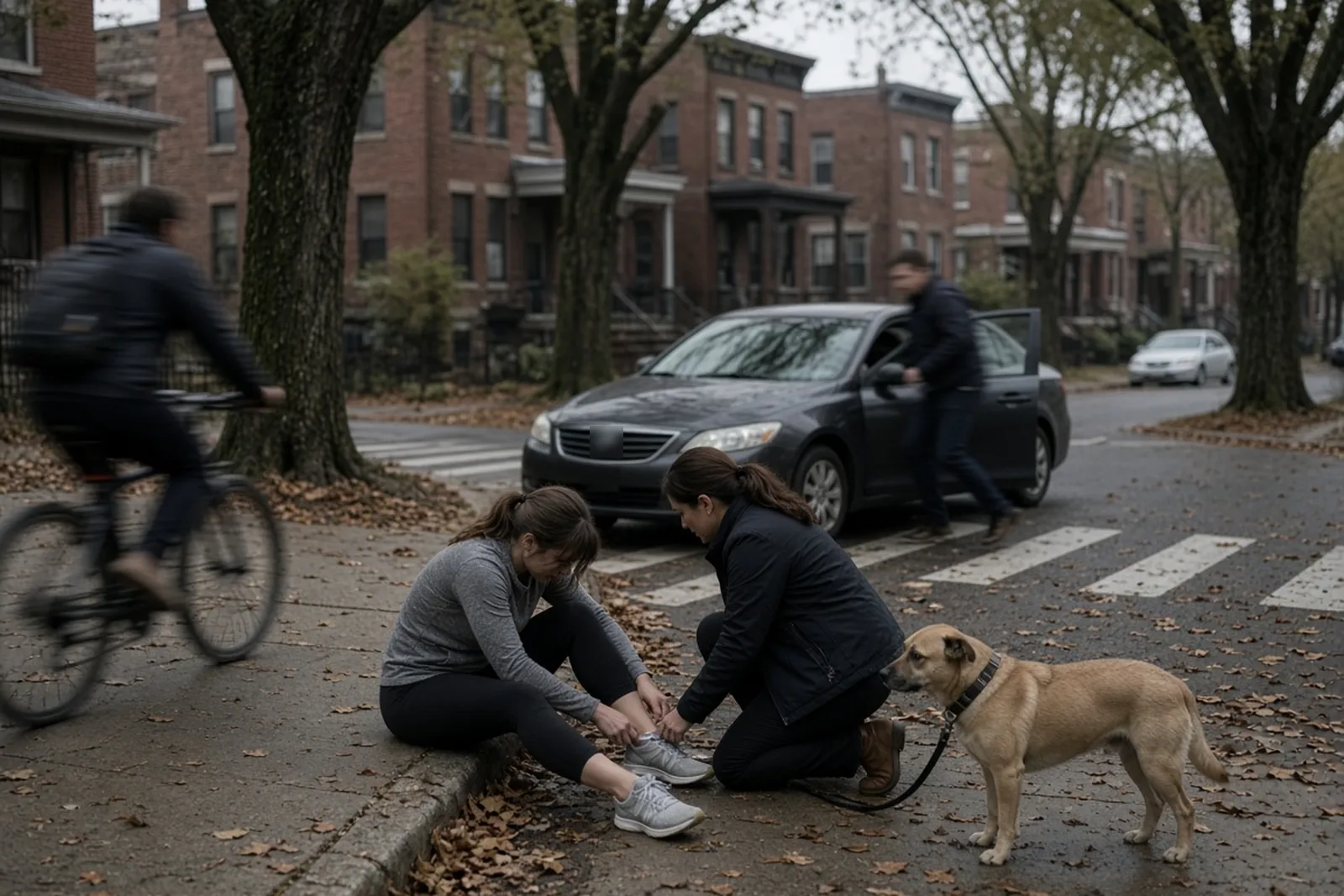
Walking or jogging around Louisville should be simple. But a driver’s mistake can change everything in a second. If you or someone you love was hit by a car while walking, the next steps matter, from the intersection or sidewalk where it happened to the insurance and legal rules that follow. This guide is for people hurt on foot, whether walking, jogging or walking a dog; for how pedestrian claims work in general, see our Louisville pedestrian accident lawyer page.
We will walk through the Louisville streets where walkers, joggers, and dog walkers get hit, including neighborhood roads, park routes, and busy commercial corridors. You will learn what Kentucky drivers owe pedestrians, how sidewalk, shoulder, and crosswalk rules can affect fault, and what injuries often result when a car hits a person on foot.
We also explain what to do at the scene if you are hit by a car while walking, how UM coverage and Kentucky PIP may apply if the driver flees, how pure comparative fault works under KRS 411.182, and the deadlines under KRS 413.140 and KRS 304.39-230. Because a pedestrian hit by a car has a motor-vehicle claim, the two-year rule under KRS 304.39-230 generally applies, measured from the injury or the last PIP payment.
Reviewed by Larry Forman, Attorney. If you need help, call (502) 931-6788 for a free case review. No fee unless we win.
Louisville Streets Where Walkers, Joggers and Dog Walkers Get Hit
Reviewed by Larry Forman, Attorney.
If you walk, jog, or walk a dog in Louisville, you know the trouble spots: busy streets with curbside parking and narrow walkways; neighborhood parks where joggers cross driveways with limited sight lines; and greenway or trail segments that touch and cross busy roads. These are the settings where a routine route turns dangerous.
If you were hit by a car while walking, you are managing a driver, an insurer, a police report, a medical bill, and a filing deadline at once. Joggers, dog walkers, and pedestrians each add a different rule to that mix. For the next step, see our Bicycle & Pedestrian Crashes on Louisville Roads.
What Kentucky Drivers Owe You When You Are on Foot
Kentucky law requires drivers to stop after a crash, but the duty starts sooner. A driver near pedestrians owes ordinary care, and KRS 189.570 requires every operator to “exercise due care to avoid colliding with any pedestrian,” sound the horn when necessary, and take proper precaution around children or visibly incapacitated people. Distraction, speed, impairment, failure to yield, or failure to keep a proper lookout can breach that care and turn a crash into a negligence claim.
Four elements decide a negligence claim. Duty: the driver must look and yield. Breach: the driver fails to use due care, for example by rolling a right turn on red while distracted. Causation: that failure causes the crash. Damages: the injuries, medical bills, and lost wages that result.
Repeat behaviors: left turns across a crosswalk, rolling right turns on red, backing from driveways and parking spots, phone use, low-light driving, and passing a vehicle stopped for someone in the roadway.
An unmarked or mid-block crossing does not erase the driver’s share of fault; Kentucky apportionment measures that share rather than wiping it out. Report, photograph, and gather witnesses from day one, because insurers hunt for evidence you contributed.
Next: sidewalk, shoulder, and crosswalk rules shape those fault arguments.
No fee unless we win.
Sidewalk, Shoulder and Crosswalk Rules That Decide Fault
After driver duty, ask where you were walking. KRS 189.570 bars walking in the adjacent roadway when a usable sidewalk exists. No sidewalk? Use the shoulder, as far from traffic as practicable. No shoulder? Stay near the outside edge; on two-way roads, walk on the left, facing traffic.
Marked and unmarked crosswalks differ. Outside marked or unmarked intersection crosswalks, pedestrians yield to vehicles. At non-signal crosswalks, drivers must yield to pedestrians crossing or approaching so closely as to be in danger, and cannot pass a car stopped for them. Signals, walk indications, mid-block crossings and beacons change the analysis.
The pedestrian rules in KRS 189.570 apply to anyone traveling on foot. Running in the roadway or entering against a signal hands the other side a fault argument. Right of way does not stop a driver who never looked.
Dog walkers face leash and control issues. A dog that pulls you into the street or breaks free complicates the injury claim and any animal-related claim.
Where you stood when you were hit by a car while walking rarely ends a Kentucky claim, but it changes fault arguments. Document the exact spot with photos, measurements, and the police report.
Injuries From a Car Hitting a Person on Foot
When you are hit by a car while walking, you have no steel frame, no seat belt, and no airbag. The bumper or grille usually strikes the legs or torso directly, and that first hit is often followed by a second impact with the pavement, a parked car, or another vehicle. Injury causation in these crashes is determined from medical and engineering evidence, not assumed.
Raise these with a doctor rather than self-diagnosing:
- Traumatic brain injury and concussion
- Neck and spine damage
- Pelvic and leg fractures
- Knee and ankle injuries, which hit runners hardest
- Torn ligaments
- Road rash and burns
- Internal bleeding or organ damage
- Soft tissue injuries that worsen over the following days
If you were hit by a car while walking, getting evaluated the same day or the next day creates the medical record linking the injury to the crash. Treating notes, imaging, prescriptions, and bills are the evidence of your damages.
What to Do at the Scene After You Are Hit by a Car While Walking
Your health comes first, but the minutes at the scene decide what evidence exists later.
- Get clear and call 911. Move out of the roadway to the safest spot you can reach. Request an ambulance even if you feel fine; an on-scene evaluation creates a contemporaneous medical record.
- Identify the driver. Write down name, address, phone number, insurer and policy number, plate number and vehicle description. If police have not arrived, photograph the driver’s license and insurance card.
- Confirm a report will exist. Before you leave, get the report or case number, the officer’s name and agency, and whether a citation was issued. A report fixes where you were, what the driver said and how the officer saw it.
- Collect witnesses and video fast. Nearby businesses, porches, doorbell cameras, dash cameras and transit or traffic cameras. Act the same day, video may not be available later.
- Document and stay quiet. Photograph your injuries, torn clothing, the crosswalk or shoulder, sight lines, lighting, signs, skid marks and the vehicle’s position. Write your own account that day. Avoid discussing fault at the scene; consult a lawyer before giving any recorded statement to an insurer. For what comes next, see the first 24 hours after a car accident.

If the Driver Flees: UM Coverage and Kentucky PIP
If you were hit by a car while walking and the driver fled, your own coverage may still respond. Kentucky is a no-fault state: basic personal injury protection (PIP) pays up to $10,000 per person for medical bills and lost wages regardless of fault. That $10,000 is a first tier of benefits, not the value of your case, and it applies to pedestrians too.
A person on foot can reach several policies: the car that struck you, a household auto policy, and your own. Which responds first depends on statute and policy terms, and it gets harder when the driver is from out of state, as our guide to out-of-state driver accidents in Kentucky explains. At home, pull each declarations page and note every policy number.
Uninsured motorist (UM) coverage stands in when the at-fault driver has no insurance or cannot be identified, meaning the hit-and-run driver. Underinsured motorist (UIM) coverage responds when the driver’s liability limits are too low. UM coverage details, including definitions and limits, vary by policy.
Report the crash to police as soon as possible and retain all documentation. Review your policy’s notice requirements promptly after the crash.
Your own auto policy can respond even though you were hit by a car while walking. When an insurer disputes coverage, litigation often settles the question, and our firm handles crash cases like these.
Shared Fault in Kentucky: How Pure Comparative Fault Works
Even when coverage exists, an insurer can still shrink what it pays by arguing that part of the crash was your fault. Kentucky courts apply what is commonly called pure comparative fault under KRS 411.182, meaning your recovery is reduced by your share of fault rather than barred outright.
How the reduction works
Under that rule, the fact finder assigns a percentage of total fault to each party. As an illustration only: at 20 percent fault, recovery drops by 20 percent; at 60 percent, it drops by 60 percent. That is how the rule operates, not a prediction of any outcome.
Where fault arguments come from
Insurers build these percentages from the pedestrian conduct factors discussed above.
When the driver who fled is never identified, that share may be recoverable from no one, which is where the UM coverage discussed above does its work.
Assume the insurer will float a fault percentage on the first phone call. Thorough documentation of sightlines, lighting, signals, and speed is how that number comes down.
The Deadlines That Threaten a Pedestrian Injury Claim
Fault percentages matter less if you wait too long. Many Kentucky injury claims carry a one-year filing deadline under KRS 413.140, and a missed deadline can end a claim, with only narrow exceptions. For motor-vehicle claims, including a person on foot struck by a car, KRS 304.39-230 provides two years from the injury or the last PIP payment, whichever is later.
Exceptions and special rules can apply depending on the claim, the coverage and the facts, so get advice now rather than waiting to see how things develop.
Other clocks run faster:
- Notice requirements for claims against a government entity or an allegedly defective roadway.
- UM and PIP policy notice requirements (discussed above).
- Evidence decay. Surveillance and dash camera video may not be available for long, and skid marks, debris and sight lines change. Missed treatment appointments create the same problem, which is why deadlines for seeing a doctor after a crash deserve attention too.
One concrete action: mark four dates on a calendar: the crash date, two years from the crash, two years from the last PIP payment, and any policy notice date. Bring that list to a lawyer instead of relying on memory.
Your Next Step After a Louisville Pedestrian Crash
Follow the scene steps outlined above, treat consistently, preserve the police report and evidence, and sign nothing from an insurer without understanding what it releases. Each one matters when fault is disputed or an insurer questions whether your injuries are real.
If the case has to be fought rather than settled quietly, courtroom experience matters. Larry Forman has tried 50+ jury trials and won 95% of them. He brings that same approach to every pedestrian crash: No fee unless we win.
Call (502) 931-6788 for a free case review.
Reviewed by Larry Forman, Attorney.
Conclusion
Being hit by a car while walking in Louisville can leave you facing serious injuries, disputed fault, and insurance tactics while you are still trying to recover. Kentucky courts apply pure comparative fault under KRS 411.182, meaning evidence of what happened matters from day one. For a pedestrian hit by a car, the deadline is generally two years from the injury or the last PIP payment under KRS 304.39-230, so acting promptly is essential. Photos, video, the police report, and consistent medical treatment all protect your claim.
Your next step is simple. Call Larry Forman at (502) 931-6788 for a free case review. No fee unless we win, call (502) 931-6788.