Reviewed by Larry Forman, Attorney
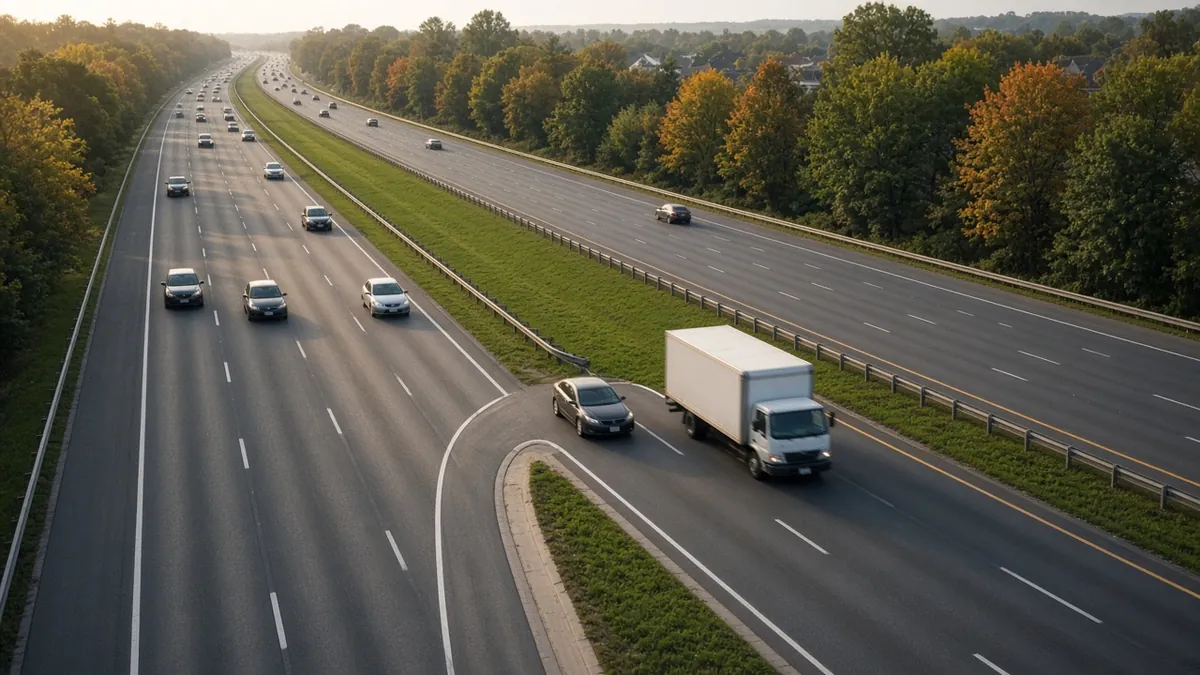
The Gene Snyder Freeway is Louisville's outer loop. It sweeps around the south and east sides of the city through Okolona, Fern Creek, Jeffersontown, Middletown and Prospect, crosses I-65, I-64 and I-71, and runs north to the Ohio River. Commuters treat it as a fast way around the city, and trucks use it to skip downtown. When something goes wrong at those speeds, a Gene Snyder accident is rarely minor. Here's where crashes happen, what causes them and how fault is sorted out.
Where Gene Snyder crashes happen
- The interstate interchanges. Traffic transfers between the Snyder and I-65 in the south, I-64 near Middletown and I-71 near Prospect. Short merges and drivers cutting across lanes for an exit cause many sideswipes. See sideswipe accidents.
- The I-64 interchange. It was rebuilt with new flyover ramps as part of the state's I-Move Kentucky project. Drivers who learned the old layout can still get caught off guard.
- Busy surface-road exits, including Preston Highway, Bardstown Road, Taylorsville Road, Shelbyville Road, La Grange Road, Westport Road and Brownsboro Road, where traffic backs up onto the freeway at rush hour
- The southwest end, where the freeway continues west of I-65 toward Dixie Highway as KY 841. Two of the surface roads that feed it there, Taylor Boulevard/New Cut Road and Greenbelt Highway/Cane Run Road, are on Louisville's High Injury Network of the city's most dangerous streets.
- The north end toward the river, with a tunnel and a bridge crossing. Drivers from across the river may be involved. See out-of-state driver accidents.
If you live or work along the Snyder, see our Jeffersontown, Middletown and Okolona pages.
How many crashes happen on the Gene Snyder?
| I-265 in Kentucky (2024) | Number |
|---|---|
| Total collisions | 756 |
| Fatal collisions | 4 |
| People killed | 5 |
| People injured | 118 |
Source: KSP, 2024 Kentucky Traffic Collision Facts, "Collisions on Interstates and Parkways."
For comparison, the Watterson Expressway (I-264), the inner loop, had 1,428 collisions the same year. See Watterson Expressway accidents.
The I-Move Kentucky widening
The state widened the Gene Snyder from four lanes to six, three in each direction, between Taylorsville Road and I-71, and rebuilt the I-64 interchange with flyover ramps. The main work was substantially complete in November 2024, with finishing work like sound walls and signs continuing after that (KYTC, Nov. 26, 2024).
More lanes can mean smoother traffic, but also higher speeds and more lane changes. When a crash happens in an active construction area, special rules can apply. See our work zone accident page.
What causes crashes on the Snyder?
- Speed. Wide lanes and long straight stretches encourage it, and speed turns small mistakes into serious crashes.
- Following too closely when rush-hour traffic suddenly stops near an interchange. See rear-end collisions.
- Unsafe lane changes across several lanes to reach an exit
- Distracted and drowsy driving on a road that feels easy
- Crossover crashes. A car that leaves its side of the road and crosses the median can cause a head-on collision.
- Wrong-way drivers entering on an exit ramp. See wrong-way driver accidents.
- Heavy trucks bypassing downtown. See our truck wreck lawyer page.
Who is at fault in a Gene Snyder accident?
Usually the driver who was speeding, following too closely, changing lanes unsafely or not paying attention. In chain-reaction crashes, fault can be split among several drivers. See multi-vehicle pileups. If a truck was involved, the trucking company may share responsibility along with its driver.
Kentucky's pure comparative fault rule means you can recover even if you were partly at fault, reduced by your share. See our Kentucky negligence law guide. The interchange crashes where the Snyder meets I-64 and I-71 are similar to the ones we see downtown at Spaghetti Junction.
What to do after a crash on the Gene Snyder
- If you can move your car, get to the shoulder and turn on your hazard lights. If you can't, stay buckled in.
- Call 911 and give your direction and the nearest interchange or cross street.
- Take photos of the cars, lanes and any skid marks once it's safe.
- Save your dashcam video right away. See dashcam footage after a crash.
- Get the names of witnesses, and the company name and DOT number of any truck.
- Get medical care the same day, even if you feel okay.
How Forman & Associates helps
We move quickly to preserve the evidence that disappears first on a busy freeway: video, vehicle data and witness accounts. We identify every driver, company and insurer involved. We prepare cases for trial from the start. Larry Forman has tried 50+ jury trials and won 95% of them. See our Louisville car accident attorney page for more.
Gene Snyder accident FAQ
How many crashes happen on I-265 in Kentucky?
Kentucky State Police counted 756 collisions on I-265 in Kentucky in 2024, with 5 people killed and 118 injured.
Is the Gene Snyder still under construction?
The main I-Move Kentucky widening between Taylorsville Road and I-71 and the new I-64 interchange were substantially complete in November 2024. Smaller projects and lane closures still happen.
Who is at fault for a crash at a Gene Snyder interchange?
Usually the driver who merged or changed lanes unsafely, or who followed too closely in slowing traffic. Fault can be shared when several drivers contributed.
What if a truck caused my Gene Snyder accident?
The trucking company may be responsible along with the driver. Trucks carry higher insurance limits, and the company's driver and maintenance records can be key evidence.
How long do I have to file a claim after a Gene Snyder crash?
Generally two years from the crash or the last PIP payment for Kentucky car crash claims. Evidence like video disappears much sooner, so don't wait.
Hurt in a crash on the Gene Snyder?
Let us preserve the evidence while it still exists. Get a free case evaluation or call (502) 931-6788. No fee unless we win.
This post is general information about Kentucky law, not legal advice.