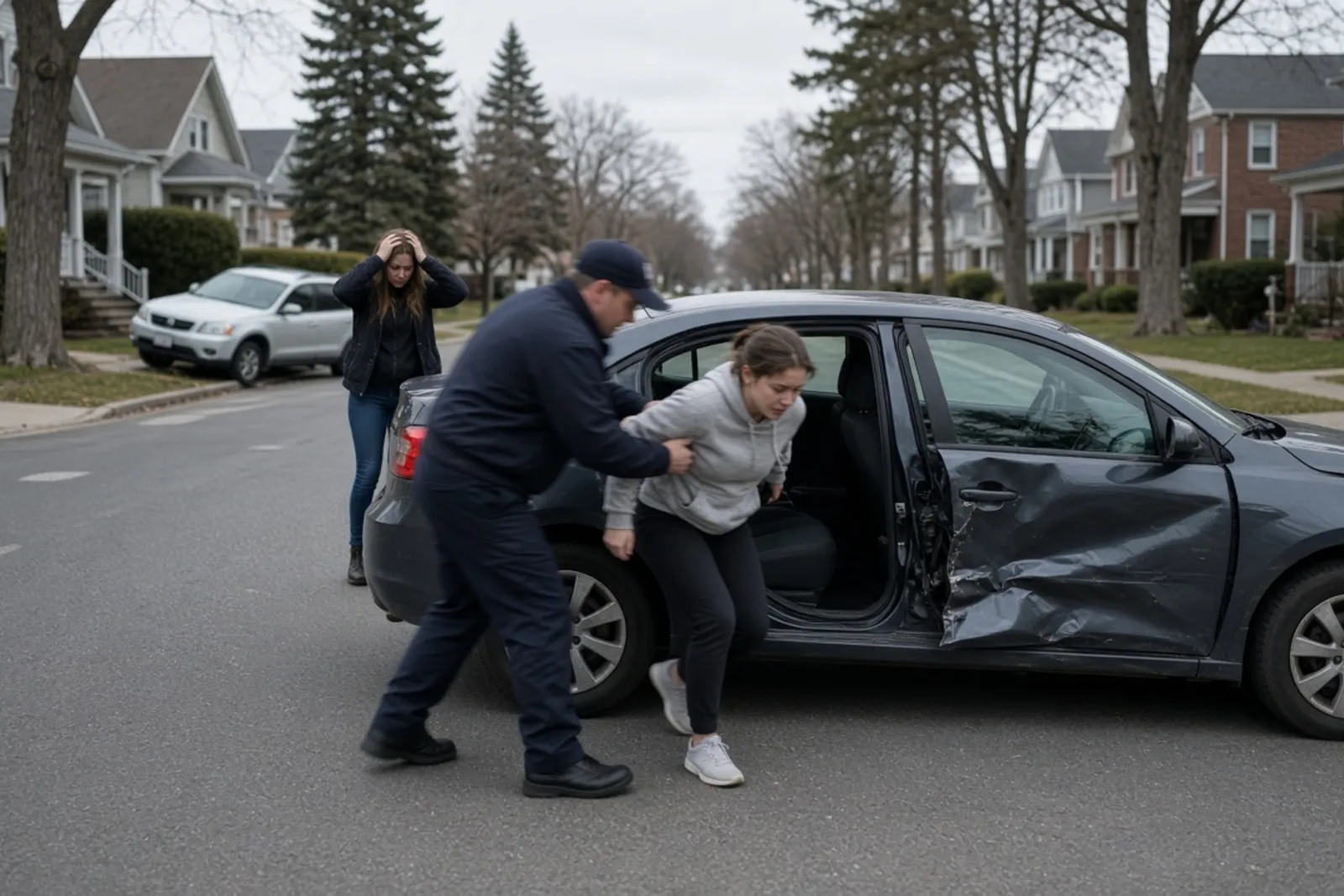
Injured as a Passenger? Your Rights After a Kentucky Car Crash
Hurt as a passenger in Kentucky? Learn how a passenger injury claim works: whose PIP pays, how to claim against either driver (even a family member), and what coverage may apply.
Reviewed by Larry Forman, Attorney
As a passenger, you didn’t control the speed, the lane or the turn. You were just along for the ride. Yet after a crash, passengers often get the most confusing answers: whose insurance pays, whether you can claim against a friend or family member who was driving, and what happens when both drivers blame each other.
The good news is that passengers are usually in a strong position under Kentucky law. You’re rarely at fault, and several insurance policies may be available to you. Forman & Associates helps injured passengers in Louisville and across Kentucky sort out who pays and how much.
Step one: PIP pays first, from the car you were riding in
Kentucky’s no-fault law provides personal injury protection (PIP) benefits for medical bills and lost wages, up to $10,000 per person, regardless of fault. For a passenger, the order is set by KRS 304.39-050:
The policy on the vehicle you were in pays first.
If that vehicle had no insurance, a policy under which you are a “basic reparation insured” applies. That’s usually your own auto policy, or one covering a relative you live with.
If the first insurer doesn’t pay within 30 days after reasonable proof of the loss, you may be able to collect from your own policy, which then gets reimbursed.
You can’t collect PIP from more than one company for the same crash, or more than $10,000 in basic benefits total (KRS 304.39-050(3)). Some policies carry added PIP above that. See how Kentucky PIP works.
Step two: claims against the driver or drivers at fault
PIP covers only part of your losses. For pain and suffering, the rest of your medical bills and the rest of your lost income, you bring a claim against whoever caused the crash, once your injury meets Kentucky’s no-fault threshold. That means more than $1,000 in medical expenses, a broken bone, permanent injury, or one of the other qualifying injuries in KRS 304.39-060(2)(b).
The at-fault party could be:
The other driver
The driver of your own car
Both of them. Under Kentucky’s comparative fault statute, each pays its “equitable share” based on its percentage of fault (KRS 411.182)
Someone else entirely, such as a driver’s employer, a vehicle owner, or a party responsible for a road hazard
Because a passenger usually has no share of fault, the main dispute is often between the drivers and their insurers. That’s one reason not to rely on either driver’s insurer to look out for you. Both may try to minimize your injuries to protect their own driver. See common insurance adjuster tactics.
“But the driver is my friend,” or “my spouse”
This is the hardest part for many passengers. Here’s what helps to know:
The claim is paid by insurance. In most cases, a claim against the driver of your car is a claim against that driver’s liability insurance. That coverage exists for exactly this.
Family members aren’t shut out. In Lewis v. West American Insurance Co., 927 S.W.2d 829 (Ky. 1996), the Kentucky Supreme Court held that “family exclusion” clauses in liability policies are “invalid and unenforceable.” In that case, a 9-year-old passenger hurt while her mother was driving was entitled to the policy’s full limits, not just the state minimum.
Kentucky has no “guest statute.” Some states once barred passengers from suing their drivers. Kentucky’s was struck down decades ago.
You don’t have to decide anything on day one. But don’t let loyalty or awkwardness lead you to skip the coverage that’s there to protect you.
When the insurance isn’t enough: UM and UIM
Kentucky’s minimum liability limits are only $25,000 per person (KRS 304.39-110). Serious injuries can exceed that quickly. Additional coverage may include:
Underinsured motorist (UIM) coverage on the car you were riding in, if you qualify as an insured under that policy
Your own UIM coverage, or a household relative’s
Uninsured motorist (UM) coverage if an at-fault driver had no insurance or fled
Whether you count as an “insured” depends on each policy’s wording, so we review every policy that might apply. See our underinsured motorist and uninsured motorist pages.
Seat belts and child passengers
Kentucky requires seat belts for drivers and passengers, but not wearing one “shall not constitute negligence per se” (KRS 189.125(5)). Insurers may still argue that a missing seat belt made injuries worse, so expect the question.
For children, the same subsection says failure to use a child restraint or booster seat “shall not be considered as contributory negligence” and isn’t admissible in a civil trial.
When the injured passenger is a child, a parent or guardian brings the claim. Settling a minor’s claim usually requires extra legal steps to protect the money until the child is an adult.
Passengers in other kinds of vehicles
Uber or Lyft: different insurance layers apply depending on the app’s status. See our rideshare injury page.
Motorcycle passengers: Kentucky’s no-fault tort limits don’t apply to injuries to “the passenger of a motorcycle” (KRS 304.39-060(2)(c)). See our motorcycle wreck page.
What passengers should do after a crash
Get medical care right away, even if the drivers seem more hurt than you.
Photograph both vehicles and where you were sitting.
Get insurance information for both drivers, plus the vehicle owner if it’s someone else.
Find your own auto policy, and any policy for relatives you live with.
Don’t give recorded statements to either driver’s insurer before getting advice.
Watch the deadline. Most Kentucky crash lawsuits must be filed within two years of the crash or the last PIP payment, whichever is later. A spouse’s separate loss of consortium claim may have only one year. See the statute of limitations guide and our guide to loss of consortium.
How we help injured passengers
Identify every policy: both drivers, the vehicle owner, and your household’s PIP, UM and UIM
Sort out fault between the drivers so your claim isn’t caught in the middle
Coordinate PIP and health insurance so your bills are handled
Document your injuries and lost income fully
Handle a claim against a friend or family member’s insurer with care. We’ll explain how the process works and any conflict issues.
File suit when needed. Larry Forman has tried 50+ jury trials and won 95% of them.
Whose insurance pays a passenger’s medical bills in Kentucky?
Usually the PIP coverage on the vehicle you were riding in, up to $10,000. If that vehicle had no insurance, your own policy or a household relative’s may apply (KRS 304.39-050).
Can a passenger sue the driver of the car they were in?
Yes, if that driver was at fault. The claim is usually paid by the driver’s liability insurance. Kentucky has no guest statute barring these claims.
Can I make a claim if the driver was my spouse or parent?
Generally, yes. The Kentucky Supreme Court held in Lewis v. West American Insurance Co. (1996) that family exclusion clauses in liability policies are unenforceable.
What if both drivers were at fault?
Each driver’s insurer pays its share based on percentage of fault under KRS 411.182. As a passenger, you can bring claims against both.
Will not wearing a seat belt hurt my claim?
Kentucky law says it isn’t negligence per se (KRS 189.125(5)), but insurers may argue it made injuries worse. It doesn’t automatically bar your claim.
How long does a passenger have to file a claim?
Generally two years from the crash or the last PIP payment for the injury claim against a driver. Other claims can have shorter deadlines, so talk to a lawyer early.
Hurt as a passenger? Let’s sort it out
We’ll find every policy that applies and handle the insurers, including when the driver is someone you care about. No fee unless we win. Get a free case evaluation or call (502) 931-6788. Our office is at 1139 S. 4th St., Louisville, KY 40203.
More answers: our personal injury FAQ.
This page is general information about Kentucky law, not legal advice. Coverage depends on the exact policy language.