Reviewed by Larry Forman, Attorney
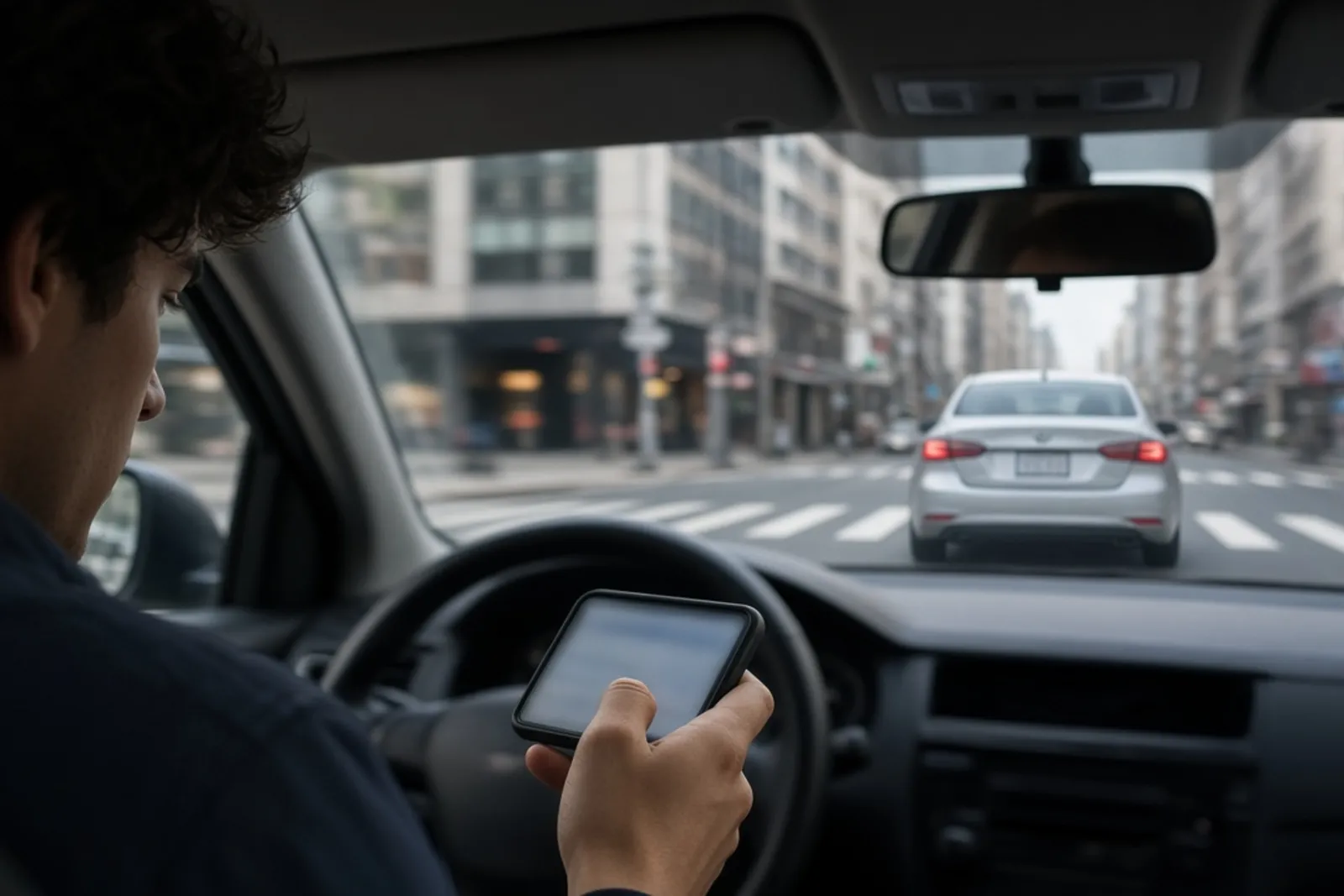
Most people hit by a distracted driver have the same thought: they weren’t even looking. Maybe you saw the phone in their hand, or they admitted it at the scene. Or maybe you just know nobody paying attention would have done what they did.
Knowing it and proving it are different things. Distraction leaves fewer traces than skid marks, and those traces start disappearing quickly. Forman & Associates represents people hurt by distracted drivers in Louisville and across Kentucky. This page explains what Kentucky law prohibits, how distraction is proven, and what to do now.
How big is the problem?
According to NHTSA’s research note Distracted Driving in 2023, 3,275 people were killed in U.S. crashes involving distracted drivers that year. NHTSA counts crashes where police identified at least one distracted driver. That count almost certainly understates the problem, because distraction is hard to detect after the fact.
Kentucky’s numbers show the same pattern. In the Kentucky State Police 2024 Collision Facts report, officers listed driver inattention in 42,363 collisions, about 36% of all reported crashes. They listed distraction in 4,479 and cell phone use in 925. Phone use only gets recorded when an officer can tell. See our Kentucky car crash statistics.
What Kentucky law says about phones and driving
Texting is banned for all drivers
KRS 189.292 says no one may, “while operating a motor vehicle that is in motion on the traveled portion of a roadway, write, send, or read text-based communication using a personal communication device.” That includes text messages, instant messages and email.
The statute has exceptions, including:
Using a phone’s GPS or a built-in navigation system
Reading, selecting or entering a phone number or name to make a call
Texting to report illegal activity, summon medical help or law enforcement, or prevent injury
Drivers under 18 face broader limits
KRS 189.294 bars drivers under 18 from using a personal communication device at all while the vehicle is in motion on the traveled portion of a roadway. The only exception is summoning medical help or police in an emergency. A stand-alone or built-in navigation system doesn’t count as “use,” but typing into a phone’s GPS does.
No general hands-free law for adults
As of October 2026, Kentucky doesn’t have a general hands-free law for adult drivers. Holding a phone for a call isn’t, by itself, a violation of these statutes for an adult. That doesn’t make it safe or legal to drive carelessly. Every driver must operate “in a careful manner, with regard for the safety and convenience of pedestrians and other vehicles” (KRS 189.290). A driver watching a video, scrolling an app or dialing while drifting into your lane can be negligent whether or not a texting statute applies.
Why a violation matters in your claim
Kentucky law says “a person injured by the violation of any statute may recover from the offender such damages as he sustained by reason of the violation” (KRS 446.070). When a driver was texting in violation of KRS 189.292 and that caused the crash, the violation itself can be powerful evidence of fault.
Commercial drivers have stricter federal rules
Drivers of commercial motor vehicles are covered by federal safety rules that prohibit texting and using a hand-held mobile phone while driving (49 C.F.R. §§ 392.80 and 392.82). Trucking and delivery companies may also have their own written phone policies. Violating those policies can be important evidence. See our truck wreck, commercial vehicle and delivery vehicle crash pages.
Distraction isn’t just phones
Safety researchers describe three kinds of distraction:
Visual: eyes off the road, such as reading a screen, looking at a map or turning to the back seat
Manual: hands off the wheel, such as eating, reaching or adjusting controls
Cognitive: mind off driving, such as an intense conversation or daydreaming
Phones combine all three, which is why they’re so dangerous. In-dash touchscreens, rideshare and delivery apps, grooming and eating cause crashes too. See our rideshare injury page for app-based drivers.
How we prove a driver was distracted
Distraction cases are built from several sources that point the same way:
Phone records. Carrier records can show the timing of calls, texts and data use around the moment of the crash. Getting them usually requires a lawsuit and a subpoena or court order. Courts often limit records to a narrow window around the crash, so the request has to be precise.
Vehicle data. Event data recorders can show speed, braking and steering in the seconds before impact. No braking before a rear-end crash is a classic sign the driver wasn’t looking. See our guide on black box evidence for commercial vehicles.
The vehicle’s infotainment system. Many cars log phone connections, calls and messages through Bluetooth.
App and employer data. Delivery and rideshare apps, and fleet telematics, can show what the driver was doing on the app.
Video. Dashcams, in-cab cameras, doorbells and business cameras.
Witnesses. People who saw the driver looking down, or saw the phone.
Admissions. What the driver said at the scene or to police.
Crash reconstruction. A driver who never reacted to a hazard they should have seen tells its own story.
Speed matters. Video can be overwritten within days. Phone carriers don’t keep every type of record forever. We send preservation letters right away so evidence isn’t lost. Our checklist of evidence to preserve after an accident explains what you can save yourself.
Common distracted-driving crashes in Louisville
Rear-end collisions in stop-and-go traffic. See our rear-end collision page.
Expect the other driver’s insurer to deny any phone use, argue you were partly at fault, or minimize your injuries. Under Kentucky’s pure comparative fault rule, your recovery is reduced by any percentage of fault assigned to you. See how pure comparative fault works. Strong evidence of distraction undercuts those arguments.
In rare cases, distraction combined with other extreme conduct may support a claim for punitive damages. The bar in Kentucky is high. See our guide to punitive damages in Kentucky.
What to do after a crash with a distracted driver
Call 911 and tell the officer if you saw the driver using a phone.
Get names and numbers of witnesses, especially anyone who saw the driver before impact.
Write down what the driver said, as soon as you can.
Look for cameras nearby: businesses, homes, buses.
Get medical care right away and follow through.
Don’t give the other insurer a recorded statement.
Call a lawyer quickly so preservation letters go out before evidence is lost.
Deadlines apply: most Kentucky crash lawsuits must be filed within two years of the crash or last PIP payment, and some claims have shorter limits. See the Kentucky statute of limitations guide.
How Forman & Associates can help
We move fast to lock down phone, vehicle and video evidence. We build the medical case and deal with every insurer. Larry Forman has tried 50+ jury trials and won 95% of them, and we prepare every case to be tried if needed. Learn more about Larry Forman or visit our main car crash lawyer page.
Distracted driving accident FAQs
Is texting while driving illegal in Kentucky?
Yes. KRS 189.292 bars all drivers from writing, sending or reading text-based communications while the vehicle is in motion on the traveled portion of a roadway, with limited exceptions like GPS and emergency use.
Is it illegal to talk on a hand-held phone while driving in Kentucky?
For adult drivers, Kentucky doesn’t currently have a general hands-free law. Drivers under 18 can’t use a personal communication device while driving except to call for help in an emergency, and commercial drivers face federal hand-held phone limits.
How can I prove the other driver was on their phone?
Through phone records obtained in a lawsuit, vehicle and infotainment data, app or employer data, video, witnesses and the driver’s own statements. Act fast, because some of that evidence is short-lived.
Can I get the other driver’s phone records?
Usually through a subpoena or court order after a lawsuit is filed. Courts often limit the request to a short window around the crash.
Does a texting violation automatically mean I win?
Not automatically. You still have to show the violation caused the crash and prove your damages. But a texting violation can be strong evidence of fault under KRS 446.070.
What if the distracted driver was working?
Their employer may also be responsible, and federal rules may apply if it was a commercial vehicle. Company phone policies and app data can become key evidence.
Hurt by a distracted driver? Call us
The sooner we start, the more evidence we can save. No fee unless we win. Get a free case evaluation or call (502) 931-6788. Our office is at 1139 S. 4th St., Louisville, KY 40203.
This page is general information about Kentucky law, not legal advice.