

The moments immediately following a car accident are among the most disorienting of a person’s life. Your heart is racing, adrenaline is flooding your system, and you may not even realize how seriously you or someone else has been injured. What you do in those first 24 hours, however, can make or break your ability to recover fair compensation.
Most people make costly mistakes in the chaos following a crash, not out of carelessness, but simply because nobody ever taught them what to do. They apologize at the scene. They skip the police report. They give a recorded statement to an insurance adjuster before fully understanding their rights. Each of these missteps can severely damage a legitimate claim before it even begins.
This guide walks you through every critical step you need to take in the first 24 hours after a car accident. You will learn how to document the scene properly, what information to collect, which words to avoid saying out loud, and how to protect yourself when insurance companies come calling. Follow this checklist, and you will be in a far stronger position from the very first minute.
Why the First 24 Hours Define Your Entire Claim
Every word you say at a crash scene becomes evidence. Every apology, every offhand “I’m sorry,” every speculation about speed or fault gets preserved and can be used against you throughout the claims process.
When the other driver’s insurer calls, it is often sooner than you expect, and their interest is in resolving the claim efficiently for themselves, not maximizing your recovery.
Under Kentucky’s pure comparative negligence statute, even a partial admission of fault proportionally reduces your recoverable damages. A 20% fault assignment means a 20% reduction in your award. Communication discipline starts at the scene, not when the adjuster calls.
Practical reality: witnesses leave, conditions change, and details blur quickly, which is why immediate documentation matters.
This checklist runs chronologically from the roadside through the end of day one. Bookmark it now, before you need it. If a fatality is involved, Kentucky’s wrongful death law carries additional rules about who can file and who can recover that most families do not learn until it is too late.
Step 1: Secure the Scene and Assess Injuries Immediately
The clock starts the instant your vehicle stops moving.
Activate your hazard lights immediately, before you assess damage, before you check your phone, before you do anything else. This single action warns oncoming traffic and reduces your risk of a secondary collision.
Before opening a door, check yourself and every passenger for injury. Do not trust how you feel. Adrenaline released during impact routinely suppresses pain, meaning serious injuries, including concussions and soft tissue damage, may not register for hours.
Call 9-1-1 right away if anyone is injured, showing distress, or if you are simply unsure. You are not qualified to triage crash injuries at a roadside without medical training. When uncertain, call.
Do not move anyone who may be injured unless there is an immediate threat such as fire. Moving a person with an undetected spinal injury can cause permanent paralysis.
Only move vehicles if the crash is clearly minor, everyone is uninjured, and the position creates an active secondary hazard. For any serious collision, leave vehicles where they came to rest. Investigators reconstruct fault from collision geometry, and moving a vehicle destroys that evidence permanently.
For a broader overview of what to do after a car crash, this resource covers the full picture once the immediate scene is secure.
Step 2: Call the Police and Get a Report Number
Once 9-1-1 is called and the scene is secured, your next priority is a written police report, even when the crash looks minor.
Kentucky law requires you to report accidents involving injury, death, or property damage exceeding $500. Even below that threshold, request a responding officer. A contemporaneous police report carries far greater evidentiary weight than a memory offered weeks later.
When officers arrive, keep your answers factual. Describe the sequence of events, your approximate speed, and road conditions. Do not apologize, speculate about fault, or offer theories about the crash.
Before the officer leaves, collect their full name, badge number, and the report number. Under KRS 189.635, law enforcement must file the completed report within 10 days; check with the Kentucky State Police for availability after that window. Our guide on how to get a Kentucky accident report and what to do if it contains errors walks through that process in detail.
If police decline to respond, file your own report through the Kentucky State Police civilian collision reporting portal within 10 days. Failure to report when required can result in fines or license suspension.
Step 3: Document the Scene Before Anything Is Moved
While the officer’s report is being filed, start building your own evidence record. Every minute the scene sits undisturbed is a minute you can use.
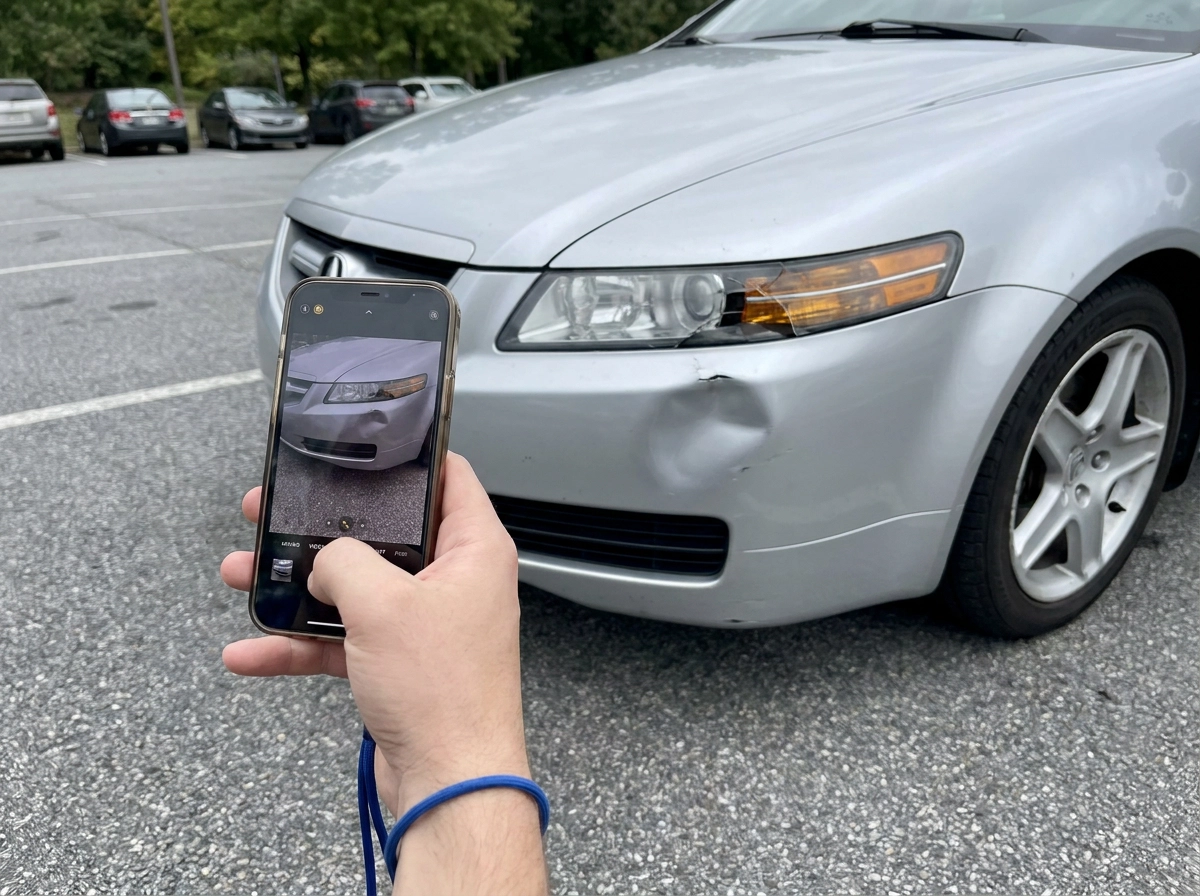
Photograph every vehicle before anyone moves. Shoot all four sides of every car involved, then take close-ups of each contact point and all visible damage. Also capture each license plate, any insurance card displayed in a window, and the VIN through the windshield.
Expand your frame to capture context. Photograph tire marks, debris, traffic signals, stop signs, lane markings, and the nearest cross street or mile marker. These establish location, road conditions, and environmental factors that directly affect liability.
Document your own injuries now. Research in peer-reviewed forensic medicine confirms that bruising, lacerations, and swelling peak in the hours immediately following impact and may diminish before your first medical appointment. Photograph every visible mark before you leave the scene.
Collect witness information before people disperse. Names and phone numbers take 30 seconds to capture; tracking witnesses down days later is often impossible.
Record a short narrated video walkthrough. Still photos miss spatial relationships. A brief video preserves context that images alone cannot.
For a complete breakdown of what evidence matters most, see what evidence you should preserve after a Kentucky car accident.
Step 4: Exchange Information the Right Way
Once you have photographed the scene, turn your attention to collecting the other driver’s information before anyone leaves.
Collect the following from every driver involved:
- Full legal name, home address, and phone number
- Driver’s license number
- License plate number
- Insurance company name and policy number
Photograph, do not transcribe. Hold your phone up to the other driver’s insurance card and license and photograph both documents directly. A single transposed digit in a policy number can delay or derail your claim.
In multi-vehicle crashes, repeat this process for every driver. Do not assume the police report will cover it. Officers occasionally transpose numbers or omit a party entirely, and you may not discover the error until weeks into the claims process.
Keep the conversation strictly functional. Exchange contact details, nothing more. Do not explain what you were doing, how fast you were going, or what you think caused the crash. That conversation has no upside for you.
Finally, note the make, model, year, and color of each vehicle and count the occupants in each. Occupant numbers directly affect how injury claims are valued, and this detail is easy to capture now and nearly impossible to verify later.
Step 5: What Not to Say at the Scene (This Is Where Claims Are Lost)

Once you have exchanged information, close that conversation. What you say next is where claims are quietly won or lost.
Never say “I’m sorry,” “I didn’t see you,” or “I wasn’t paying attention” in any form. Under Kentucky Rules of Evidence 801A(b), your own statements are admissible against you in litigation without hearsay protection. A roadside apology is not courtesy; it is evidence. For a full breakdown of how partial fault affects your recovery, read the rules for partly at fault drivers recovering compensation in a Kentucky car crash.
Do not speculate about fault, your speed, or road conditions. Fault is a legal determination, not a roadside conclusion.
Avoid accusations toward the other driver. Even accurate ones can damage your credibility and escalate conflict in ways that complicate your claim.
If the other driver says something like “you pulled out in front of me,” do not deny it, explain it, or agree. A silent, neutral non-response is legally safer than any reply.
These rules apply to everyone at the scene except law enforcement. Bystanders and witnesses may be recording, may know the other driver, or may mischaracterize what you said. Treat every non-officer ear as a potential adverse witness.
Step 6: Seek Medical Evaluation Within the First 24 Hours
As noted, adrenaline suppresses pain signals after a crash. Concussions, soft tissue injuries, and internal trauma frequently produce no symptoms until well after the collision. Feeling okay does not mean you are okay.
Seek evaluation within 24 hours. Choose based on severity: emergency room first, urgent care second, primary care physician third. Tell the provider every symptom, including minor soreness, headaches, or stiffness you would normally dismiss.
Be precise about how the injury occurred. Give the provider the accident date, time, and a brief description of how your body moved on impact. That information enters your medical record and establishes the causal link between the crash and your injuries.
A gap in your medical timeline can invite questions about whether injuries were caused by this accident, getting evaluated promptly eliminates that uncertainty.
Keep every document: discharge paperwork, prescription receipts, and follow-up appointment records. Medical records are the evidentiary foundation of a personal injury claim. Missing records are rarely recoverable later. The same discipline applies in other serious incidents, such as the steps outlined for those seeking guidance after an aviation crash injury.
Step 7: Notifying Your Insurance Company, And What to Watch For
Once you have medical documentation, notify your own insurer promptly. Most policies require timely notification as a condition of coverage, meaning delays can jeopardize your benefits regardless of who caused the crash.
When you call, keep it factual: date, time, location, the other driver’s information, and the police report number. Do not offer a narrative about what happened or who you believe was at fault. That determination belongs to investigators and attorneys, not a call made the day of the accident.
Adjusters represent the insurer’s interests, not yours, keeping your initial statement factual protects your options.
If the other driver’s insurance company calls before you have spoken with an attorney, personal injury attorneys consistently advise against giving a recorded statement to the opposing insurer without counsel, you can decline and request to respond through an attorney. For a clear picture of how quickly insurers build a fault narrative against you, and what it takes to push back, the stakes become obvious.
Off-the-cuff answers to a trained adjuster’s leading questions can contradict your medical records, establish partial fault, or minimize injury severity in ways that are nearly impossible to correct later.
The Recorded Statement: Why You Should Never Give One Without an Attorney
Recorded statements are a standard tactic, not a neutral request. Adjusters who call you are trained interviewers, not fact-finders. Their questions are structured to surface admissions, expose inconsistencies, and capture minimizing language that reduces your claim’s value.
The timing is deliberately designed to work against you. A good-faith statement like “I feel okay” or “it wasn’t that bad,” made hours after a crash, can be presented as evidence weeks later when a concussion or soft tissue injury becomes fully symptomatic. As covered earlier, declining to give a recorded statement and routing communications through counsel is the consistent advice of personal injury attorneys. Beyond that point, the risks multiply quickly.
Even accurate answers carry risk when they are incomplete. “Were you wearing your seatbelt?” and “how fast were you going?” are not neutral questions. Together, they construct a contributory fault picture.
The solution costs nothing: consult a personal injury attorney before any recorded statement is given. One conversation can protect thousands of dollars in claim value, whether or not you ultimately hire representation.
When to Consult a Personal Injury Attorney After a Car Accident
That advice about recorded statements applies the moment any injury exists, including soreness, headaches, or stiffness.
An attorney reached within the first 24 hours can direct evidence preservation, communicate with adjusters on your behalf, and block early mistakes that permanently reduce settlement value. Consultations are free.
The assumption that attorneys are only for serious injuries is one of the most costly misconceptions in personal injury claims. Soft tissue injuries are commonly undervalued because they are not visible at the scene and symptoms often emerge days later, by which point early minimizing statements have already been recorded.
The real question is not whether your case is big enough for an attorney. It is whether you want representation whose financial interest is aligned with maximizing your recovery.
Your Complete First 24 Hours Checklist at a Glance
Here is everything covered in one scannable reference you can return to at any point during the first day.
Immediately at the scene
- Hazard lights on before anything else
- Check yourself and all passengers for injury; do not rely on how you feel in the moment
- Call 9-1-1; do not guess at injury severity yourself
- Do not move injured persons unless fire or immediate life threat exists
While waiting for police
- Photograph all vehicles from every angle, all damage, license plates, and road conditions
- Capture skid marks, debris, traffic signs, and cross streets
- Collect names and phone numbers from every witness before they leave
When police arrive
- State facts only: sequence of events, speed, road conditions
- Obtain the officer’s name and the report number before they leave
- Do not speculate about fault and do not apologize
Information exchange
- Record the other driver’s full name, license number, insurance company, and policy number
- Photograph the insurance card and license directly; do not transcribe
Words to avoid at all times
- “Sorry,” “my fault,” “I didn’t see you,” “I’m fine,” and any statement about cause
- These can be treated as admissions and used to reduce your recovery
Within hours of the accident
- Seek medical evaluation even without obvious symptoms; injuries surface days later
- Tell your provider exactly how the crash occurred; document every symptom
Before end of day
- Notify your own insurer with basic facts only: date, location, report number
- Decline any recorded statement request from the opposing insurer until you have spoken with an attorney
First opportunity
- Consult a personal injury attorney; initial consultations are free, and early involvement is the single highest-impact step you can take to protect your claim’s full value
Protect Your Claim From the First Minute
Every step in this checklist carries legal weight. These are not formalities; they are the evidentiary foundation your entire claim will stand or fall on.
The most damaging mistakes are rarely obvious. A reflexive apology, a symptom you didn’t mention to the ER physician, a recorded statement given before you understood the stakes, these are the errors that quietly reduce or eliminate recoveries.
Insurance companies have institutional systems built to resolve claims efficiently for the insurer. You deserve representation built to do the opposite.
If you were injured in a Kentucky car accident, contact Larry Forman Law for a free consultation. Getting counsel before you speak to any adjuster costs you nothing and could protect everything.
Conclusion
The first 24 hours after a car accident are not a grace period. They are the foundation of your entire claim, and every decision you make during this window carries lasting consequences.
Remember the essentials: document everything before it disappears, seek medical care even when symptoms feel minor, share only basic facts with your insurer, and never give a recorded statement without legal counsel by your side.
Insurance adjusters work quickly because time favors them. You deserve someone working just as fast on your behalf.