
Reviewed by Larry Forman, Attorney
A raised slab lifted by tree roots. A crumbling curb cut. A missing utility cover. A sidewalk trip and fall can break a wrist, a hip or a kneecap, and the first question is always the same: who's responsible for this sidewalk? In Louisville, the answer is complicated. Louisville Metro is often immune, the property owner next to the sidewalk usually isn't liable just because the sidewalk is in front of their building, and some cities require notice within 90 days. But there are often other paths to recovery, and they depend on acting fast.
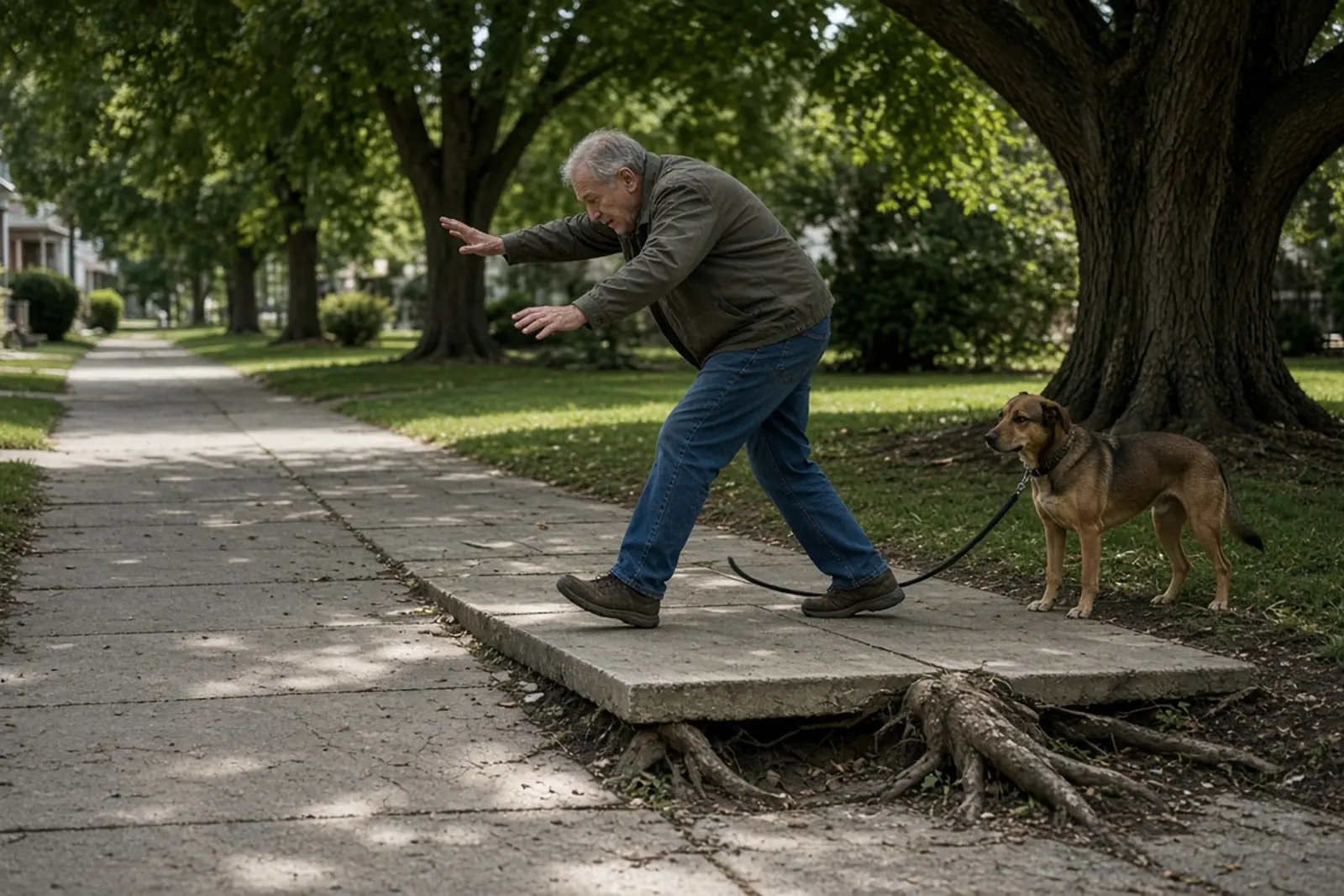
It depends on who owns and controls the exact spot where you fell.
| Where you fell | Who may be responsible | Key rule |
|---|---|---|
| Public sidewalk in Louisville Metro | Usually Louisville Metro, but it's generally immune | Same sovereign immunity as a county (KRS 67C.101) |
| Public sidewalk in a separate small city in Jefferson County (or another Kentucky city) | That city | Written notice within 90 days (KRS 411.110) |
| Sidewalk along a state highway | The Transportation Cabinet | Kentucky Board of Claims, one-year deadline |
| Private walkway (store, shopping center, apartment complex, office) | The owner, manager or tenant in control | Regular premises liability |
| Spot damaged by a contractor or utility | The company that did the work | Negligence |
Kentucky law gives Louisville Metro Government "the same sovereign immunity granted counties." Kentucky courts have applied that to sidewalks. In a 2023 case, the Court of Appeals upheld the dismissal of a claim by a man who tripped over a defect in a Metro-owned sidewalk. So a claim against Metro alone usually won't succeed. That's why it's important to find out whether someone else owns, controls or damaged the spot.
Jefferson County has many separate small cities. For a sidewalk owned by one of them (or by any Kentucky city), KRS 411.110 says no action can be brought unless written notice is given to "the mayor, city clerk or clerk of the board of aldermen" within 90 days. It must state "the time of and place where the injury was received and the character and circumstances of the injury," and that you'll claim damages.
Kentucky's Supreme Court has enforced this strictly. In Schilling v. Schoenle, 782 S.W.2d 630 (Ky. 1990), the injured pedestrian missed the 90-day notice and couldn't bring the city into the case. If you're not sure who owns the sidewalk, give notice to any city that might.
Usually not, just because the sidewalk is in front of their property. Many cities have ordinances requiring owners to repair sidewalks. But in Schilling, the Kentucky Supreme Court, following an earlier Louisville case, held that such an ordinance creates a duty to the city to pay for repairs, "not to the individual," and that violating it isn't negligence per se.
An adjoining owner or business may be responsible when they did something to the sidewalk themselves, such as:
For snow and ice on sidewalks, see ice and snow slip and falls.
If you tripped on a sidewalk inside a shopping center, apartment complex, hospital campus or office park, the owner or manager in control is generally responsible for keeping it reasonably safe. These are standard premises liability claims. For apartments, see apartment and landlord injury claims. For proof, see how to prove property owner negligence.
Insurers often say "you should have seen it." Kentucky uses comparative fault, so an obvious defect doesn't automatically end the claim. Lighting, distractions and whether you had a safe way around matter. See Kentucky negligence law.
If you were hit by a car while walking in the street because the sidewalk was blocked, see our pedestrian accident page.
We identify who owns and controls the spot, send any required notices on time, and look for contractors, utilities and businesses that caused the hazard. We prepare cases for trial from the start. Larry Forman has tried 50+ jury trials and won 95% of them. Learn more about Larry Forman, see our case results (past results don't guarantee a similar outcome), or return to our slip and fall lawyer page.
Usually not successfully. Louisville Metro has the same sovereign immunity as a county, and courts have applied it in sidewalk trip cases. Other parties may still be responsible.
KRS 411.110 requires written notice to a city within 90 days of a sidewalk or street injury, stating when, where and how you were hurt, before you can sue that city.
Usually not just because of location. Kentucky courts have held that sidewalk-repair ordinances create a duty to the city, not to pedestrians. They may be liable if they created the hazard.
That's usually private property, and the owner or manager in control can be responsible under premises liability law.
There's no single number in Kentucky law. Photos with measurements, the lighting and how the defect looked to a walker all matter.
Generally one year for a lawsuit, but city notice may be due within 90 days. State-owned sidewalks have a one-year Board of Claims deadline.
The 90-day clock may already be running. Get a free case evaluation or call (502) 931-6788. No fee unless we win.
This page is general information about Kentucky law as of October 2026, not legal advice.