Reviewed by Larry Forman, Attorney
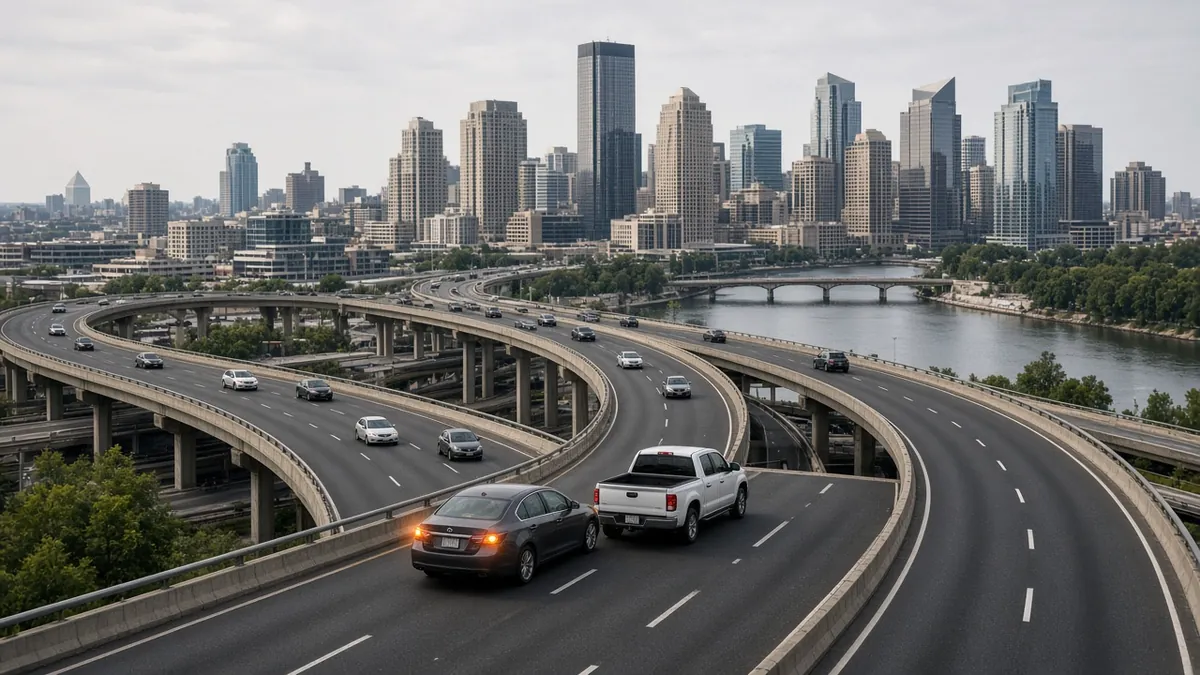
Downtown Louisville's Kennedy Interchange, better known as Spaghetti Junction, is where I-64, I-65 and I-71 meet beside the Ohio River. Drivers have seconds to pick a lane, merge or exit, often next to trucks and commuters doing the same. When a Spaghetti Junction accident happens, the first question is usually who changed lanes when they shouldn't have.
This guide explains how fault is decided in interchange crashes, which Kentucky traffic laws apply, and what evidence to lock down before it disappears. For other high-crash roads, see the most dangerous roads in Louisville.
What is Spaghetti Junction?
The Kennedy Interchange connects three interstates and the I-65 bridges over the Ohio River. A 2008 Kentucky Transportation Cabinet (KYTC) value engineering study described it as carrying "over 300,000 vehicles per day" between the three interstates. The same study said the rebuild aimed to "eliminate left-side exits where possible and eliminate weaving sections where possible."
KYTC rebuilt the interchange as part of the Ohio River Bridges Project's Downtown Crossing, which was finished in 2016. That work included a new I-65 bridge with six northbound lanes (the Abraham Lincoln Bridge), reconfiguring Spaghetti Junction, and rehabbing the Kennedy Bridge to carry six southbound lanes.
The rebuild helped, but it's still a place of quick lane decisions, bridge approaches and heavy traffic.
Common crash types at the Kennedy Interchange
These are the situations that come up most often at a busy interchange like this one:
- Lane-change and sideswipe crashes. A driver realizes late that they're in the wrong lane for their interstate and cuts over.
- Merge crashes. Traffic entering from a ramp and traffic already on the interstate compete for the same space.
- Rear-end crashes in sudden slowdowns. Backups form fast near the bridges and exits. See rear-end collisions.
- Chain-reaction crashes. One impact pushes cars into others, and several drivers may share blame.
- Truck crashes. A tractor-trailer changing lanes has large blind spots and needs more room to stop. See our truck wreck page.
- Motorcycle crashes. Drivers changing lanes often say they never saw the bike. See motorcycle wrecks.
Who is at fault in a Spaghetti Junction accident?
Kentucky doesn't have one "merge law." Fault in an interchange crash is usually argued under a handful of traffic statutes:
- Changing lanes safely. Where a road is divided into three or more marked lanes in one direction, a driver must stay "as nearly as may be practical entirely within a single lane" and "shall not move from that lane until the driver ascertains that the movement can be made with safety" (KRS 189.340(7)(a)).
- Signaling. A driver may not "move right or left upon a roadway until the movement can be made with reasonable safety" and without an appropriate signal (KRS 189.380(1)).
- Following distance. A driver may not follow "more closely than is reasonable and prudent, having regard for the speed of the vehicle and the traffic upon and condition of the highway" (KRS 189.340(9)(a)).
- Speed for conditions. Even under the posted limit, a driver may not go faster than "is reasonable and prudent, having regard for the traffic and for the condition and use of the highway" (KRS 189.390(2)).
- Careful driving. Every driver must drive "in a careful manner, with regard for the safety and convenience of pedestrians and other vehicles" (KRS 189.290(1)).
In practice, the driver who moved into an occupied lane usually bears most of the fault for a sideswipe. A driver who rear-ends someone in a sudden slowdown usually bears most of the fault for that impact. But interchange crashes are rarely that clean. Insurers often argue that the other driver sped up to block a merge, was in a blind spot too long, or braked for no reason.
Kentucky's pure comparative fault rule (KRS 411.182) lets a jury divide fault among every driver involved. Your recovery is reduced by your share but not wiped out. That's why the evidence of who was where, and when, matters so much. See what to do if you were partly at fault.
Chain-reaction and multi-vehicle crashes
When three or more vehicles are involved, each driver's insurer tends to point at someone else. A few things help sort it out:
- The sequence of impacts. Damage patterns and witness accounts can show which car hit first and whether later impacts caused new injuries.
- Vehicle data. Many cars and trucks store speed and braking data from the seconds before a crash. It has to be preserved before the vehicle is repaired or scrapped.
- More than one policy. You may have claims against more than one driver. If the driver who caused the crash is uninsured or underinsured, your own coverage may help.
What evidence exists after a Spaghetti Junction accident?
Don't count on a traffic camera. TRIMARC, the traffic-management program that runs the interstate cameras around Louisville, says in its FAQ that it does not record video from its camera feeds.
Useful evidence usually comes from:
- Dashcams in other cars and in commercial trucks
- Vehicle event data recorders
- Police body or in-car cameras that recorded the scene afterward
- Witnesses, including other drivers who stopped
- Photos of lane markings, debris and where the vehicles came to rest
Act within days. See our list of evidence to preserve after an accident.
What to do after a Spaghetti Junction accident
- Get safe. If no one is hurt and your car can move, get to the shoulder or off the interstate. If someone is hurt or the car can't move, stay buckled with your hazards on and call 911.
- Note the details: which interstate and direction you were on, which lane, and the nearest exit or mile marker.
- Get the other drivers' and witnesses' names and numbers, and the responding agency. Interstate crashes may be worked by Kentucky State Police or LMPD. Here's how to get your Kentucky accident report.
- Get medical care the same day if you have any pain.
- Don't argue fault at the scene or give a recorded statement to the other driver's insurer before you get advice.
Kentucky law in brief
- PIP: Unless you rejected it, Kentucky's no-fault coverage pays up to $10,000 per person for medical bills, lost wages and similar losses, whoever was at fault. See how Kentucky PIP insurance works.
- The threshold: To claim pain and suffering from the at-fault driver, you generally need more than $1,000 in medical expenses or a qualifying injury such as a fracture or permanent injury (KRS 304.39-060).
- Deadlines: Most motor vehicle injury lawsuits must be filed within two years of the injury or the last PIP payment, whichever is later (KRS 304.39-230). See our statute of limitations guide.
For interstate crash totals, see our Kentucky car crash statistics.
How Forman & Associates helps
Interchange cases are won on details: lane positions, timing and vehicle data. We get the crash report, find witnesses, send preservation letters to trucking companies and other drivers for dashcam and vehicle data, handle PIP, and push back when an insurer tries to pin the merge on you. When an insurer won't be fair, we're ready for court: Larry Forman has tried 50+ jury trials and won 95% of them. Learn more about our Louisville car accident practice.
Spaghetti Junction accident FAQ
Where is Spaghetti Junction in Louisville?
It's the Kennedy Interchange downtown, where I-64, I-65 and I-71 meet near the Ohio River and the I-65 bridges. KYTC rebuilt it as part of the Downtown Crossing, finished in 2016.
Who is at fault for a merge crash in Kentucky?
Usually the driver who moved into a lane that wasn't clear. Kentucky law says a driver must not leave a lane until the move "can be made with safety." But fault can be shared, for example if the other driver was speeding or following too closely.
What if several cars were involved in my interchange crash?
A jury can divide fault among every driver under Kentucky's pure comparative fault rule. Damage patterns, witness accounts and vehicle data help show the order of impacts and who caused what.
Will there be traffic camera video of my Spaghetti Junction accident?
Probably not from TRIMARC, which says it doesn't record its camera feeds. Look instead for dashcams, truck cameras, vehicle data and witnesses, and ask quickly before footage is erased.
Do I need a lawyer for a Spaghetti Junction accident?
Not for every fender-bender. If you were hurt, the other driver blames you, or a truck or several cars were involved, a lawyer can preserve evidence that would otherwise be lost. Our consultation is free, and there's no fee unless we win.
Talk to a Louisville car accident lawyer
If you were hurt in a Spaghetti Junction accident, call Forman & Associates Accident Injury Lawyers at (502) 931-6788 or get a free case evaluation. Our office is at 1139 S. 4th St., Louisville, KY 40203. No fee unless we win.
This post is general information about Kentucky law, not legal advice. Reviewed October 2026.