
Reviewed by Larry Forman, Attorney
A jackknife truck accident happens when a tractor-trailer folds at the hitch, and the trailer swings out at an angle to the cab, like a folding pocketknife. An 80,000-pound rig that was traveling in one lane can suddenly block two or three, and the cars behind it have nowhere to go. Jackknifes often start multi-vehicle pileups, especially on wet or icy interstates and ramps around Louisville.
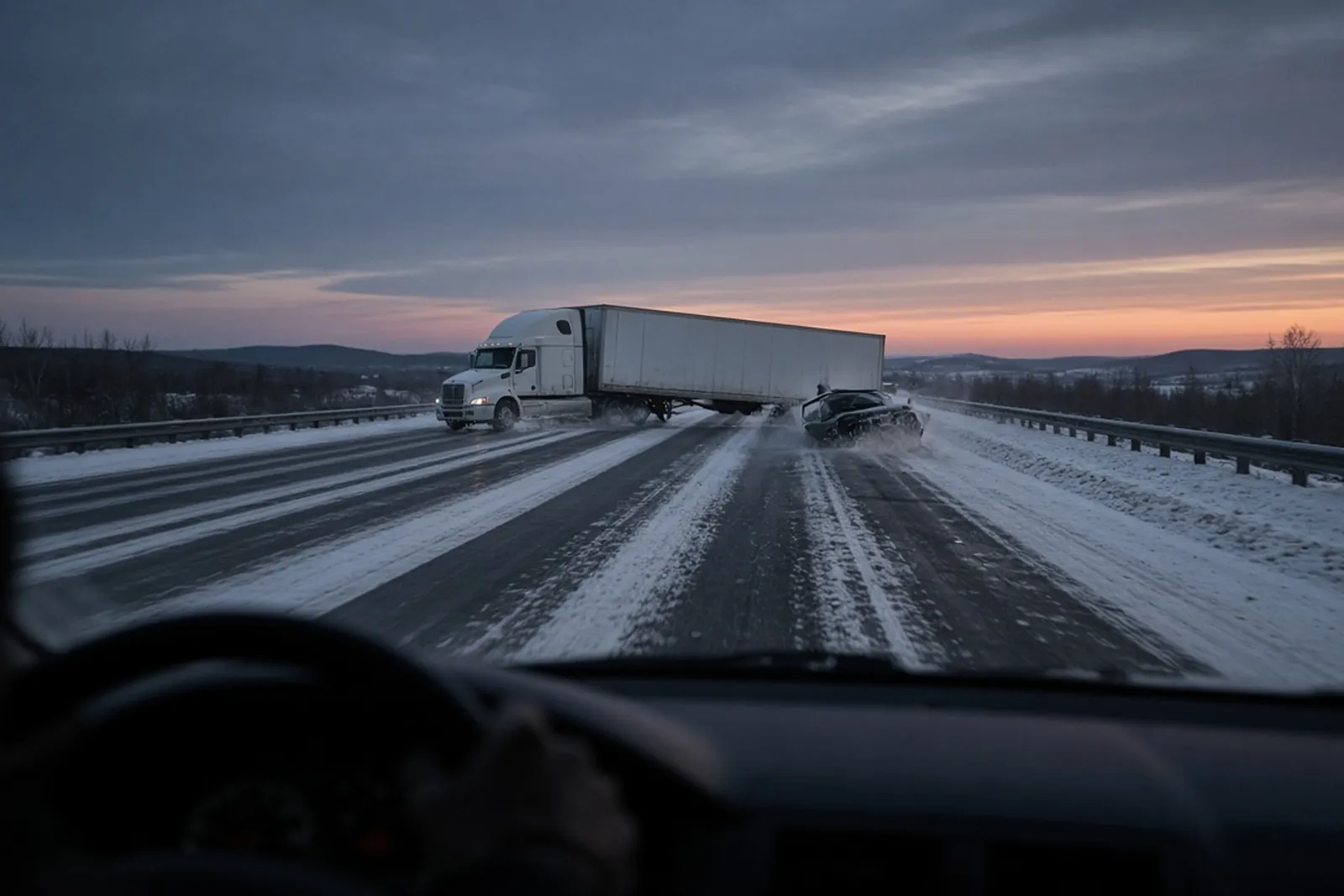
These crashes are rarely just “bad weather.” They usually trace back to speed, braking, loading or maintenance decisions made by the driver or the trucking company. Here’s how these cases work.
In a typical jackknife, the tractor’s drive wheels lock or lose traction, often under hard braking or on a slick surface. The trailer’s momentum keeps pushing forward. Without traction to hold the tractor straight, the trailer pivots around the hitch. Empty or lightly loaded trailers are especially prone to it, because there’s less weight on the trailer axles.
An empty trailer behind a powerful tractor is light and easy to push around. Drivers hauling empty or partial loads have to brake earlier and more gently, especially on wet pavement, downhill grades and exit ramps. A load that’s off-center or poorly secured can shift in a curve and pull the trailer out of line.
Kentucky’s weather adds to the risk. Freezing rain, overnight refreezes on bridges and overpasses, and sudden heavy rain are common from late fall through early spring. Federal rules don’t excuse a jackknife because the road was slick. They require the driver to slow down for those conditions, and to stop if driving can’t be done safely.
Every motor carrier must “systematically inspect, repair, and maintain” its vehicles, and parts must be “in safe and proper operating condition at all times” (49 CFR 396.3). Drivers must file a written report at the end of each day listing any defects in brakes, tires, coupling devices and other key parts, and the carrier must fix listed defects before the truck goes back out (49 CFR 396.11). A jackknife involving worn brakes or a known ABS warning often leads straight to the carrier’s maintenance records.
Kentucky applies these federal rules to both interstate and in-state commercial trucking (601 KAR 1:005).
Jackknifes often involve several vehicles: the truck, cars that hit the trailer, and cars that rear-end each other trying to stop. Kentucky’s pure comparative fault law requires fault to be apportioned among everyone involved (KRS 411.182). Each party pays only its share.
That makes the investigation critical. Trucking insurers will try to push fault onto drivers who couldn’t stop in time. Under Kentucky law, the drivers behind still have to keep a safe distance (see rear-end collisions), but a truck that jackknifed because it was going too fast on ice usually bears the largest share.
The carrier controls most of this. We send a preservation demand right away.
Engine data is especially important in a jackknife case. It can show whether the driver was speeding for the conditions, when the brakes were applied and how hard, and whether the ABS was working. Put that next to weather records and the driver’s inspection reports, and the “slick road” explanation often falls apart. Without a prompt demand, the truck may be repaired, and its data overwritten, before anyone downloads it.
Jackknife crashes often involve side impacts and multiple impacts, causing brain injuries, catastrophic injuries and deaths. See our wrongful death page. Your own auto policy’s PIP usually pays first, up to $10,000. See how Kentucky PIP works. Larger losses are claimed against the trucking company’s insurance. Federal rules require for-hire interstate carriers of general freight to carry at least $750,000 in liability coverage (49 CFR 387.9), far more than Kentucky’s car minimums.
Claims against the driver and carrier generally must be filed within two years of the injury or the last PIP payment (KRS 304.39-230(6)). Other claims may have shorter deadlines. See our statute of limitations guide.
Learn more about Larry Forman, see our case results (past results don’t guarantee a similar outcome), or return to our truck wreck and commercial vehicle crash pages.
Usually hard braking, excessive speed for the conditions, slick roads, brake or ABS problems, or poorly loaded cargo, often in combination. An empty or light trailer is more prone to it.
Rarely by itself. Federal rules require truck drivers to slow down in snow, ice or rain, and to stop if conditions get too dangerous. Driving at normal speed in bad weather is a choice.
Possibly several parties. Kentucky apportions fault among the truck driver, the trucking company and other drivers, and each pays its share. The truck usually draws the most scrutiny.
Yes. Truck tractors built since March 1, 1997, and air-braked trucks and trailers built since March 1, 1998, must have ABS under federal rules.
Not necessarily. A trailer blocking lanes with no warning can leave following drivers no time to react. Any fault on your part reduces your recovery but doesn’t bar it.
Generally two years against the driver and carrier under Kentucky’s no-fault law. Evidence disappears much faster, so act quickly.
The trucking company’s team starts working the day of the crash. We’ll start working for you just as fast. No fee unless we win. Get a free case evaluation or call (502) 931-6788. Our office is at 1139 S. 4th St., Louisville, KY 40203.
This page is general information about federal and Kentucky law as of October 2026, not legal advice.