Reviewed by Larry Forman, Attorney
E-bikes have changed how a lot of Louisville gets around, from commuters on Frankfort Avenue to families on the Louisville Loop. They’re quick and quiet, and drivers routinely misjudge how fast they’re moving. When a crash or a battery failure puts you in the hospital, the questions an e-bike accident lawyer has to answer are different from those in an ordinary bicycle or car case. They start with something surprisingly basic: what does Kentucky law even consider your e-bike to be?
Forman & Associates represents people hurt on e-bikes, and people hit by them, across Kentucky. Here’s how these claims work.
How Kentucky law treats e-bikes
Many states sort e-bikes into Class 1, 2 and 3. Kentucky doesn’t. As of October 2026, “electric bicycle” doesn’t appear in Kentucky’s traffic or vehicle-licensing statutes. Instead, an e-bike can land in one of several existing categories:
Bicycle. Kentucky’s bicycle safety regulation defines a bicycle as a device with a seat “propelled primarily by human power” (601 KAR 14:020). Many pedal-assist e-bikes are ridden and treated like bicycles.
Electric low-speed scooter. State law defines this broadly: a device under 100 pounds with wheels, handlebars and a brake, designed to be stood or sat upon, powered by an electric motor, human power or both, and designed for a top speed of 20 mph (KRS 189.010(26)). Some lower-speed e-bikes may fit that description. Riders must be 16 or older (KRS 189.289).
Moped or motorcycle. A more powerful machine may fall under the moped or motorcycle definitions (KRS 186.010), which bring licensing and insurance rules.
Louisville has its own definition. Louisville Metro’s code defines an e-bike as a two- or three-wheeled vehicle with fully operable pedals and a motor under 1,000 watts that goes less than 20 mph on motor power alone (Ord. No. 157-2021). Riders 11 and older may not ride bicycles or e-bikes on Metro sidewalks, and no one may in the Downtown Form District (LMCO § 74.02).
Why this matters: the category can affect whether no-fault (PIP) benefits apply, which deadline controls, and which traffic rules a jury hears about. Insurers know the law is unsettled and sometimes use that to delay claims.
Hit by a car while riding an e-bike: who pays?
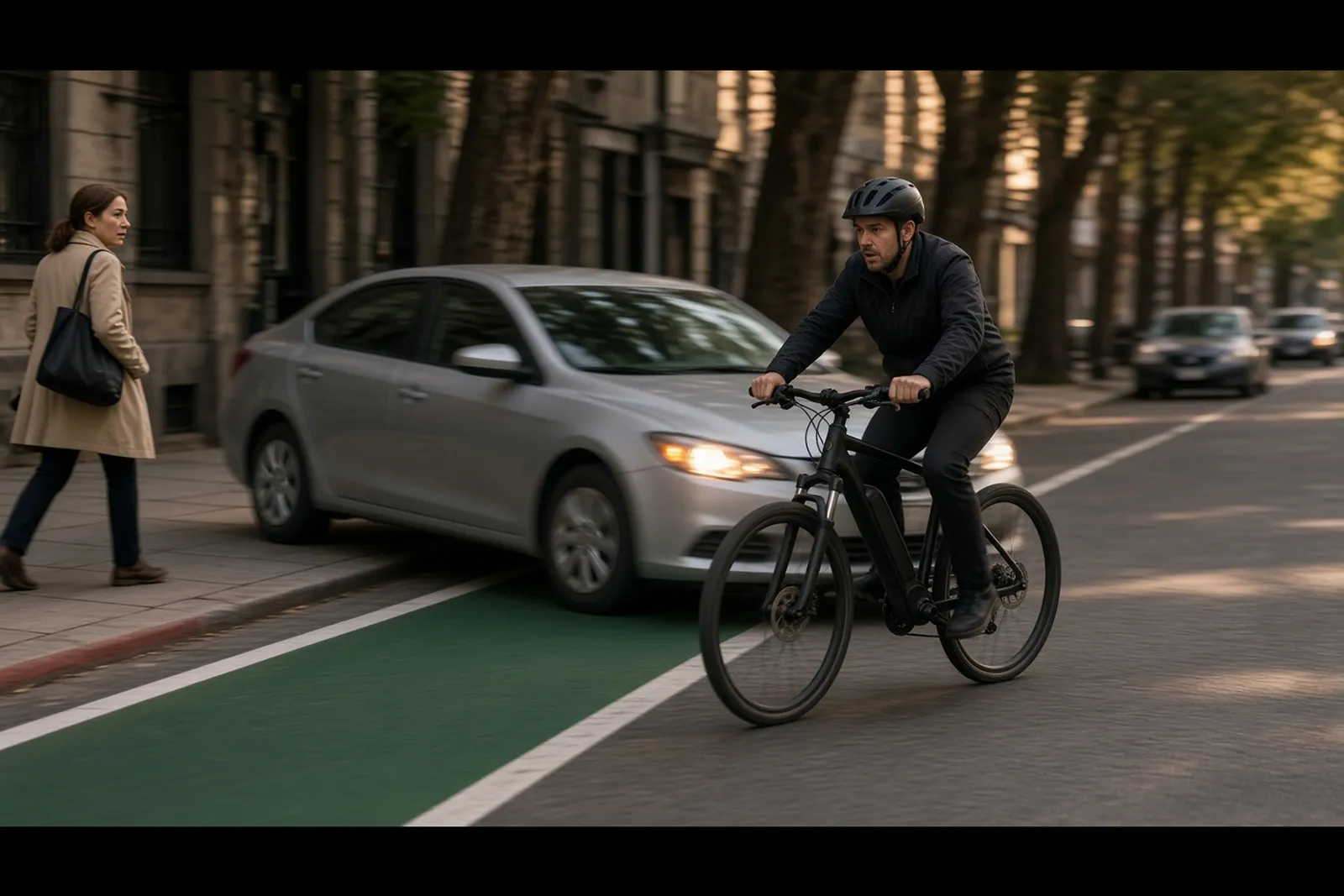
Most serious e-bike injuries involve a car or truck: right hooks across the bike lane, left turns in front of the rider, opened doors and close passes. Kentucky’s three-foot passing rule protects bicycles and electric low-speed scooters (KRS 189.340(2)). Phones and screens play a role too. See distracted driving accidents.
Several kinds of coverage can apply:
PIP (basic reparation benefits). Kentucky’s no-fault law treats anyone who isn’t “making use of a motor vehicle” as a pedestrian, and a pedestrian’s PIP comes from the insurance on the vehicle that struck them (KRS 304.39-050(1)). Basic PIP is capped at $10,000 per person (KRS 304.39-020). Kentucky’s Court of Appeals held that a moped rider hit by a pickup was a “pedestrian,” because mopeds are excluded from the act’s “motor vehicle” definition (Howard v. Hicks, 737 S.W.2d 711 (Ky. App. 1987)). Electric low-speed scooters are excluded too. E-bikes aren’t mentioned, and we haven’t found a published Kentucky appellate decision on them, so expect insurers to test the point. If the vehicle that hit you had no insurance, your own household auto policy may provide PIP (KRS 304.39-050(2)). More: how Kentucky PIP works and 2026 PIP law changes.
The driver’s liability insurance for medical bills beyond PIP, lost income, pain and suffering, and permanent injury.
Uninsured and underinsured motorist coverage on your household’s auto policy when the driver has too little insurance or none. See our underinsured motorist page. If the driver fled, see hit-and-run accidents.
Lithium-ion batteries can overheat and catch fire, sometimes while charging indoors. Frames, brakes, throttles and controllers can fail at speed. The U.S. Consumer Product Safety Commission identified 227 incidents tied to lithium-ion batteries in micromobility products from 2019 through 2023, linked to 39 deaths and 181 injuries. Fires made up most of those incidents. In June 2026 the CPSC proposed a mandatory safety standard for these batteries and electrical systems, built on the UL 2849 standard for e-bikes (Federal Register, June 24, 2026). As of October 2026 the rule isn’t final. Federal law already treats low-speed electric bicycles as consumer products subject to the federal bicycle safety rules (15 U.S.C. § 2085).
In Kentucky, injury claims over defective products fall under the Product Liability Act of Kentucky (KRS 411.300 to 411.350). It covers design, manufacturing, warning and marketing claims. Three rules matter in e-bike cases:
Modifications. A manufacturer is liable only for injuries that would have happened if the product had been used in its original, unaltered condition. “Alteration” includes failing to do routine care and maintenance, but not ordinary wear and tear. If the injured person made an unauthorized change that was a substantial cause of the accident, the claim against the manufacturer fails (KRS 411.320). Aftermarket batteries, mismatched chargers and “unlocked” speed limiters are where these fights happen. Modifications done to the manufacturer’s own specifications don’t count.
Age of the product. A product is presumed not defective if the injury happened more than five years after the first sale or more than eight years after manufacture. Evidence can overcome that presumption (KRS 411.310).
Sellers. A retailer or distributor that sold the product in its original condition generally isn’t liable if the manufacturer is identified and subject to the court’s jurisdiction, unless the seller breached an express warranty or knew or should have known of the defect (KRS 411.340).
After a fire or failure, the bike is the evidence. Keep the battery, charger, frame and packaging, and don’t hand them to the seller, manufacturer or an adjuster. Save the receipt, take photos, and get the fire department’s report. See our product liability and burn injury pages.
When an e-bike rider hits a pedestrian or another rider
E-bikes are heavier and faster than most bicycles, and a collision on a path or sidewalk can badly injure a person on foot. A careless rider can be held responsible like any other negligent person. In Louisville, riding where the code forbids it, such as a Metro sidewalk at age 11 or older, can be evidence of carelessness. Finding insurance is often the hard part: whether a homeowner’s or renter’s policy responds depends on its wording.
Helmets, speed and blame-shifting
Kentucky has no statewide helmet requirement for adult bicycle riders. By statute, the state’s safety regulations for electric low-speed scooters can’t include a helmet requirement (KRS 189.289(6)). Louisville requires helmets for riders under 18 on park roads and in public parks (LMCO § 74.07).
Insurers still argue that a missing helmet made a head injury worse, or that the rider was going “too fast for a bicycle.” Kentucky’s pure comparative fault rule means those arguments can reduce what you recover, but they don’t bar your claim (KRS 411.182). Learn how Kentucky’s pure comparative fault rule works. We answer them with the scene, the medical records and the physics, and we watch for adjuster tactics meant to shift blame to you.
Deadlines for e-bike accident claims
Kentucky deadlines are short, and the e-bike’s unsettled status makes them trickier:
Crash involving a car or truck: generally two years from the injury or the last PIP payment, whichever is later (KRS 304.39-230(6)). Howard v. Hicks applied that two-year rule to a moped rider.
No motor vehicle involved (a battery fire, a defective frame, a collision with a pedestrian or another rider): generally one year (KRS 413.140(1)(a)).
A defective city street or sidewalk: a claim against a city may require written notice within 90 days (KRS 411.110).
Get medical care right away, and tell providers you were on an e-bike. Head injuries can be worse than they first seem. See our traumatic brain injury page.
Call the police, and get the driver’s name, insurance and plate.
Photograph the scene, the vehicle, the bike lane, the road surface and your injuries.
Keep the e-bike, battery, charger, helmet and clothing as they are. Don’t repair or discard them.
Save the make, model, serial number, receipts and any ride data from an app.
Kentucky has no e-bike statute. Depending on its design, an e-bike may be treated as a bicycle, an “electric low-speed scooter,” or a moped. The no-fault law excludes scooters and mopeds from “motor vehicle” but doesn’t mention e-bikes, so the answer can depend on your bike.
Will PIP pay my medical bills if a car hit me on my e-bike?
Often, yes. A person who isn’t using a motor vehicle is treated as a pedestrian, and PIP comes from the insurance on the vehicle that struck them, up to $10,000. An insurer may argue the e-bike itself was a motor vehicle, so get advice before accepting a denial.
My e-bike battery caught fire while charging. Who is responsible?
Possibly the maker of the e-bike, battery or charger, and sometimes the seller, under the Product Liability Act of Kentucky. Keep the battery, charger and receipts, and don’t give them to anyone before your lawyer documents them.
I upgraded my e-bike’s battery or speed settings. Do I still have a case?
Maybe. Kentucky limits a manufacturer’s liability to injuries that would have happened with the product in its original condition, but a claim against a driver who hit you isn’t limited that way. Tell your lawyer exactly what was changed.
How long do I have to file an e-bike accident claim in Kentucky?
Generally two years if a motor vehicle was involved and one year if not, such as a battery fire. Claims against a city can require notice much sooner.
Talk to a Louisville e-bike accident lawyer
Insurers and manufacturers start building their side right away. We’ll move just as fast on yours. No fee unless we win. Get a free case evaluation or call (502) 931-6788. Our office is at 1139 S. 4th St., Louisville, KY 40203.
This page is general information about Kentucky law and Louisville ordinances as of October 2026, not legal advice. E-bike law is changing.