
Reviewed by Larry Forman, Attorney.
A loaded tractor-trailer can weigh up to 80,000 pounds. Speed makes it harder to stop, harder to steer around a slowdown, and far more destructive on impact. Speeding is one of the most common things investigators find in serious truck crashes, and it is one of the easiest to prove when the evidence is preserved in time.
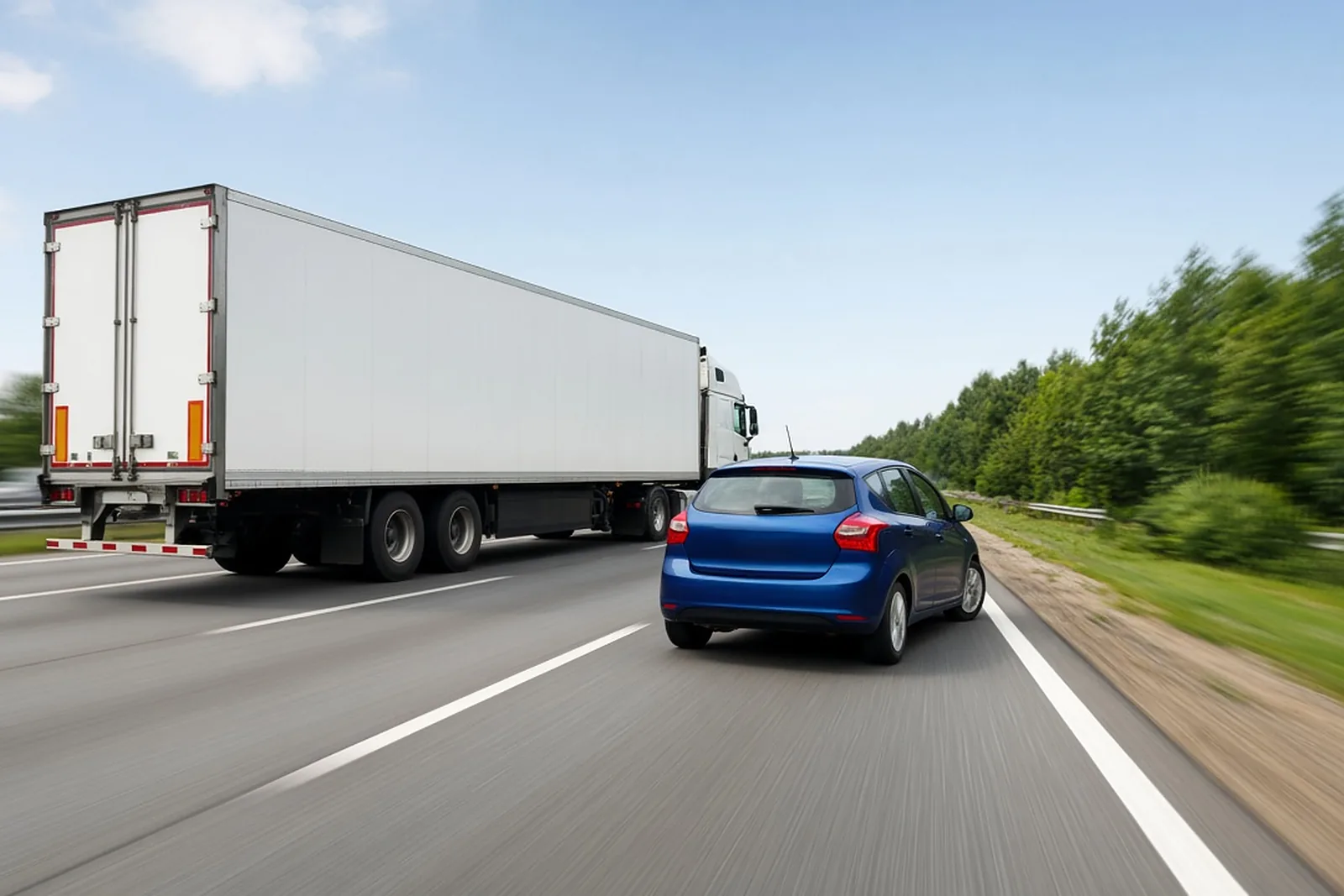
No federal rule currently requires speed limiters on heavy trucks, but many carriers set them anyway. When a company’s own trucks are governed and this one wasn’t, or the setting was raised, that is evidence.
The driver, and in most cases the trucking company, which is responsible for its driver’s conduct on the job and for its own decisions about schedules, pay structure and supervision. A company that pays by the mile, sets impossible delivery windows or ignores speeding alerts can be liable for its own negligence. See trucking company liability. Extreme speed can support punitive damages in Kentucky when the conduct shows gross negligence (KRS 411.184).
Interstate carriers hauling general freight must carry at least $750,000 in liability coverage (49 CFR 387.9). Kentucky’s pure comparative fault rule means your recovery is reduced only by your own share of fault, if any (KRS 411.182). Most motor vehicle injury lawsuits must be filed within two years after the injury or the last PIP payment, whichever is later (KRS 304.39-230(6)).
Larry Forman has tried 50+ jury trials and won 95% of them. See our Louisville truck accident lawyer page and speeding car accidents.
Usually with the truck’s engine control module data, fleet GPS and telematics, camera video and reconstruction. Records like these can be overwritten, so a preservation letter should go out quickly.
Yes. The company is generally responsible for its driver’s conduct on the job, and it can be liable for its own negligence, such as scheduling runs that require speeding, which federal rules prohibit (49 CFR 392.6).
There is no federal speed limiter requirement in effect for heavy trucks. Many carriers set governors on their own; whether this truck had one, and how it was set, can be evidence.
Yes. Kentucky requires every driver to go no faster than is reasonable for traffic and road conditions (KRS 189.390(2)). A truck at the limit in heavy rain or stopped traffic can be going too fast.
Tell us what happened. We’ll explain your options and what to do next. The consultation is free.
Get a free case evaluation or call 502-931-6788. Our office is at 1139 S. 4th St., Louisville, KY 40203.
This page is general information about Kentucky law as of October 2026, not legal advice. Every case is different.