
Truck Wreck Cases

Truck Blind Spot and Wide Turn Accidents in Louisville

When a semi changes lanes into you or swings wide and traps your car on a turn, the trucker and the carrier may be responsible. How these cases are proven.

Reviewed by Larry Forman, Attorney.

A tractor-trailer driver sits high up, but the truck still has large areas where other vehicles disappear from view. Trucks also need extra room to turn, and drivers sometimes swing left before turning right. When a trucker doesn’t check carefully, cars, motorcycles, cyclists and pedestrians get hit. These crashes happen every day on I-64, I-65, I-71 and the Watterson, and at downtown and industrial intersections.

Key takeaways
  • Truck blind spots, often called “No-Zones,” are in front, behind and along both sides.
  • Truckers must check mirrors and make sure a lane is clear before moving over.
  • A wide right turn that traps a car is a common and preventable crash.
  • Camera and engine data often show exactly what the driver did.
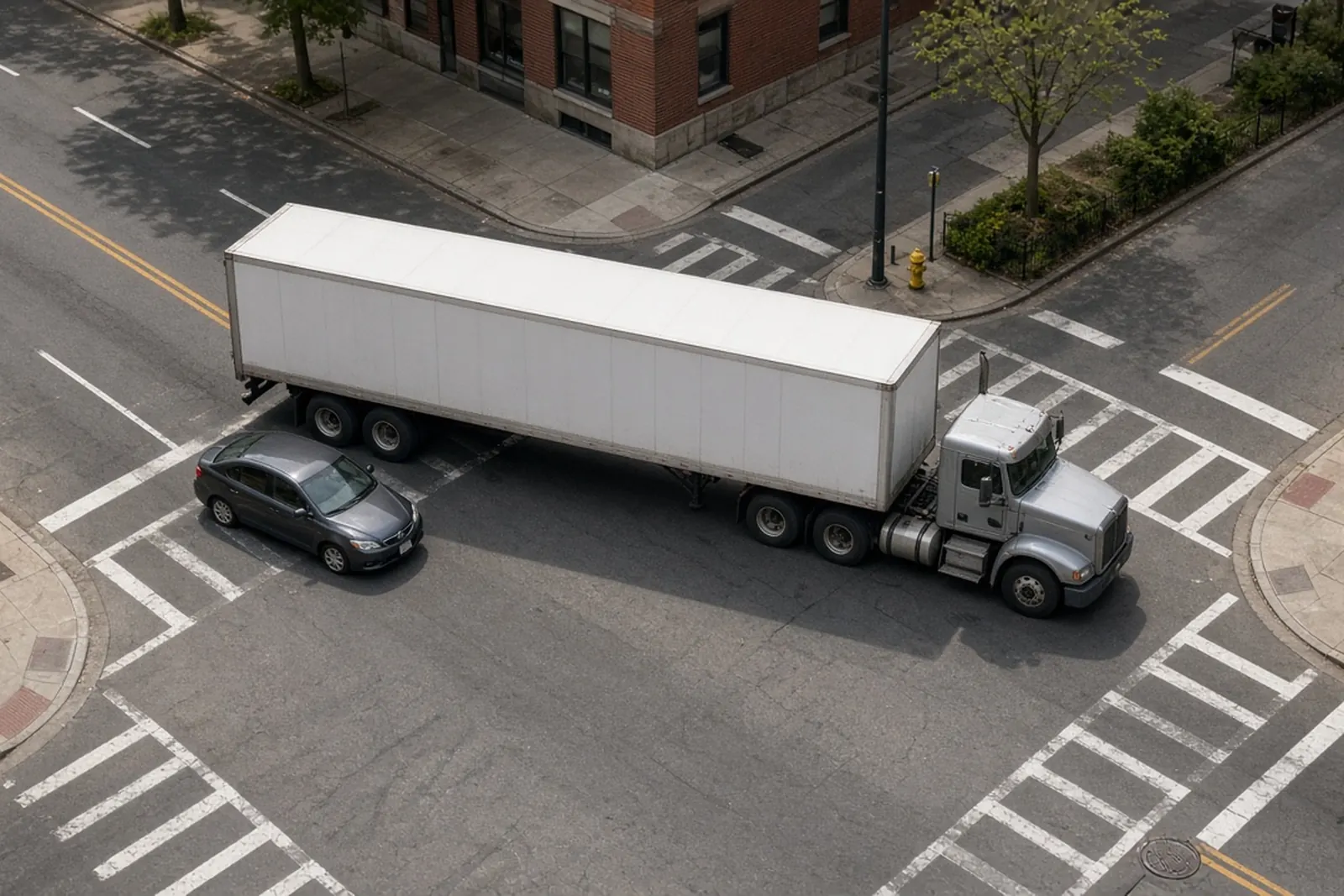
Truck blind spot: tractor-trailer making a wide right turn at a city intersection with a small car stopped close beside the trailer

Where a truck’s blind spots are

The blind spots commonly cited in federal safety materials are roughly 20 feet in front of the cab, about 30 feet behind the trailer, the lane beside the cab on the left, and up to two lanes along the right side. The Federal Motor Carrier Safety Administration’s rule of thumb is simple: if you can’t see the truck driver in the side mirror, the driver probably can’t see you (FMCSA: driving safely around large trucks).

Knowing where blind spots are doesn’t excuse the trucker. Professional drivers are trained to use their mirrors, signal early and move over only when the lane is clear.

Common blind spot and turning crashes

  • Lane change sideswipes: the truck merges into a car on its right. See sideswipe accidents.
  • Wide right turns: the trucker swings left, a car pulls into the gap on the right, and the trailer closes on it.
  • Left turns across traffic: a slow-turning truck blocks lanes and is hit or hits oncoming traffic.
  • Backing crashes: at loading docks, parking lots and job sites.
  • Underride: a car slides under the side or rear of a trailer. See underride accidents.
  • Pedestrians and cyclists: people crossing in front of a cab or beside a turning trailer. See pedestrian accidents.

Who is responsible

  • The truck driver for an unsafe lane change, turn or backing move. Kentucky requires drivers to stay in a lane until they can move safely (KRS 189.340) and to turn properly at intersections (KRS 189.330).
  • The trucking company for its driver’s negligence on the job, and for poor training, bad mirrors or missing camera systems. See trucking company liability.
  • A shipper or broker in some cases. See freight broker liability.

Insurers often argue the car “lingered in the blind spot.” Even if a jury agrees you share some fault, Kentucky uses pure comparative fault: your share of fault reduces your recovery but doesn’t bar it (KRS 411.182).

Evidence in blind spot cases

  • Forward- and side-facing camera footage, which many fleets now use
  • Engine control module and telematics data showing speed, braking and turn signals. See truck black box evidence.
  • Mirror condition and adjustment, and whether required mirrors were in place (49 CFR Part 393)
  • Driver logs, training records and prior crashes. See FMCSA safety records.
  • Damage location on both vehicles, which often shows who moved into whom

We send preservation letters quickly, because carriers can overwrite camera and telematics data.

What you can recover

Medical bills, lost wages, future care, pain and suffering and property damage. Unless you rejected it in writing, your own PIP (personal injury protection) coverage pays up to $10,000 of medical bills and lost wages regardless of fault. See how Kentucky PIP works. To recover pain and suffering from an at-fault driver, Kentucky’s no-fault law generally requires more than $1,000 in medical expenses, or an injury such as a fracture, permanent injury, permanent disfigurement or permanent loss of bodily function (KRS 304.39-060).

Deadlines

Most Kentucky motor vehicle injury claims must be filed within two years of the crash or the last PIP payment, whichever is later (KRS 304.39-230). Estimate your dates with our statute of limitations calculator.

50+ jury trialsReady to take your case to court
Free consultationTalk with us at no cost
Louisville basedServing injured people across Kentucky
We come to youPhone, video or in person

Frequently asked questions

Is it my fault if I was in the truck’s blind spot?

Not automatically. The trucker has a duty to make sure the lane is clear before moving. A jury may compare fault, but in Kentucky your share only reduces your recovery.

What is a “squeeze play” truck accident?

It’s when a truck swings wide to make a right turn, a car moves into the gap on the right, and the trailer closes on the car as the truck turns.

Do trucks have cameras that show blind spot crashes?

Many fleets use forward- and side-facing cameras. We ask the carrier to save that footage right away.

Hit by a truck that didn’t see you?

Let us get the camera and truck data before it’s gone. The consultation is free.

Get a free case evaluation or call 502-931-6788.

This page is general information about Kentucky law as of October 2026, not legal advice. Every case is different.

Call (502) 931-6788 Request a free consultation

Contact us for Your FREE Case Evaluation