
One moment, the floor is dry. The next, you are on the ground, injured, and wondering what just happened. Whether it was a puddle left unattended in a grocery store aisle, an icy walkway that nobody bothered to salt, or a broken stair with no warning sign in sight, slip-and-fall accidents happen fast. What follows can be overwhelming: medical bills, missed work, and a property owner who may be telling you it was your own fault.
Here is what you need to know. Property owners have a legal responsibility to keep their spaces reasonably safe. When they fail to meet that responsibility and someone gets hurt, the law provides a path to compensation through what is called a premises liability claim.
This guide will walk you through everything a beginner needs to understand about that process. You will learn the four core legal elements every claim must prove, how your status as a visitor affects your rights, what evidence to collect after a fall, and how to position yourself for the strongest possible outcome. Let’s start from the beginning.
What Is Premises Liability and When Does It Apply?
Premises liability is the area of law that holds property owners and controllers legally responsible for injuries caused by unsafe conditions on their property. In plain terms: if you control a space, you have a legal obligation to keep it reasonably safe for the people who enter it.
This distinguishes premises liability from other personal injury claims. In a car accident, two drivers are at fault; the dispute centers on their conduct behind the wheel. In a premises liability case, the physical condition of the property itself is what created the harm. The floor, the staircase, the parking lot, the lighting, the space is the defendant.
That legal obligation extends across virtually every property type. Grocery stores, apartment complexes, office buildings, private homes, parking lots, and public sidewalks all fall under this framework. Responsible parties can include homeowners, commercial tenants, property management companies, maintenance contractors, and event organizers. If a party exercised control over the dangerous condition, they may carry legal liability. You can explore the full range of covered situations under Premises & Property Injuries.
Here is the critical threshold most people miss: slipping and falling on someone else’s property does not automatically create a lawsuit. The law requires proof of negligence, and that word has a precise legal meaning. Negligence means a responsible party failed to meet a legal duty to keep the property reasonably safe, and that failure directly caused your injury. A random fall does not equal liability. A fall caused by a hazard the owner knew about, or should have known about and failed to fix, is a fundamentally different situation.
Proving negligence in a premises liability case comes down to four elements: Duty, Breach, Causation, and Damages. Every section of this guide walks through one of those elements in detail, building a complete picture of what a valid claim actually requires.
Who You Are on That Property Changes Everything
Before the law asks what happened on that property, it asks who you were when you were there. Your legal status as a visitor determines how much protection you are owed, and the difference between categories is not subtle.
Premises liability law recognizes three visitor classifications:
Invitees: The Highest Protection
An invitee is someone who enters a property for a purpose connected to the owner’s business or public use. Retail customers, restaurant diners, and event patrons all qualify. Property owners owe invitees the most demanding duty in premises liability law: an affirmative obligation to actively inspect for hazards, make prompt repairs, and post warnings of known dangers.
That word active matters. The store cannot simply wait for a customer to report a spill. It must monitor its premises, maintain inspection schedules, and address conditions before someone gets hurt.
Licensees: Moderate Protection
A licensee has permission to be on the property but not for a business purpose. The clearest example is a social guest at a private home. The homeowner must warn of known hazards, but is not legally required to conduct the same rigorous, ongoing inspections demanded of a commercial operation. The duty here is disclosure, not proactive discovery.
Trespassers: Limited Protection
Trespassers receive the least protection. Property owners owe them only the duty to avoid intentional harm, meaning no deliberate traps or willful injury. One important exception applies to children: under the attractive nuisance doctrine, a property that foreseeably draws children and poses an unreasonable risk may expose the owner to liability even for trespassers too young to recognize danger.
Why This Framework Changes Your Case
Consider a shopper who slips on a wet floor at a Louisville grocery store. That shopper is an invitee. The store had an ongoing legal duty to monitor that floor, identify the spill, and clean it or post a warning. Most slip-and-fall victims never realize that standard exists in their favor.
Visitor status shapes that duty at every level.
Element 1: Duty of Care — What the Property Owner Was Legally Required to Do
Visitor classification tells you how much protection the law provides. Duty of care answers the prior question: who is legally obligated to provide it?
Duty of care is not automatic. It is a specific legal obligation established by the relationship between the party who controlled the property and the person who was hurt. A party who invited you onto their premises, or who exercised control over conditions there, owes you a legally recognized duty.
Commercial vs. Residential Duty
The type of property determines how demanding that duty is. A commercial landlord managing a retail strip mall carries an active, ongoing obligation: inspect common areas, correct hazards promptly, and warn visitors of dangerous conditions. A homeowner hosting a neighbor operates under a less demanding standard. The commercial context signals to courts that the property is held open to the public, which raises the duty accordingly.
Duty Falls on Anyone Who Controlled the Hazard
Duty is not limited to the property owner’s name on the deed. Any party that exercised control over the dangerous condition may owe a duty. That includes:
- Commercial tenants operating within a leased space
- Property management companies overseeing maintenance
- Maintenance contractors hired to service specific systems
- Event organizers who assumed control of a venue
This expands the field of potentially liable parties, which directly affects your ability to recover.
Identifying Every Responsible Party Is Critical
Identifying every potentially liable party early is critical — in some jurisdictions one at-fault party can be held for the full loss, while others cap recovery at each party’s fault share.
Consider an icy Kentucky strip mall parking lot. The property management company that contracted for snow removal may bear duty for failing to treat it. The commercial tenant who noticed the ice two days earlier and never reported it may share that duty. Just as childcare facilities and schools have one non-negotiable obligation above all others: keep the children in their care safe, anyone who accepts control over a space where others walk accepts the duty to keep it reasonably safe.
Element 2: Breach — Did the Owner Fail to Act Like a Reasonable Person?
Once duty is established, the next question is whether the owner actually lived up to it. That is where breach comes in.
Breach has a straightforward test: would a reasonably careful property owner in the same situation have recognized the hazard and done something about it? If yes, and this owner did nothing, that is a breach of duty.
The Constructive Knowledge Doctrine
Property owners frequently claim they never saw the hazard. Courts largely reject that defense through a doctrine called constructive knowledge: an owner is legally charged with knowing about any dangerous condition their reasonable inspection would have uncovered. Ignorance is not a shield when the ignorance itself was unreasonable.
Here is how it plays out in practice. A puddle of juice sits in a grocery store aisle for 45 minutes. No employee reported it. No manager saw it. But a store operating proper inspection rounds would have found and cleaned it well before the 45-minute mark. Because diligent inspection would have revealed the hazard, the law treats the store as if it already knew. That is constructive knowledge, and it satisfies breach.
Actual Knowledge vs. Constructive Knowledge
Actual knowledge means the owner or staff directly witnessed the hazard or was told about it. Someone calls the front desk to report a broken step; a manager watches a spill form and walks past it. Either scenario gives the owner direct, undeniable notice.
Constructive knowledge means they should have known through reasonable inspection, even without direct notice. Both forms of knowledge satisfy the breach element equally. The distinction matters for strategy, not for whether you have a claim.
When Prior Notice Makes Breach Undeniable
The most powerful breach evidence is a documented pattern of neglect. A broken stair railing reported to building management three weeks before someone falls is not a freak accident. It is a property owner who received actual notice, did nothing, and let a foreseeable injury happen. Juries recognize that timeline for exactly what it is: deliberate indifference. Maintenance request records, complaint logs, and prior incident reports can transform a close case into a compelling one.
Element 3: Causation — Connecting the Hazard to Your Injury
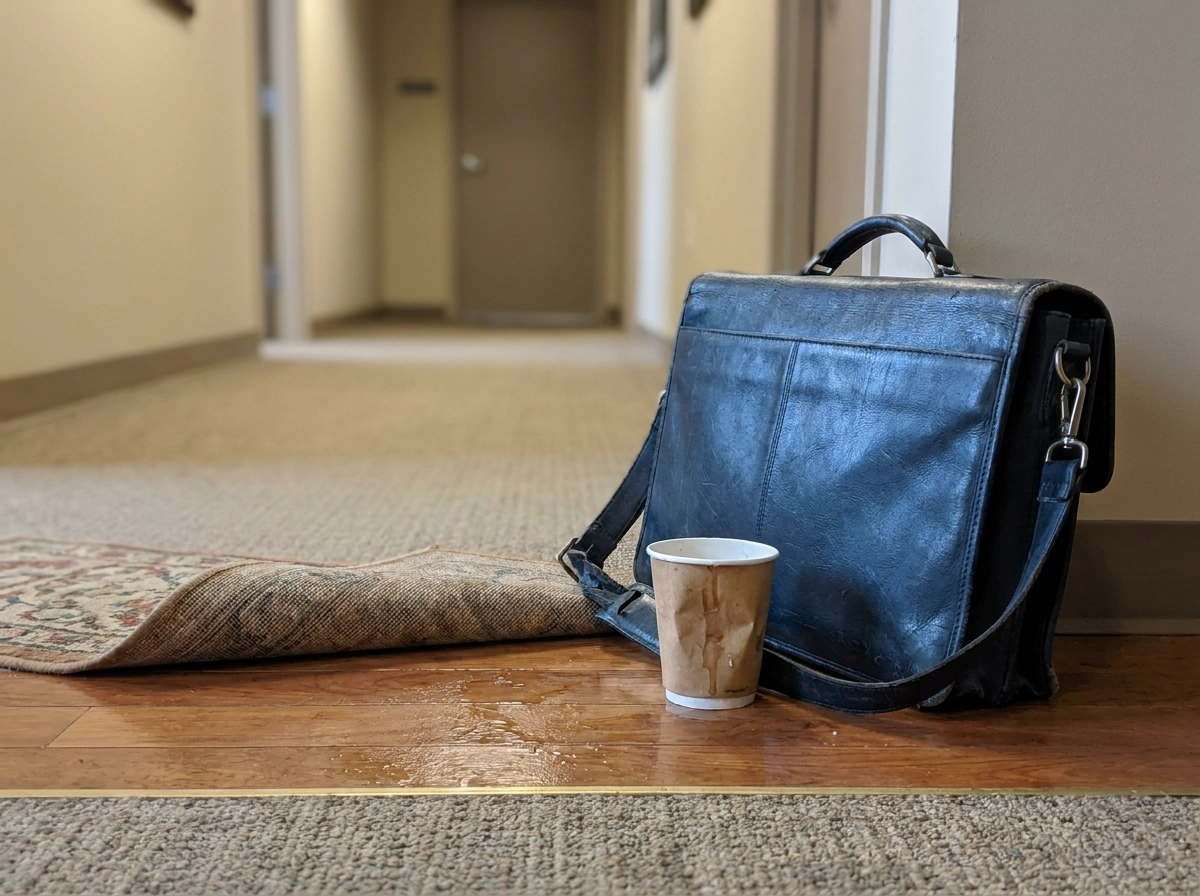
Proving breach gets you halfway there. Causation is the legal bridge connecting the owner’s failure to the harm you suffered, and it requires more than showing a hazard existed alongside an injury.
Causation has two distinct components. Actual cause asks a but-for question: but for the wet floor, would the fall have occurred? If the answer is no, actual cause is established. Proximate cause asks whether the harm was foreseeable: was it reasonably predictable that an unaddressed slippery surface would cause someone to fall and sustain injuries? A slippery floor injuring a shopper is exactly the outcome the law anticipated when it imposed a duty to inspect and remedy hazards.
When the Defense Argues You Caused Your Own Fall
This is where property owners and their insurers push hardest. Defense attorneys routinely argue the injured person shares responsibility, claiming the victim was distracted by a phone, wore inappropriate footwear, or walked past a clearly posted warning sign. These are not hypothetical arguments; they are standard playbook moves designed to reduce what the insurance company pays out.
Kentucky addresses this through its pure comparative fault system under KRS 411.182. Juries assign a fault percentage to every party, including the plaintiff, and your recovery is reduced proportionally. A $100,000 verdict with 20% fault against you yields an $80,000 recovery. Unlike states that bar recovery once fault crosses a threshold, Kentucky’s pure comparative fault rule lets you recover even if partially responsible, though every percentage point the defense assigns to you costs money.
Understanding how comparative fault interacts with causation shapes every strategic decision in your case, from how evidence is gathered to how arguments are framed at trial. An attorney who has argued causation in front of real juries understands exactly how defense counsel will frame these arguments and how to counter them effectively, which changes what the other side is willing to offer before a verdict is reached. The same logic applies in complex multi-party cases, such as determining who is liable in a Kentucky bus wreck, where causation disputes across multiple defendants follow similar patterns.
Element 4: Damages — Putting a Real Number on What You Lost
Once causation is established, the final question is the one most clients ask first: how much is this worth?
Damages fall into two categories. Economic damages are the calculable losses: medical bills, future treatment costs, lost wages during recovery, and reduced earning capacity if the injury permanently limits your ability to work. Non-economic damages cover what cannot be invoiced: pain and suffering, emotional distress, and loss of enjoyment of life. Both categories are compensable in a premises liability claim; both require more than your word.
A verbal account of your injuries, no matter how credible, is easy for a defense attorney to minimize. Economic damages must be supported by objective documentation: medical bills, pharmacy receipts, pay stubs, employment records, and any out-of-pocket expenses tied directly to the injury. Without that paper trail, even a legitimate claim becomes difficult to quantify at the negotiating table or in front of a jury.
Injury severity shapes the number significantly. A sprained wrist that resolves in six weeks carries a very different valuation than a fractured hip requiring surgery and months of rehabilitation, or a traumatic brain injury affecting cognitive function for years. Permanent injuries introduce lost earning capacity, calculated at present value across your remaining working life, which can represent the largest single component of a serious claim. You can see how this plays out in cases like elevator injury lawsuits, where long-term disability claims demand detailed financial modeling.
In high-value cases, three categories of expert witnesses typically work together to build the full picture. Medical experts confirm the necessity of past and future care. Vocational rehabilitation specialists assess how the injury affects your job performance and career trajectory. Economists translate those findings into present-value figures a jury can evaluate.
The documentation you create immediately after a fall is the foundation all of this is built on, which is exactly why the next section focuses entirely on evidence collection.
How to Prove It: Your Evidence Collection Playbook After a Fall
Photograph everything before you leave the scene. Capture the hazard itself (the puddle, ice patch, or broken step), the precise location within the property, any warning signs that were posted or conspicuously absent, your visible injuries, and the ambient lighting conditions. Poor lighting is both a hazard and a breach indicator; a single photo showing a dim stairwell can carry significant weight later.
Act immediately on surveillance footage. Commercial properties often overwrite security footage on short retention cycles — an attorney can send a legal preservation letter demanding the property owner retain all relevant recordings, and that letter must go out as quickly as possible. This is one of the most time-sensitive steps in any premises liability case.
File an incident report before you walk out. Ask the property owner or manager to create a written report on the spot, and do not leave without a copy. This contemporaneous record locks in the property’s own acknowledgment of the event while details are fresh, and it is very difficult for a defense team to contradict their own documentation later.
Collect witness information immediately. Get names and phone numbers from anyone who saw the fall or was already aware of the hazard. A bystander who can confirm the spill had been sitting there for 40 minutes before you arrived is powerful corroboration for your constructive knowledge argument.
Seek medical care the same day, then follow every treatment recommendation without interruption. Defense attorneys routinely point to gaps in treatment as evidence that injuries were not serious. An unbroken medical record from the date of the fall forward eliminates that argument entirely.
For a broader framework on how to preserve evidence and keep a record of your reports after any injury on someone else’s property, that guidance applies directly to slip-and-fall situations as well.
The Most Common Slip-and-Fall Hazards and How They Connect to Breach
Knowing what evidence to collect puts you ahead of most injured victims. The next step is understanding which specific hazards generate the most premises liability disputes, and exactly how each one connects to a property owner’s breach.
Wet, icy, or slippery floors are the single most litigated hazard in premises liability law. Breach analysis centers on three questions: How long did the condition exist before the fall? Were wet floor signs posted? Did the property follow a documented inspection schedule? Duration is the key variable — the longer a hazard sat unaddressed, the more clearly constructive knowledge is satisfied.
Broken stairs and loose railings represent structural failures in a different category. These do not appear suddenly; they deteriorate over time. When a tenant submitted a maintenance request about a wobbly railing two weeks before someone fell gripping it, that paper trail converts constructive knowledge into something closer to actual knowledge. Prior complaints and unresolved repair tickets are some of the most damaging evidence a plaintiff can introduce at trial.
Uneven or cracked sidewalks and parking lot surfaces matter especially in commercial and multi-tenant settings. A property owner’s duty to inspect and maintain extends to exterior common areas, not just interior spaces. Municipalities may share liability for public walkways immediately adjacent to private property, which can mean multiple responsible parties in a single claim. For related structural hazard questions, the Construction Injury FAQs cover overlapping duty-of-care principles worth reviewing.
Poor lighting both causes falls and conceals other hazards. A burned-out fixture in a parking garage or stairwell that went unreplaced for weeks supports a breach argument because the failure was ongoing and discoverable through basic maintenance checks.
Elevator and escalator malfunctions carry strict maintenance obligations under both negligence standards and building codes. When an owner cannot produce inspection and service records, that absence itself becomes evidence. Courts treat missing maintenance logs as a reason to infer the inspections never happened.
What Counts as a Reasonable Inspection? The Standard That Decides Your Case
Each hazard discussed in the previous section shares a common thread: whether the property owner had a reasonable inspection process in place. That standard is where breach cases are often won or lost.
Reasonable inspection means the frequency and thoroughness of property checks that a prudent owner running the same type of operation would conduct. A high-volume commercial property open around the clock faces higher inspection expectations than a low-traffic retail space, because more foot traffic creates more frequent hazard opportunities.
Commercial vs. Residential Duties
Commercial property owners serving the public carry an affirmative, ongoing obligation. That means scheduled walkthroughs, documented hazard reports, and established maintenance protocols, not reactive fixes after someone gets hurt. Residential homeowners face a meaningfully lower bar; a private homeowner hosting a dinner guest is not expected to run timed inspection circuits of their property.
How Inspection Records Cut Both Ways
Written maintenance logs and timestamped inspection records are powerful evidence in either direction. A commercial property that produces records showing a completed walkthrough minutes before a fall has a credible defense that the hazard did not yet exist. Under the constructive knowledge standard, if an owner cannot demonstrate that reasonable inspections occurred, they risk being charged with knowledge of whatever hazard a proper inspection would have found.
Courts Require Reasonableness, Not Perfection
Courts weigh how long since the last inspection and how long the hazard existed — both gaps matter more than whether any employee actually saw it.
The Direct Connection to Breach
If a property had no formal inspection protocol at all, or conducted infrequent checks relative to its volume of foot traffic, that gap itself can establish breach, even without a single witness who saw the hazard.

Why Trial Readiness Changes the Value of Your Premises Liability Claim
Knowing the legal standard for reasonable inspection matters. What happens to your case once an attorney takes it matters just as much, and that is where most injured people get hurt a second time.
The settlement mill problem is real. Many high-volume personal injury firms resolve cases fast because speed is their business model. They lack the jury trial infrastructure, the courtroom experience, or the willingness to credibly threaten a defendant with trial. Insurance adjusters know which firms never actually go to court. When your attorney’s reputation is “he settles everything,” the other side has no incentive to offer full value.
Insurers calibrate offers against risk. A defense attorney evaluating a premises liability claim is not just assessing your injuries; they are assessing your lawyer. An attorney with 50+ jury trials and a 95% win rate is a fundamentally different threat than one who settles before discovery closes. That credibility gap translates directly into the number on the settlement check.
SCOTUS licensure reflects a different level of legal rigor. An attorney admitted to practice before the United States Supreme Court has met appellate standards that shape how they build arguments from the ground up. That discipline extends into how trial court cases are framed, briefed, and argued, not just how far they can escalate.
Your fee structure determines what you actually keep. Larry Forman collects fees ranging from 3.33% to 15% less than most competing firms. Understanding what a contingency fee actually means for your recovery makes clear that the best representation should not require the worst financial trade-off. More of the verdict or settlement belongs in your pocket.
Premises liability cases are fact-intensive and time-sensitive. Surveillance footage overwrites. Witnesses disappear. Hazards get repaired before they can be photographed. The single most important step after a serious slip-and-fall is getting a trial-ready attorney involved before evidence vanishes and before the insurance company’s adjuster reaches you first.
What to Do Right Now If You Were Injured on Someone Else’s Property
Your claim still rests on the same four pillars — duty, breach, causation, and damages — but what happens in the hours after a fall determines whether you can prove them.
Surveillance footage at commercial properties can be overwritten quickly — sometimes within days. Witnesses scatter and memories fade. The wet floor gets mopped, the broken railing gets fixed, and the physical evidence of negligence vanishes before anyone documents it. The clock starts the moment you hit the floor.
If you were a customer or member of the public, you almost certainly qualify as an invitee — the classification carrying the strongest legal protections — and that determination belongs to an attorney, not to you.
An attorney with a real trial record commands a different calculation from the other side at every stage.
Larry Forman brings deep courtroom experience to every premises liability case and charges lower fees than most firms, so more of your recovery stays with you. Call today. Evidence does not wait, and neither should you.
Conclusion
Duty, breach, causation, and damages are the four pillars every claim must establish — and your status as an invitee gives you the strongest foundation in premises liability law. Evidence disappears fast, so acting immediately is not optional; it is essential. And the attorney you choose changes not just your odds in court, but what the other side offers before you ever get there.
If you were hurt on someone else’s property, you deserve an honest evaluation of your claim, not guesswork. Larry Forman brings real courtroom experience, lower fees than most firms, and a track record that moves the needle at every stage. Call today and protect your right to recover what you lost.