
Synopsis: You should always refuse Standardized Field Sobriety Tests (SFSTs) because they are entirely voluntary in Kentucky and are subjective exercises designed to manufacture probable cause against you. Always refuse warrantless blood tests because the Kentucky Supreme Court, in Commonwealth v. McCarthy (2021), ruled that refusing a warrantless blood draw cannot be used to enhance your criminal penalties, cannot imply guilt, and cannot even be mentioned to the jury to explain the lack of scientific evidence.
While refusing a breath test triggers a pretrial driver’s license suspension under Kentucky’s Implied Consent Law (KRS 189A.105), for a first-time offender, it cannot be used as a mandatory jail aggravator (Commonwealth v. Gaitherwright). Taking these tests simply hands the Commonwealth the scientific and physical evidence they need to secure a conviction; refusing them strips the prosecution of their primary weapons, forcing them to rely on subjective officer testimony that a skilled defense attorney can dismantle in court.
More than a Decade in the Trenches: The Absolute Necessity of Refusing the State’s Evidence
I have spent over a decade practicing criminal and DUI defense, in my previous life. I have stood between the citizen and the state. I have seen everything from a simple DUI to a DUI crash involving murder charges against my clients. In my tenure leading Forman & Associates, litigating cases from the district courts of Jefferson County all the way to the Sixth Circuit Court of Appeals, I have cross-examined generations of law enforcement officers. I have watched the Kentucky General Assembly rewrite the traffic code, and I have read every relevant binding opinion handed down by the Kentucky Supreme Court and the Sixth Circuit on the issue.
If a decade of continuous trial practice (and over 50 jury trials) has taught me a single, unyielding truth, it is this: when the flashing blue lights illuminate your rearview mirror, the officer walking up to your window is not there to clear your name. They are there to build a case. And the most tragic mistake a citizen can make is to hand them the very bricks they will use to build your prison cell.
You must refuse the Standardized Field Sobriety Tests (SFSTs). You must refuse the breathalyzer (except in the few states it is charged as a separate crime). And you must absolutely, without hesitation, refuse the blood test. What follows is not mere defiance; it is a meticulous, legally grounded, and statutorily supported blueprint for surviving a DUI investigation in the Commonwealth of Kentucky.
The Roadside Trap: Why Field Sobriety Tests Are an Illusion
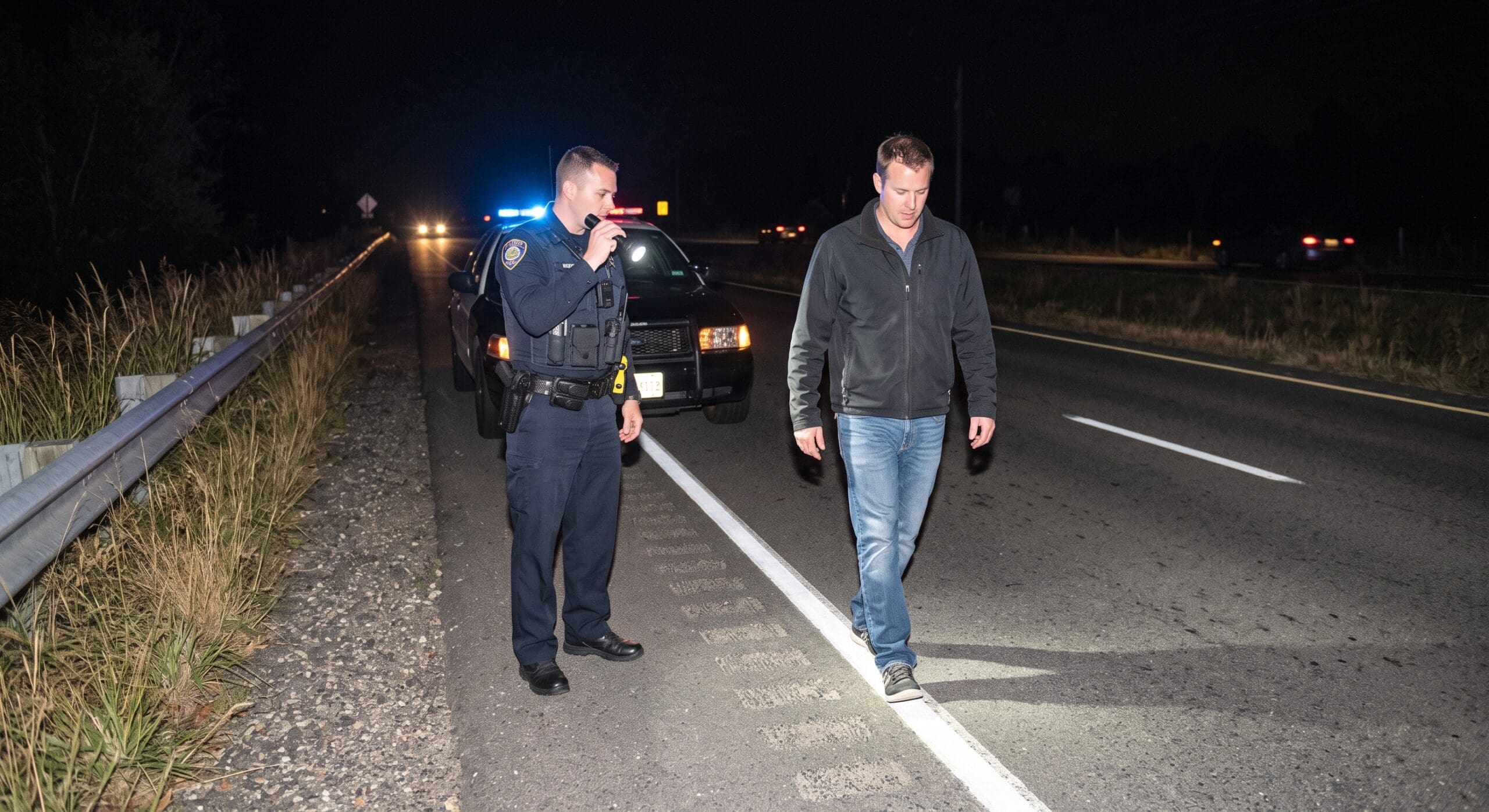
When an officer pulls you over on suspicion of driving under the influence, their first tactical maneuver is to invite you out of the vehicle to perform a series of “simple” roadside gymnastics. These are the Standardized Field Sobriety Tests, endorsed by the National Highway Traffic Safety Administration (NHTSA). They typically consist of the Horizontal Gaze Nystagmus (HGN), the Walk and Turn (WAT), and the One Leg Stand (OLS).
Officers will frame this as an opportunity for you to prove you are safe to drive. This is a psychological snare. The SFSTs are not objective measures of driving impairment; they are divided-attention tests designed for failure. You are asked to perform unnatural physical maneuvers, under immense stress, on an uneven shoulder of a dark highway, while heavy traffic blasts past you. If you put your foot down an inch off the imaginary line, or if you begin the test half a second before instructed, the officer scores a “clue” of impairment. They do not record how well you balanced; they solely record your deviations.
More importantly, under Kentucky law, field sobriety tests are completely voluntary (but the officer will never tell you that).
There is no statute in the Kentucky Revised Statutes (KRS) that requires a motorist to submit to roadside coordination tests. Unlike chemical testing, which is governed by the Implied Consent Law, there is no penalty against your driver’s license for declining the HGN, the Walk and Turn, or the One Leg Stand. You cannot be charged with a separate crime for saying, “Officer, on the advice of my counsel, I respectfully decline to perform any physical tests.”
When you attempt the SFSTs, you are volunteering to generate physical evidence against yourself. The officer is equipped with a body-worn camera. Every slight sway, every misstep, and every clarifying question you ask will be recorded, scrutinized, and played before a jury to demonstrate a lack of normal physical faculties. By politely refusing the roadside tests, you deny the Commonwealth the physical evidence necessary to bolster their probable cause for arrest, leaving them with nothing but their subjective observations of your driving behavior and demeanor.
The Chemical Coercion: Navigating Kentucky’s Implied Consent Law
Once an officer decides to arrest you for DUI, the environment shifts from the roadside to the precinct or the hospital. Here, the state attempts to extract the most damning evidence of all: your blood alcohol content (BAC) or the presence of controlled substances in your system.
Kentucky operates under an “Implied Consent” framework, codified in KRS 189A.103. The legal fiction of implied consent dictates that by operating a motor vehicle on the roadways of Kentucky, you have implicitly agreed to submit to a chemical test of your breath, blood, or urine if an officer has reasonable grounds to believe you are driving under the influence.
However, implied consent is not absolute consent. You still possess the physical power to say no.
Under KRS 189A.105, before an officer can administer a chemical test, they must read you a very specific set of warnings. They must inform you of the consequences of refusing the test, which include the immediate suspension of your driver’s license at arraignment. Furthermore, KRS 189A.105(3) mandates that you must be afforded an opportunity of at least ten minutes, but not more than fifteen minutes, to attempt to contact and communicate with an attorney before making your decision.
When my phone rings at 2:00 AM from a client sitting in a booking room, my advice is swift and unwavering: refuse the test (unless you reside in one of the minority jurisdictions where it is a separate crime to refuse the chemical test).
The Commonwealth relies heavily on the threat of a suspended license to coerce compliance. Yes, refusing a chemical test will result in a pretrial suspension of your driving privileges. But you must weigh a temporary administrative inconvenience against the permanent, life-altering devastation of a criminal DUI conviction. If you blow into the Intoxilyzer 8000 and register a 0.08 or higher, you have handed the prosecution a per se violation of KRS 189A.010(1)(a). You have practically written their closing argument for them. You can navigate life with a suspended license or an ignition interlock device for a few months; it is infinitely harder to navigate your career and your future with a criminal record that cannot be expunged for a decade.
Breath Tests and the First-Offense Aggravator Myth
The state will try to frighten you by reading the portion of KRS 189A.105 which states that if you refuse the test and are subsequently convicted, you will face a mandatory minimum jail sentence that is twice as long as the standard penalty. This sounds terrifying. It is designed to sound terrifying. But for a first-time offender, it is largely a hollow threat regarding breath tests.
Under KRS 189A.010(11)(e), refusing a chemical test is listed as an “aggravating circumstance”. Aggravating circumstances double the mandatory minimum jail time. However, in the landmark case of Commonwealth v. Gaitherwright, 70 S.W.3d 411 (Ky. 2002), the Kentucky Supreme Court dismantled this threat for first-time offenders.
The Court looked closely at the statutory language of KRS 189A.010(5)(a), which dictates penalties for a first offense. The statute requires that the aggravating circumstance must be present while the person was operating or in physical control of a motor vehicle. The Supreme Court correctly noted that a person cannot simultaneously drive a car and refuse a breath test in a police station. Therefore, for a first-time DUI offender in Kentucky, refusing a breath, blood, or urine test cannot be used as an aggravating circumstance to double your minimum jail time.
If it is your first offense, refusing the breath test protects you from providing the state with an exact numeric value of your intoxication, and the refusal itself cannot trigger the mandatory enhanced jail penalty. It is a strategic necessity.
The Constitutional Fortress: Refusing the Blood Test
If the advice to refuse a breath test is a matter of profound tactical advantage, the advice to refuse a blood test is a matter of absolute constitutional right. The legal landscape surrounding blood tests has undergone a seismic shift over the last decade, completely altering how we defend these cases at the Brandeis School of Law clinics and in the courtrooms of the Sixth Circuit.
The revolution began at the Supreme Court of the United States with Birchfield v. North Dakota, 579 U.S. 433 (2016). The Supreme Court recognized a fundamental biological difference between blowing air into a plastic tube and having a needle pierce your vein to extract your blood. The Court ruled that while a breath test is a valid search incident to a lawful arrest, a warrantless blood draw is a severe intrusion into human bodily integrity. Therefore, absent exigent circumstances, police must obtain a search warrant to force a blood draw. More importantly, Birchfield held that a state cannot criminalize the refusal of a warrantless blood test.
Kentucky courts grappled with how to apply Birchfield to our specific implied consent statutes. The definitive, resounding answer came in 2021 with the Kentucky Supreme Court’s decision in Commonwealth v. McCarthy.
In McCarthy, the defendant was pulled over, subjected to SFSTs, arrested, and taken to a hospital where the officer requested a blood draw without a warrant. The officer read the standard KRS 189A.105 warnings, threatening McCarthy with enhanced jail time and the use of his refusal as evidence of guilt in court. McCarthy, exercising his constitutional right, refused the needle.
The Kentucky Supreme Court handed down a sweeping victory for the defense, establishing three unassailable pillars regarding blood test refusals in Kentucky:
- No Enhanced Penalties:The Commonwealth is strictly prohibited from penalizing a DUI suspect for refusing to submit to a warrantless blood test. The threat of doubling your jail time under KRS 189A.105 for refusing a blood test is constitutionally void unless the police have a signed warrant from a judge.
- No Implication of Guilt:A suspect’s refusal to consent to a warrantless blood test cannot be offered as evidence of guilt during the trial. The prosecutor cannot stand before the jury and argue that you refused the blood test because you knew you were intoxicated. Exercising your Fourth Amendment right against unreasonable search and seizure cannot be weaponized against you as “consciousness of guilt.”
- No Evidentiary Explanations:In the most crushing blow to the prosecution, the McCarthy Court ruled that the Commonwealth cannot even introduce the fact of your refusal to explain to the jury why they lack scientific evidence. The state is not permitted to say, “Ladies and gentlemen, we don’t have a BAC number for you today because the defendant refused the test”. The refusal is entirely inadmissible.
Because of Commonwealth v. McCarthy, refusing a warrantless blood test in Kentucky is completely insulated from criminal repercussion. If you refuse, the state has no blood evidence, they cannot enhance your sentence, they cannot call you guilty for refusing, and they cannot even tell the jury you refused. To submit to a warrantless blood draw in the modern era of Kentucky jurisprudence is to voluntarily surrender the greatest constitutional shield the courts have ever handed to a criminal defendant.
The Reality of Trial
When you refuse the field sobriety tests, the breath test, and the blood test, you force the Commonwealth to try a case based entirely on opinion and circumstantial observation. The prosecutor will be left holding a file that notes you had “glassy, bloodshot eyes,” an “odor of alcohol,” and perhaps that you fumbled briefly with your insurance card.
In my century of cross-examinations, I have never seen an officer concede that a driver was merely tired, or suffering from seasonal allergies, or nervous because they were just pulled over by an armed agent of the state. Every observation is automatically attributed to impairment. But without the rigid, mathematical certainty of a 0.12 BAC printout, and without the recorded video of a failed One Leg Stand, those subjective observations wither under the heat of a vigorous cross-examination.
We challenge the odor of alcohol by establishing that the scent of a beverage does not correlate to the quantity consumed or the level of impairment. We challenge the bloodshot eyes by pointing out the late hour, the harsh police spotlight, and the natural fatigue of the working citizen. By refusing the state’s tests, you ensure that the jury must weigh the officer’s subjective opinions against the high constitutional burden of “beyond a reasonable doubt.”
The system relies on your intimidation. It relies on the cold roadside environment and the complex legal warnings to pressure you into manufacturing your own guilt. But the law, when wielded by a defense attorney who has spent lifetimes mastering it, provides you with the right to stand still, remain silent, and refuse. Protect your liberty, invoke your rights, and let the Commonwealth bear the impossible burden of proving a case you refused to help them build.
Although I do not actively practice DUI defense much anymore, if you truly want the best representation that money can buy, with a lawyer who has won more DUI cases than almost any other lawyer in Kentucky, I would be happy to make an exception and represent you in your case. We charge a $250 consultation fee for criminal defense cases. Call us at 502-931-6788 or contact us.