
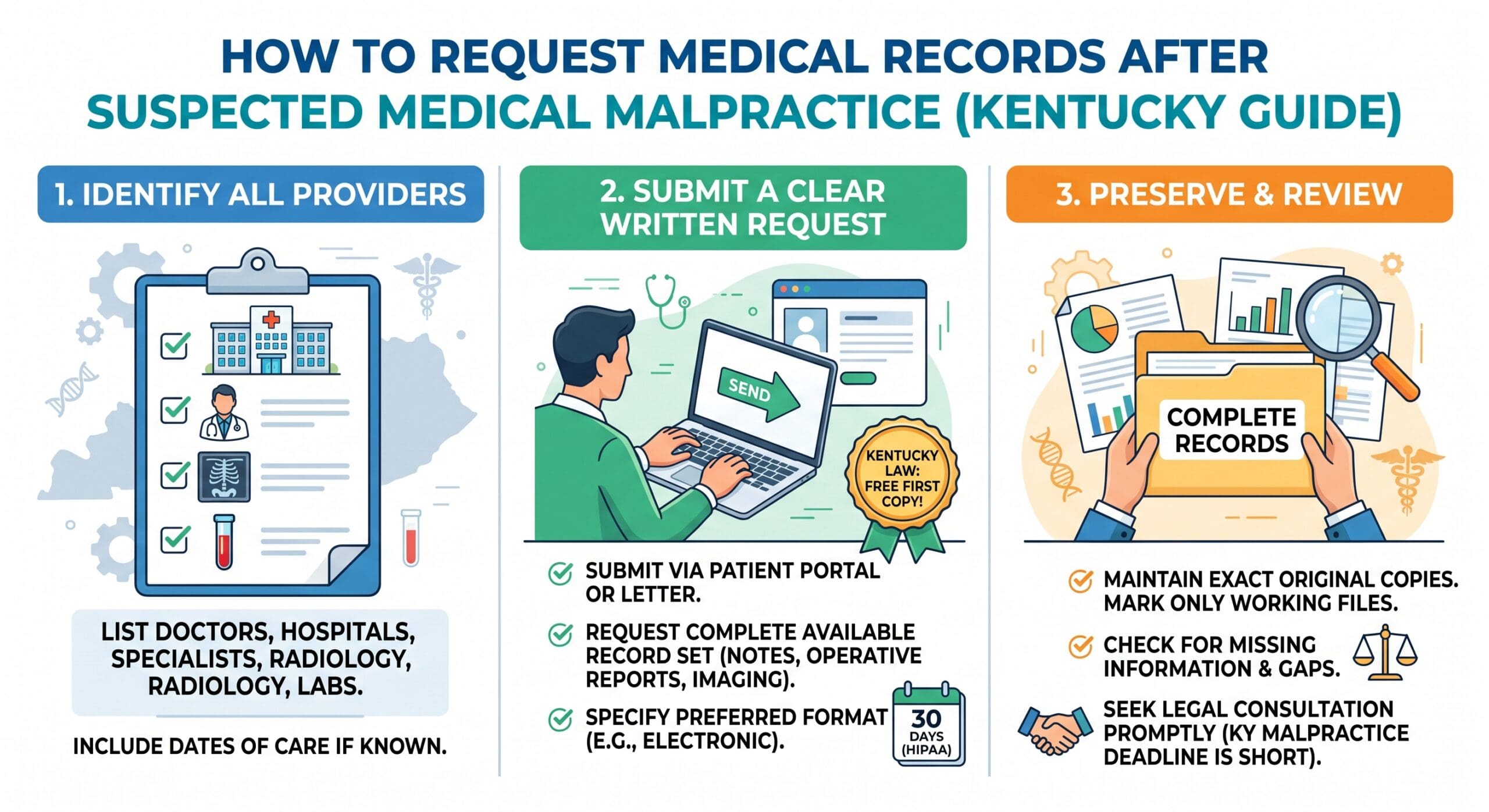
If you suspect that a doctor, hospital or other health care provider made a serious mistake, your medical records can help establish what happened, when decisions were made and how your condition changed. Knowing how to request medical records in Kentucky can also help you preserve an organized copy of the information before speaking with an attorney or another medical professional.
Medical records do not prove malpractice by themselves. A poor outcome is not automatically negligence, and determining whether care fell below the applicable standard often requires medical and legal review. Still, obtaining the records is a practical early step because they can document the timeline of your treatment and the information available to the people involved in your care.
Start With Every Provider Involved in Your Care
A malpractice concern may involve more than the physician you initially suspect. Hospitals, specialists, radiology groups, laboratories, pharmacies and follow-up providers may each maintain separate records.
Make a list of every facility and provider involved before sending requests. Include the dates of treatment if you know them. If the care occurred during a hospitalization, identify both the hospital and any outside medical groups that treated you.
Federal HIPAA access rights generally give patients access to protected health information in a covered entity’s designated record set. Depending on the circumstances, that can include medical records, billing records, laboratory results, medical images, consent forms and clinical notes.
Send a Clear Written Medical Records Request
Many hospitals and medical practices accept records requests through a patient portal or health information management department. When you request medical records in Kentucky, identify the treatment period and the information you want as clearly as possible.
Your request should include:
- Your full name, date of birth and current contact information
- The provider or facility whose records you are requesting
- The dates or date range of treatment
- The records you want
- The format you prefer, such as an electronic copy
- Where the records should be sent
For suspected malpractice, consider requesting the complete available record for the relevant period rather than only a discharge summary or portal snapshot. Depending on the treatment involved, useful medical malpractice records may include physician notes, nursing notes, operative reports, medication administration records, laboratory results, imaging reports and images, anesthesia records, consent forms and billing records.
Keep a copy of the request and proof of when it was submitted.
Kentucky Law Provides a First Copy Without Charge
Under Kentucky’s medical-record law, a hospital licensed under KRS Chapter 216B or a health care provider must provide a patient with a copy of the patient’s medical record without charge after a written request. The statute allows a copying fee of up to $1 per page for a second copy requested by the patient, the patient’s attorney or an authorized representative.
Kentucky’s first-copy rule can therefore be especially useful when you are gathering records after a suspected medical error.
Know How Long the Provider Has To Respond to the Medical Records Request
The HIPAA access rules generally require a covered entity to act on a request no later than 30 calendar days after receiving it. If the entity cannot complete the request within the initial period, it may take one extension of no more than 30 additional days when it gives written notice explaining the delay and the expected completion date.
Many providers can produce electronic records sooner, particularly when the information is readily available through an electronic system.
A patient’s access right is broad but not unlimited. Some information, including separately maintained psychotherapy notes and certain material prepared for legal proceedings, is excluded from the HIPAA right of access. A provider may also deny access in limited circumstances.
Review and Preserve What You Receive
Save the records in the form received and make a separate working copy if you want to highlight or annotate anything. Keep emails, portal confirmations, request forms and correspondence about delays or denied material together with the records.
Review the production for obvious gaps. Check whether the dates run continuously through the period of care and whether expected items such as imaging, laboratory results, operative reports or discharge records are present.
If something appears inaccurate, incomplete or inconsistent, do not change the original file or mark up your only paper copy. Note the issue separately and preserve the records exactly as you received them. A clean copy can make it easier for an attorney or medical reviewer to compare the documentation later.
What If the Provider Does Not Produce the Medical Records?
Follow up in writing and ask the provider to identify what remains outstanding. If access is denied, ask for the written denial and the basis for it.
Patients who believe a covered entity violated HIPAA access requirements may file a HIPAA complaint with the U.S. Department of Health and Human Services Office for Civil Rights. HHS generally requires a complaint within 180 days of when the person knew about the alleged violation, although OCR may extend that period for good cause.
Do not assume that waiting for records gives you extra time to bring a malpractice claim. Kentucky’s malpractice deadline is generally one year after the cause of action accrues for negligence or malpractice actions against physicians, surgeons, dentists or hospitals covered by the statute. Kentucky law also contains a discovery rule and other timing provisions, so the deadline can depend on the facts.
Get Help Reviewing Medical Records for a Medical Malpractice Case
If you need to request medical records in Kentucky after suspected malpractice, obtaining the records is only one part of evaluating what happened. Medical malpractice records may need to be reviewed alongside the treatment timeline, the applicable standard of care and the harm that followed.
Forman & Associates can review the circumstances of a suspected Kentucky medical malpractice matter and discuss what information may be relevant. You can request a free case evaluation to discuss your situation and the next steps that may be available.