
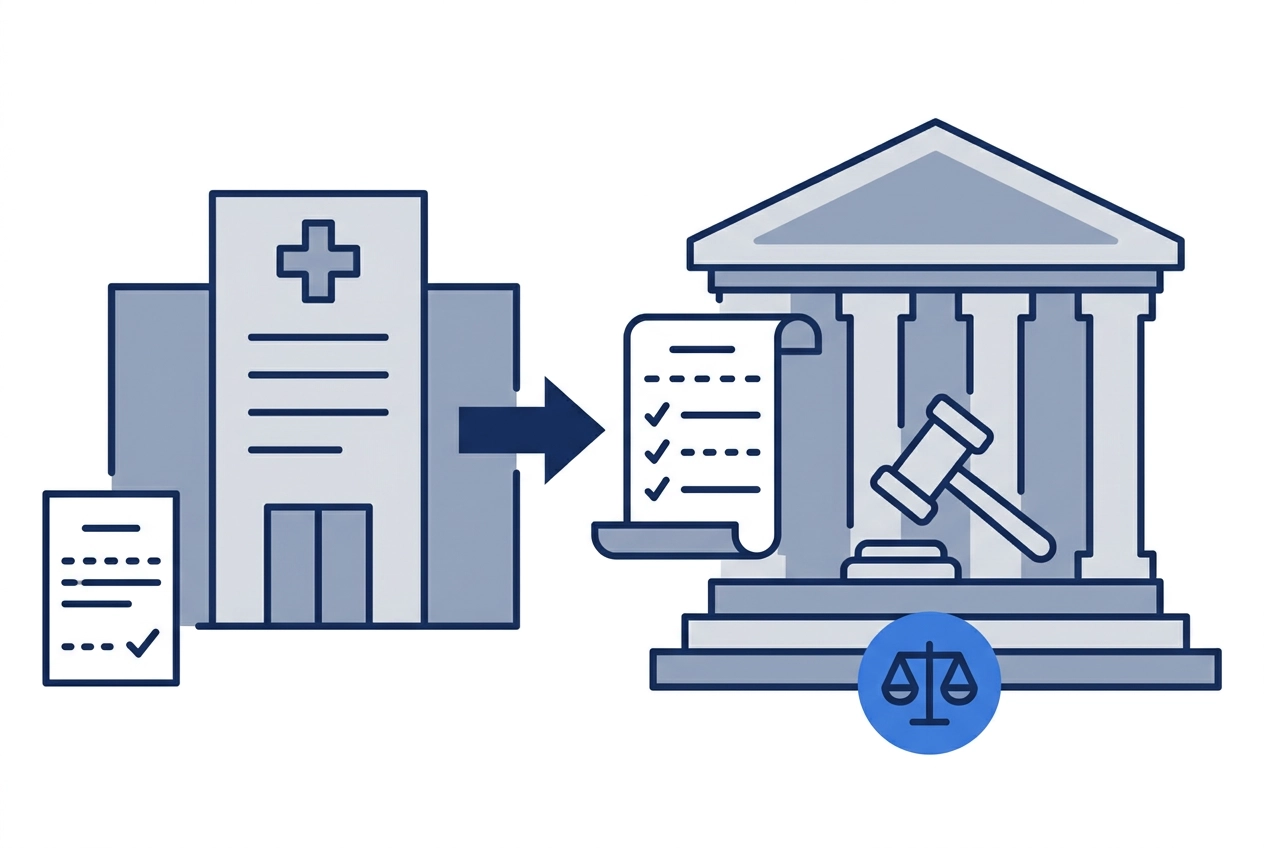
When a doctor commits sexual misconduct against a patient, the betrayal is devastating. But many victims never realize they may have legal recourse beyond suing the individual physician. The hospital, clinic, or medical group that employed that doctor may also bear significant legal responsibility.
Under Indiana law, healthcare facilities can be held accountable when they fail to properly screen, credential, supervise, or retain the physicians they place in positions of trust over vulnerable patients. This is not a legal technicality. It reflects a core principle: institutions have a duty to protect the people they serve.
This post breaks down exactly how hospital liability works in cases of physician sexual misconduct. You will learn the difference between direct corporate negligence and vicarious liability, what legal duties hospitals owe their patients before and after hiring a doctor, how a federal court held a VA hospital accountable in a real case, and what options are available to survivors who want to pursue justice. Whether you are a victim, a concerned family member, or simply trying to understand your rights, this guide will walk you through what the law actually allows.
Can a Hospital Really Be Held Responsible?
Yes, hospitals can be held legally responsible for a physician’s sexual misconduct, and many have been.
When a doctor abuses a patient, two distinct legal claims can run against the hospital simultaneously. The first is corporate negligence, meaning the hospital itself failed in its own institutional duties, such as screening, credentialing, supervising, or retaining a dangerous physician. The second is vicarious liability, meaning the hospital bears responsibility for what its employee did while operating under the authority and access the institution provided. These are separate legal theories, and an institutional abuse lawyer who will hold the right parties accountable will pursue both at once.
A victim does not have to choose between suing the doctor and suing the hospital. Both defendants can be named in the same case, and courts have allowed multi-party claims to proceed regularly.
This matters practically because hospitals carry substantial institutional insurance and assets. In many cases, meaningful financial recovery depends on holding the institution accountable alongside the individual physician.
The sections that follow examine the key questions courts ask: What did the hospital know? What should it have done? And when does the doctor’s conduct legally become the hospital’s responsibility?
Direct Liability: What Is Corporate Negligence?
Corporate negligence means the hospital itself did something wrong, separate from the physician’s misconduct. Even if the doctor bears direct criminal or civil responsibility, the institution can be independently liable for failures in its own administrative practices.
Courts evaluate hospital conduct across four categories:
Negligent hiring requires hospitals to independently verify credentials, licensure, and employment history before granting privileges, including criminal background checks, license validation, and reference calls to prior employers. In Sparks Regional Medical Center v. Smith (1998), the hospital never investigated a five-year employment gap, missing a prior termination for sexually harassing a patient.
Negligent credentialing is an ongoing obligation. Every time a hospital renews or expands a physician’s privileges, it must re-verify qualifications, check for new disciplinary actions, and review malpractice history. Skipping that process at renewal is its own independent failure.
Negligent supervision requires active, documented monitoring of clinical conduct, including whether a physician stays within authorized scope and whether patient interaction patterns raise concerns. A system that only reviews complaints reactively rather than monitoring proactively falls short of this standard.
Negligent retention applies once the hospital receives a complaint, observes a red flag, or accesses information signaling risk. Ignoring warning signs and keeping the physician on staff is a separate, actionable failure.
All four categories are governed by the “knew or should have known” standard. A hospital cannot escape liability by claiming ignorance if reasonable due diligence would have surfaced the risk. Courts ask what a prudent institution would have found, then measure the defendant against that benchmark. This same institutional accountability principle applies beyond healthcare; for instance, when the institution entrusted with your child’s safety fails them, a daycare and school negligence lawyer holds it fully accountable using the same foundational negligence framework.
Vicarious Liability: When the Doctor Was Acting on the Hospital’s Behalf

Corporate negligence focuses on what the hospital itself did wrong. Vicarious liability is a different theory: it asks whether the hospital should be responsible for what the doctor did, simply because the doctor worked there.
The legal doctrine behind this is called respondeat superior, a Latin phrase meaning “let the master answer.” In plain terms, employers can be legally responsible for harm their employees cause while on the job. The rationale is straightforward: the hospital benefits from the physician’s work, controls the environment, and carries the resources to compensate victims.
The core question courts ask is: was the misconduct committed within the scope of employment? Sexual misconduct complicates this because courts have historically treated it as a personal act falling outside normal job duties, which can seem like a barrier.
It is not always a dead end, though. Many courts extend vicarious liability when a doctor used the specific authority, access, or clinical setting the hospital provided to commit the misconduct. A physician who abuses a patient during an examination in a hospital-controlled room, using hospital equipment, and relying on the professional trust the institution conferred, is using hospital-provided tools to cause harm.
The employment label also matters. Hospitals often classify physicians as independent contractors to limit exposure, but courts evaluate the totality of the relationship, not just the contract language. Indiana law follows this approach: control, integration into hospital operations, and institutional benefit all factor into whether true employment exists.

What Hospitals Are Legally Required to Do Before and After Hiring a Doctor
Beyond the question of who the doctor worked for, hospitals face a parallel layer of accountability rooted in hard regulatory requirements, not just legal theory.
The Joint Commission and federal rules set the floor. Hospitals accredited by the Joint Commission must follow credentialing and privileging standards that govern every physician on staff. Separately, Medicare and Medicaid’s federal Conditions of Participation require hospitals to maintain a formal credentialing process as a condition of receiving federal reimbursement. These are not voluntary best practices; they are binding obligations.
What hospitals must verify at hire and at every recredentialing cycle:
- Current, valid licensure and any prior disciplinary actions
- Malpractice claims history
- Prior revocations of clinical privileges at other facilities
- National Practitioner Data Bank (NPDB) reports, which flag adverse actions taken against providers nationwide
Recredentialing must occur every two to three years. The Joint Commission also mandates Ongoing Professional Practice Evaluation (OPPE), a continuous monitoring process that cannot be satisfied by a single background check at hire.
Why this matters in your case. When a hospital skips or shortcuts these steps, that failure becomes direct evidence of institutional negligence. Regulatory violations demonstrate that the hospital bypassed systems specifically designed to identify dangerous providers, which directly supports a plaintiff’s argument that the hospital “knew or should have known” the physician posed a risk.
These obligations apply to hospitals, VA facilities, outpatient clinics, and medical groups alike. If you were harmed at any type of healthcare facility, the hospital has a legal team protecting its interests, and now you can too.
A Real Case: How One Federal Court Held a VA Hospital Accountable
Those credentialing obligations are not abstract. John X. Doe v. United States of America shows what happens when a federal healthcare institution ignores them.
In that federal district court case, plaintiffs alleged that a VA hospital employed a physician assistant who sexually abused patients. The core argument was straightforward: the institution knew or should have known, through background information that was reasonably available to it, that this provider was unfit and posed a danger to patients in its care.
The court allowed three independent claims to move forward: negligent hiring, negligent supervision, and negligent retention. Each theory survived on its own merits, confirming that a plaintiff does not need to prove all three to have a viable case.
The most important takeaway for victims is this: courts do not require proof that hospital administrators witnessed abuse or received a direct complaint. If the information existed and the institution failed to look for it or act on it, that is enough to clear the pleading stage.
Federal VA cases carry weight beyond their immediate facts. Plaintiff attorneys routinely use them as structural templates when building claims against private hospitals and medical groups, because the underlying negligence theories are the same regardless of whether the employer is a federal agency or a for-profit health system.
This case also underscores why discovery is critical. Internal credentialing files, personnel records, and complaint logs frequently reveal what the hospital knew, when it knew it, and what it chose to ignore.
Beyond Negligence: Other Legal Claims Available to Victims
Negligence claims are powerful, but most experienced attorneys don’t stop there. Courts have consistently allowed plaintiffs to pursue multiple tort theories in the same complaint, and that approach creates critical legal redundancy.
Battery is often the most direct claim. Sexual misconduct is, by definition, an intentional unauthorized touching, which satisfies the core elements of battery as a standalone tort, entirely separate from any negligence theory.
Negligent infliction of emotional distress (NIED) applies when negligent conduct causes severe psychological harm. Sexual misconduct by a trusted medical provider routinely meets that threshold, and courts have recognized it as a viable independent claim.
Invasion of privacy addresses a distinct harm: patients enter clinical settings with a reasonable expectation of bodily privacy. When a physician violates that expectation through misconduct during an examination or procedure, a separate privacy-based claim exists.
Outrage, or intentional infliction of emotional distress, applies when conduct is so extreme it exceeds all bounds of decency. Physician sexual abuse against a patient in a clinical setting regularly meets that standard, and courts have allowed standalone outrage claims to proceed.
Loss of consortium extends legal standing to family members. Spouses and close family members may hold independent claims when misconduct has severely damaged or destroyed a marital or familial relationship. Just as victims in toxic exposure cases can recover for multiple categories of harm, sexual misconduct victims and their families may pursue several distinct claims simultaneously.
Pursuing multiple theories matters strategically. If one claim encounters a procedural obstacle or legal defense, the others remain viable and keep the path to recovery open.
What Victims Should Know Before Pursuing a Hospital Liability Claim
Knowing your rights is only part of the equation. Acting on them correctly, and quickly, determines whether those rights can actually be enforced.
Filing deadlines are non-negotiable. Indiana’s Medical Malpractice Act imposes a two-year statute of limitations from the date of the alleged misconduct. Missing that window permanently bars recovery, regardless of how strong the underlying claim is. Do not wait.
Preserve everything immediately. Appointment records, patient portal messages, billing statements, and any written complaints submitted to the facility are all potential evidence. Learn how to request medical records after suspected medical malpractice before records are altered or access becomes complicated.
A hospital’s internal investigation protects the hospital, not you. If a facility launches its own inquiry after a complaint, that process is designed to manage the institution’s exposure. It is not a substitute for your independent legal claim.
Critical evidence lives in credentialing files. Through formal discovery, an attorney can compel production of the physician’s personnel and credentialing records. Prior complaints, failed background checks, and privilege revocations frequently surface there and nowhere else.
Fear of not being believed is common but not fatal to a claim. Attorney-led investigation compels disclosure of institutional records that victims cannot access on their own. Evidence that seems unavailable before litigation often becomes discoverable once the process begins.
Indiana adds a procedural layer. Before suit can proceed, claims under the Medical Malpractice Act must first be submitted to a medical review panel, which affects strategy and timeline significantly. Contacting an attorney within the first 72 hours of recognizing potential harm helps protect against procedural missteps that can derail otherwise valid claims.
These cases require an attorney experienced in both medical liability and institutional negligence, not a general personal injury practice.
How Forman and Associates Can Help You Hold the Right Parties Accountable
Choosing the right attorney for this type of case is not a procedural detail, it determines how much accountability is actually achieved.
Larry Forman brings more than 50 jury trials and a 95%+ win rate to every case, and he is admitted to practice before the Supreme Court of the United States. That courtroom depth is precisely what high-stakes institutional liability cases demand.
The firm’s fee structure also puts more money in victims’ hands. Forman and Associates charges 30% on personal injury recoveries. Settlement mills routinely take 40% to 50%, which means a smaller net recovery for the client regardless of the outcome. Lower fees translate directly to more dollars in your pocket.
When evaluating a case, the firm examines both the individual physician and the institution as separate defendants. No viable claim is left off the table. If the hospital failed in its credentialing, supervision, or retention obligations, that failure becomes part of the case.
Larry Forman is not a settlement attorney. These cases require a lawyer who is fully prepared to take the case to a jury and use that credible trial threat to build maximum leverage.
Contact Forman and Associates to discuss whether a hospital liability claim exists alongside a claim against the physician directly.
Key Takeaways: Victims Have More Legal Options Than They Realize
Victims of physician sexual misconduct have two distinct legal pathways against a hospital: corporate negligence, based on the institution’s own failures, and vicarious liability, based on responsibility for what its physician did while acting within the scope of employment.
Hospitals carry enforceable legal obligations around hiring, credentialing, supervision, and retention. When they bypass those obligations, or ignore red flags that were readily available, that breach creates direct liability exposure independent of any claim against the physician.
No single legal theory should stand alone. Battery, negligent infliction of emotional distress, invasion of privacy, and outrage can all be pursued in parallel, creating multiple paths to recovery if any one claim faces a legal obstacle.
Time works against victims. Statutes of limitations impose strict filing deadlines, and evidence, including credentialing files, personnel records, and prior complaint histories, can disappear or be altered if not preserved quickly.
If you or someone you love was harmed by a physician’s sexual misconduct, you deserve to know whether the hospital that trusted, employed, and supervised that doctor shares legal responsibility. An experienced trial attorney can investigate what the institution knew, identify every viable claim, and fight to hold every responsible party fully accountable.